


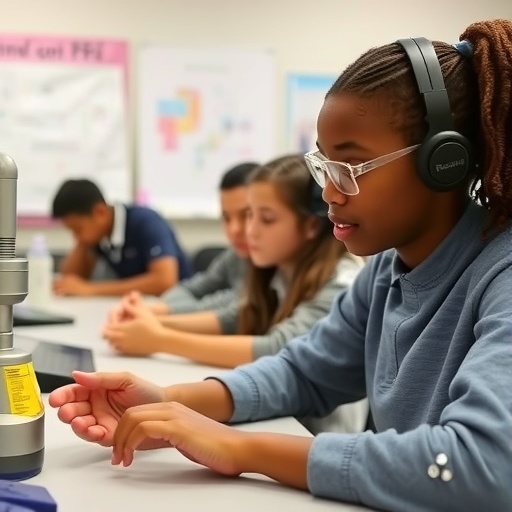
An adaptive, artificial intelligence-driven instructional program built around STEM pedagogy has shown promising signs of strengthening what education researchers call deep learning in science—the ability of students to explain, interpret, apply, and generate ideas about scientific concepts rather than simply memorize facts. The finding comes from a pilot study conducted in a private, single-sex girls’ primary school in Riyadh, Saudi Arabia, where sixth-grade students taught through an adaptive AI-based STEM program substantially outperformed peers taught with traditional methods on a validated test of deep conceptual understanding. The research, published in the International Journal of STEM Education, offers some of the first controlled classroom evidence from an Arabic-speaking context on how AI-enabled adaptivity can be woven into inquiry-rich science instruction for elementary learners.
The study arrives against a sobering backdrop. In the TIMSS 2023 international assessment, Saudi Arabia ranked 50th out of 64 participating countries in fourth-grade science, with a mean score of 428—a result the researchers cite as evidence of persistent gaps in students’ conceptual understanding and analytical reasoning. National evaluations have similarly found that Saudi students often struggle to integrate scientific ideas, apply concepts to novel situations, and construct coherent explanations. At the same time, Saudi Arabia has made STEM education a pillar of its Vision 2030 reform agenda, launching initiatives to unify science, technology, engineering, and mathematics instruction. The tension between ambitious reform goals and measurable learning shortfalls is precisely what motivated the new investigation, which sought an empirically validated model capable of harnessing adaptive technology without abandoning sound pedagogy.
Importantly, the term “deep learning” in this study refers not to neural networks but to a construct from the learning sciences: the capacity of students to build interconnected knowledge structures, generate scientific explanations, interpret phenomena, transfer concepts to real-world situations, and produce original ideas. This contrasts sharply with surface learning, in which isolated facts are recalled for tests and quickly forgotten. Prior research has linked deep learning to intrinsic motivation, evidence-based argumentation, and metacognitive awareness, and international frameworks such as the Next Generation Science Standards explicitly call for learners to progress beyond factual recall toward constructing explanatory models and reasoning with evidence. The Riyadh team operationalized deep learning across four dimensions—explanation, interpretation, application, and idea generation—and built both the intervention and its assessment around them.
The intervention itself was engineered with unusual methodological care. The researchers used the ADDIE instructional design model—Analysis, Design, Development, Implementation, and Evaluation—to construct an eight-week program built on the sixth-grade Space Unit. In the design phase, each lesson was decomposed into micro-learning units aligned with one or more deep learning dimensions, and decision rules were established to govern how students moved between units. The system was deployed as a web-based adaptive learning environment using HTML, PHP, and MySQL within the Moodle learning management system. Adaptivity operated through two complementary mechanisms. The first was a rule-based mastery engine that continuously tracked quiz accuracy, attempts per item, mastery status for each micro-lesson, progression speed, and recurring patterns of incorrect responses that signaled misconceptions. Students who reached a predefined mastery threshold of 80 percent advanced to higher-level application and idea-generation tasks, while those who fell short were automatically redirected to remedial content—including scaffolded examples, alternative conceptual representations, and focused micro-lessons targeting their specific conceptual gaps.
The second mechanism involved machine learning, though in a deliberately constrained role. The researchers integrated Moodle’s built-in learning analytics, which employ classical supervised classifiers such as logistic regression and decision-tree models, to predict the likelihood of each student’s mastery and successful unit completion. Crucially, these predictions never modified learning pathways directly; they served solely as a monitoring layer that supplemented the rule-based progression system with early-warning performance insights. The authors are explicit that the system contained no deep neural architectures or probabilistic knowledge tracing, and that all adaptivity governing student trajectories was rule-based. This design choice reflects a growing consensus in the field that AI in education should function as a support layer that augments pedagogical design and teacher judgment, rather than as a black-box substitute for instructional intent.
Before classroom implementation, the entire program underwent a rigorous expert validation process involving 14 specialists: seven in science education and STEM curriculum, four in instructional design, two in educational technology, and one in artificial intelligence in education. Experts reviewed the program architecture, the scientific accuracy of the Space Unit content, the alignment of activities with the four deep learning dimensions, the AI-driven decision rules, the embedded formative assessments, the mastery thresholds, all digital materials and simulations, and the posttest instrument itself. The deep learning test was also piloted with 43 sixth-grade students from an independent population, yielding item–total correlations between 0.571 and 0.942 and an overall reliability coefficient of 0.809 on the Kuder–Richardson Formula 20, with subscale reliabilities ranging from 0.749 to 0.817—figures the authors describe as acceptable to high for classroom-based research.
The experimental component employed a cluster-randomized, posttest-only control group design. Thirty sixth-grade students, aged 11 to 12, were divided between one experimental classroom, which received the adaptive AI-based STEM program, and one control classroom, which received traditional science instruction. Both groups were taught by the same teacher, used the same Space Science curriculum, and received equivalent instructional time, and the researchers deliberately avoided a pretest to prevent testing and sensitization effects in young learners. Because the data did not meet normality assumptions, the team used the Mann–Whitney U test with median and interquartile range summaries. The results were striking: the experimental group significantly outperformed the control group on every deep learning dimension. On explanation, the experimental median was 6 compared with 3 in the control group; similar separations appeared across interpretation, application, and idea generation, with large within-sample effect sizes indicating substantial rank separation. Process indicators from the learning management system confirmed that students genuinely engaged with the adaptive pathways, accumulating remediation cycles and mastery checks over the eight weeks.
The qualitative strand added explanatory depth. Semi-structured interviews with three science teachers—one of whom delivered instruction to both groups while the other two served as collaborators and observers—were conducted face-to-face in Arabic, transcribed verbatim, and analyzed through a hybrid deductive–inductive thematic approach with dual independent coding, inter-coder agreement calculations, and member checking. Teachers reported perceived improvements in students’ analytical reasoning, conceptual integration, inquiry-based exploration, and creative scientific thinking. They specifically credited the program’s simulations, adaptive feedback, and hands-on STEM activities with supporting conceptual understanding and sustained engagement with scientific problem solving, corroborating the quantitative picture that the adaptive environment helped students explain and apply scientific ideas more confidently.
The authors are unusually candid about the limits of their evidence, and this transparency is itself noteworthy in a field often criticized for overstated claims. Because assignment occurred at the intact classroom level with only one classroom per condition—and no shared baseline measure was administered—classroom-level confounding and baseline differences cannot be fully ruled out, and the statistical estimates are treated as exploratory at the student level. The study also took place within a single female-only private school, a contextual constraint of gender-segregated schooling in Saudi Arabia rather than a gender-based research objective, meaning the findings should not be generalized to other settings without replication. One member of the research team also served as an instructional supervisor at the school, a dual role the researchers mitigated through voluntary participation assurances, anonymization, and independent second-coder involvement, but which they nonetheless acknowledge as a limitation for the qualitative strand.
Even with these caveats, the study fills a genuine gap. Systematic reviews have found that most research on AI in elementary education remains descriptive rather than experimental, that rigorous learning outcomes are reported in only a minority of studies, and that evidence from Arabic-speaking K–12 contexts is especially thin, constrained by limited teacher AI literacy and narrow intervention scopes. By combining a structured design framework, transparent rule-based adaptivity, machine learning confined to monitoring, expert validation, and a mixed-methods evaluation, the Riyadh team has produced a template for how future studies might be conducted. The broader implications extend beyond Saudi Arabia: as schools worldwide rush to deploy AI tutors and adaptive platforms, this pilot suggests that the technology’s value may depend less on algorithmic sophistication than on the coherence between adaptive rules, learning objectives, inquiry-based pedagogy, and the teachers who interpret the resulting analytics. Larger, multi-site trials with stronger cluster-level controls are the necessary next step, but the early signal—that carefully designed AI-supported STEM instruction can cultivate deeper scientific thinking in eleven- and twelve-year-olds—is one that educators and policymakers will want to watch closely.
Cite Scienmag News
Blake Davidson. (September 8, 2026). AI-Powered Program Boosts Deep Learning in Sixth-Grade Science Classrooms. Scienmag. https://scienmag.com/ai-powered-program-boosts-deep-learning-in-sixth-grade-science-classrooms/
Blake Davidson. "AI-Powered Program Boosts Deep Learning in Sixth-Grade Science Classrooms." Scienmag, 8 September 2026, https://scienmag.com/ai-powered-program-boosts-deep-learning-in-sixth-grade-science-classrooms/. Accessed 8 September 2026.
Blake Davidson. "AI-Powered Program Boosts Deep Learning in Sixth-Grade Science Classrooms." Scienmag. September 8, 2026. https://scienmag.com/ai-powered-program-boosts-deep-learning-in-sixth-grade-science-classrooms/


