


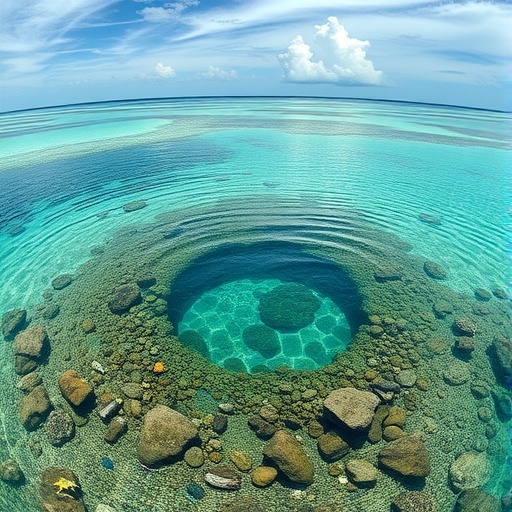
Beneath the palm-lined shores of Muli Island, a small coral island in the Maldives’ Meemu Atoll, lies one of the planet’s most fragile freshwater reserves: a thin, buoyant lens of rain-fed groundwater floating atop encroaching seawater. A new study published in Hydrogeology Journal has, for the first time, combined island-specific field monitoring with a high-resolution three-dimensional computer model to quantify just how vulnerable this hidden water supply is to drought, climate change, sea level rise and human pumping — and the results suggest that shifting rainfall patterns, not rising seas, pose the greatest near-term threat to the island’s drinking water future.
The research, led by Belay Molla Sisay of the IHE Delft Institute for Water Education in the Netherlands and the University of Aberdeen, together with colleagues Yangxiao Zhou, Assela Pathirana and Tibor Stigter, focuses on Muli, an island of barely 0.8 square kilometres located 140 kilometres south of the Maldivian capital, Malé. Its population has grown steadily from 746 residents in 2006 to 949 in 2022, and like most Maldivian outer islands, its inhabitants have historically drawn water from shallow, hand-dug wells. Those wells tap into what hydrogeologists call a freshwater lens — a dome of low-salinity groundwater sustained by rainfall percolating through porous coral sand, floating like an inverted droplet above denser saltwater that saturates the deeper aquifer.
The geological architecture of atoll islands makes such lenses inherently precarious. Muli, like other coral atolls, hosts a dual aquifer system: an upper, unconsolidated Holocene aquifer of loose coral sands and a lower, karstified Pleistocene limestone formation, typically separated by a boundary known as the Thurber discontinuity lying between 15 and 25 metres below sea level. Critically, only the upper aquifer holds freshwater; the deeper limestone is fully saline, and its high hydraulic conductivity allows saltwater to race through it and rapidly salinise any freshwater that penetrates the contact. The result is a freshwater reserve that is thin, dynamic and extraordinarily sensitive to changes in recharge.
To capture this sensitivity, the team deployed SEAWAT version 4, a widely used numerical code that couples the groundwater flow model MODFLOW-2000 with the solute transport model MT3DMS to simulate density-dependent flow — essential when modelling the interface between freshwater and seawater, which is a gradual mixing zone governed by dispersion rather than a sharp boundary. The model domain covered the island and its surrounding shallow sea and lagoon with a 20-by-20-metre horizontal grid across 40 vertical layers, from the land surface down to 34 metres below sea level, totalling roughly 385,000 active cells. The bottom layers representing the saline limestone were fixed at a constant salinity of 35 grams per litre, matching ocean water, while the sea was represented by constant-head boundaries.
Recharge — the lifeblood of the lens — was estimated using daily rainfall and temperature records from the Maldives Meteorological Services spanning 1990 to 2024. Potential evapotranspiration was calculated with the Hargreaves method, which relates evaporation demand to extraterrestrial radiation, mean temperature and the diurnal temperature range, and a soil water balance model then converted daily rainfall minus evapotranspiration into groundwater recharge. Abstraction was reconstructed from population data: with each resident using roughly 0.1 cubic metres per day and rainwater harvesting supplying a small fraction, the team calculated about 90 cubic metres per day drawn from the ground across some 150 household wells — around 0.6 cubic metres per well daily.
The calibrated baseline model, run from January 2010 to July 2024, revealed a lens in constant motion. Groundwater levels respond almost immediately to rainfall, because the unsaturated zone is shallow and the sandy soils are highly permeable. On average, recharge accounted for 90.8 percent of all water entering the aquifer, while a remarkable 96.3 percent of the outflow left the system as submarine groundwater discharge to the sea — only 3.7 percent was extracted by people. This extremely high discharge fraction, the authors note, signals an aquifer with very low water retention and limited buffering capacity against external stresses. The baseline lens held an average freshwater volume — defined as water below 1.5 grams per litre total dissolved solids — of roughly 725,500 cubic metres, but prolonged droughts in 2012 and 2022 shrank that volume by up to 20 percent. In wet seasons the fresh–saltwater interface pushed seaward; in dry periods it retreated inland, and toward the western side of the island, where most of the wells are clustered.
With the baseline established, the team projected the island’s future from 2025 to 2050 using downscaled outputs from 25 global climate models under the CMIP6 framework. After ranking the models against observed local data using statistical measures including correlation and normalised root-mean-square error, the researchers selected the NorESM2-MM model for precipitation and EC-Earth3 for temperature. Four scenarios were constructed: S1 and S2 representing moderate (SSP2–4.5) and high-emission (SSP5–8.5) climate futures, S3 adding sea level rise of approximately 25 centimetres by 2050, and S4 layering on population-driven growth in groundwater abstraction — projected to climb 37 percent, from 90 to about 124 cubic metres per day, as the population grows to roughly 1,310 by mid-century.
The climate scenarios delivered the harshest verdicts. Although total precipitation is projected to increase slightly, rising temperatures drive evapotranspiration higher, cutting net recharge to the aquifer. Under the moderate scenario S1, mean freshwater volume fell 25.8 percent relative to the baseline, to about 538,000 cubic metres; under the high-emission scenario S2, the decline reached 28 percent, to roughly 521,000 cubic metres. The S2 simulation was particularly sobering: a run of dry years between 2027 and 2030 drove the lens down to around 230,000 cubic metres by mid-2030, with some cross-sections showing more than 70 percent depletion of the lens during prolonged droughts. Perhaps most strikingly, while groundwater levels snapped back quickly once the wet season returned, salinity and freshwater volume took several years to recover — a warning that hydrological recovery and water-quality recovery operate on very different clocks.
By contrast, the scenarios often assumed to be the greatest dangers proved less punishing within the model’s framework. Adding sea level rise (S3) produced only minor additional reductions, and increased abstraction (S4) shaved just 2 percent from the volume relative to S1. The authors are careful to qualify these findings: sea level rise was represented simply as rising coastal water levels, without simulating shoreline recession, loss of island area, wave-driven overwash or inundation — processes that other studies have shown can dramatically accelerate lens contraction. Similarly, the pumping increase, while small in aggregate, produced a locally serious effect: near well clusters on the island’s western flank, the lens thinned by 2 to 3 metres, a phenomenon known as upconing, in which the freshwater–saltwater interface is drawn upward beneath a pumping well. During drought conditions, the model showed, this localised salinisation becomes most acute, precisely when residents need water most.
The study’s findings echo and extend a growing body of research on atoll hydrogeology. Previous work across the Maldives has estimated lens thicknesses ranging from 1 to 13 metres depending on island width, and modelling for Muli yields a maximum thickness of about 9 metres — consistent with an independent algebraic estimate of 10.6 metres and with volumes reported for comparable Maldivian islands such as Velidhoo and Holhudhoo. Earlier studies of Micronesian atolls projected lens losses of up to 55 percent under combined low-rainfall, high-sea-level futures, while observations in the Marshall Islands showed that a single overwash event can spike lens salinity for a month or more. The Muli study adds a crucial outer-island perspective, combining drone-derived terrain models, borehole logs and high-frequency monitoring wells — data that remain scarce across the Maldives’ 186 inhabited islands.
The practical implications extend well beyond Muli. The researchers stress that safeguarding the lens demands integrated environmental management focused on protecting and enhancing recharge. Their recommendations include expanding household rainwater harvesting, installing infiltration structures to channel stormwater back into the aquifer — pilots of which have already been built on Muli as part of the 3S Water project that funded the research — redistributing abstraction away from clustered wells, and adopting dynamic pumping regimes that respond to seasonal rainfall availability. Just as importantly, they caution that rapid urbanisation and proposed drainage systems designed to pipe water straight to the sea could quietly strangle the recharge that sustains the entire system, by sealing soil surfaces and diverting rainfall before it can soak in.
For the roughly 39 Small Island Developing States identified by the United Nations, and the millions of people who live on low-lying coral islands worldwide, the message from Muli is unambiguous. The invisible freshwater lens beneath their feet is a renewable but finite resource, replenished only by rain and lost almost instantly to the surrounding ocean. As climate change reshapes rainfall and raises temperatures across the Indian Ocean, the fight to keep these islands’ water drinkable will be won not at the shoreline, but in the soil — wherever rain is allowed to soak slowly into the ground.
Cite Scienmag News
Sloane Callahan. (September 6, 2026). Freshwater lens on Maldivian island threatened by pumping and climate change. Scienmag. https://scienmag.com/freshwater-lens-on-maldivian-island-threatened-by-pumping-and-climate-change/
Sloane Callahan. "Freshwater lens on Maldivian island threatened by pumping and climate change." Scienmag, 6 September 2026, https://scienmag.com/freshwater-lens-on-maldivian-island-threatened-by-pumping-and-climate-change/. Accessed 6 September 2026.
Sloane Callahan. "Freshwater lens on Maldivian island threatened by pumping and climate change." Scienmag. September 6, 2026. https://scienmag.com/freshwater-lens-on-maldivian-island-threatened-by-pumping-and-climate-change/


