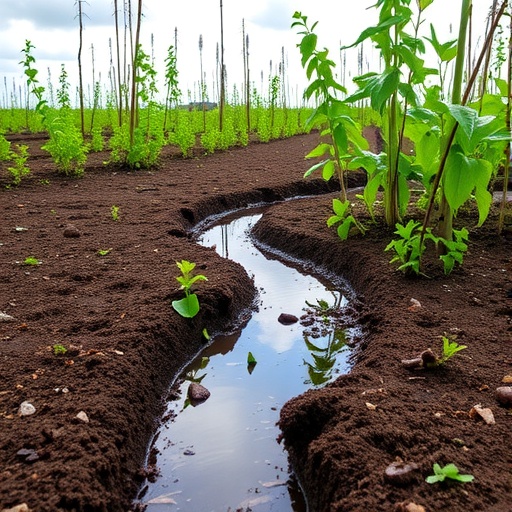
Hidden beneath the quiet surface of seasonal wetlands on the Delmarva Peninsula, a slow and persistent process is releasing carbon into the environment. A new study has shown that when groundwater rises through wetland soils, it triggers a sustained release of dissolved organic matter, and shifts the soils from methane sinks to methane sources. The findings, based on meticulous laboratory simulations with intact soil cores, reveal that carbon mobilization in wetland-dominated landscapes is not a brief pulse tied to a single storm event, but a continuous process that can persist for weeks as long as saturated conditions remain in place. This distinction matters because the wetlands in question — small, round depressions known as Delmarva bays — dot the Mid-Atlantic landscape at a density of roughly two per square kilometer, and their behavior under changing groundwater dynamics could have outsized implications for regional and global carbon budgets.
The research, led by Katherine Wardinski of Virginia Tech along with colleagues at several institutions, focused on a question that has been surprisingly difficult to answer: what happens to soil carbon when groundwater slowly rises through previously unsaturated soil? Most studies of carbon release from wetlands have looked at surface-level processes, such as the export of dissolved organic carbon during storm events when streams become hydrologically connected to wetland soils. Others have examined greenhouse gas emissions from wetland surfaces during inundation. Few have directly traced what happens inside the soil profile itself, layer by layer, as rising groundwater progressively saturates the soil column and maintains that saturation over an extended period.
To answer this question, the team collected eight intact soil cores — each roughly ten centimeters in diameter and sixty centimeters long — from four Delmarva bay wetlands in the Choptank River watershed. At each site, one core came from within the wetland basin, where organic soils are thick and saturation is nearly continuous, and another came from the transition zone at the wetland’s edge, where organic horizons are thinner and the water table only occasionally reaches the surface. The cores were transported to the laboratory and carefully mounted in a custom experimental setup that allowed the researchers to simulate the slow vertical rise of groundwater through the soil.
The experiment proceeded in two phases. During the first, designated the wet-up phase, the researchers raised the water level in each soil column by fifty millimeters per day over approximately twelve to fifteen days, mimicking the seasonal rise of the water table that occurs naturally as evapotranspiration declines in late fall and winter. Daily water samples were drawn from three soil horizons — the organic surface layer, a shallow mineral horizon, and a deeper mineral horizon — as well as from any surface water that eventually pooled on top of the saturated soil. The second phase, sustained saturation, kept the cores fully saturated for an additional twenty-five days to observe what happens when previously unsaturated soils remain waterlogged for weeks.
The results were striking in their consistency. Across both wetland and transition zone cores, and across all soil horizons, dissolved organic carbon concentrations increased steadily as groundwater rose through the soil and remained elevated throughout the sustained saturation phase. Rather than a brief pulse of carbon release followed by depletion, the soils behaved more like what earlier researchers have described as near-infinite sources of dissolved organic matter. In the transition zone cores, concentrations of dissolved organic carbon in the shallow organic soil porewater rose by an average of nearly two hundred milligrams of carbon per liter between the start and end of the experiment. Even the wetland cores, whose soils had already been leached by years of near-continuous saturation, released measurable and sustained amounts of dissolved organic carbon throughout the forty-day experiment.
The composition of the released carbon also shifted in a meaningful way over time. Using paired absorbance and fluorescence spectroscopy, the team tracked several optical indices that reveal information about the molecular weight, aromaticity, and source of dissolved organic matter. Early in the experiment, the released carbon bore the signature of recently produced, microbially processed material — lighter, less aromatic compounds that had accumulated in the pore spaces of previously unsaturated soils. As saturation progressed, the optical signature shifted toward more aromatic, heavier, plant-derived compounds characteristic of terrestrial organic matter. This shift is consistent with a mechanism in which the initial rapid release of water-soluble organics is followed by the progressive dissolution of mineral-associated organic matter as oxygen becomes depleted, iron and manganese oxides dissolve, and the pH rises enough to reduce the sorptive capacity of mineral surfaces.
The greenhouse gas measurements added another layer of complexity. Before saturation, the soil cores were consistent sources of carbon dioxide, produced by aerobic microbial respiration in the unsaturated profile. As groundwater progressively flooded the soil and cut off oxygen supply, carbon dioxide fluxes declined dramatically — in transition zone cores, dropping from an average of 0.81 micromoles of carbon per square meter per second in dry conditions to nearly zero once the soils had been flooded for weeks. But the most notable shift involved methane. During the initial wet-up, the cores acted as methane sinks, consuming this potent greenhouse gas through microbial oxidation. Once the soil surface became flooded and standing water persisted, the cores switched to methane sources. The transition zone cores averaged methane emissions of 1.2 times ten to the minus four micromoles of carbon per square meter per second during the final flooded phase, while wetland cores averaged 5.7 times ten to the minus four micromoles per square meter per second — fluxes that, while small in absolute terms, represent a meaningful reversal given methane’s global warming potential is far higher than that of carbon dioxide.
The contrast between the wetland basin and transition zone cores proved particularly informative. Despite having thinner organic horizons and far less total soil carbon, the transition zone soils released substantially higher concentrations of dissolved organic matter when saturated — more than two hundred milligrams per liter in some cases, compared to roughly fifty to one hundred milligrams per liter from wetland basin cores. The researchers attribute this to the fact that transition zone soils are rarely saturated under natural conditions, leaving a large pool of labile organic matter that has not been leached. When groundwater does reach these soils, whether during an unusually wet season or as a result of climate-driven changes to precipitation patterns, the release is dramatic. In contrast, wetland basin soils have been continuously flushed for years, depleting the most soluble carbon fractions and leaving behind a smaller pool available for release.
The implications of this work extend beyond the specific wetlands studied. Climate projections for the Mid-Atlantic and similar regions suggest increasing intensity of precipitation events alongside longer drought periods, both of which will alter groundwater dynamics in low-relief, wetland-dominated landscapes. More intense rainfall could push the water table higher more frequently, saturating previously unsaturated transition zone soils and triggering large releases of dissolved organic carbon. Prolonged droughts, conversely, could dry out wetland basin soils, allowing aerobic decomposition to accumulate organic by-products that would then be flushed in large quantities when the water table eventually rises again. Either scenario could fundamentally alter the carbon balance of these systems, potentially converting wetlands from net carbon sinks into net carbon sources, or dramatically increasing the export of organic carbon to downstream aquatic ecosystems where it may be mineralized to carbon dioxide or converted to methane.
What makes this study methodologically significant is its use of intact soil cores rather than repacked or homogenized soil samples. By preserving the natural soil structure, including the vertical arrangement of organic and mineral horizons, the physical architecture of pore spaces, and the existing microbial communities, the researchers were able to observe carbon release dynamics that more closely approximate what occurs in the field. The addition of real groundwater collected from the study sites, rather than artificial solutions, further enhanced the realism of the simulation. The daily sampling regime across multiple soil horizons provided an unprecedented level of temporal and vertical resolution, revealing that the shallow organic soil exerts the dominant influence on the composition of water exiting the soil surface — a signal that closely matches the dissolved organic matter found in the wetland surface waters of the same landscape.
The findings suggest that current carbon cycling models, which often treat dissolved organic carbon release from soils as a transient event tied to storm-driven hydrologic connectivity, may be substantially underestimating the sustained carbon mobilization that occurs when groundwater remains elevated for weeks or months. The logarithmic and linear regression models fitted to the experimental data provide rate terms that could be incorporated into process-based carbon models, helping to constrain projections of how wetland carbon stocks and fluxes will respond to future hydrologic change. For a landscape where thousands of small wetlands collectively store and move enormous quantities of carbon, understanding the slow, groundwater-mediated processes occurring beneath the surface may prove just as important as measuring what escapes to the atmosphere.
Cite Scienmag News
Violet Maxwell. (September 6, 2026). Rising water tables drive sustained soil carbon release in wetland landscapes. Scienmag. https://scienmag.com/rising-water-tables-drive-sustained-soil-carbon-release-in-wetland-landscapes/
Violet Maxwell. "Rising water tables drive sustained soil carbon release in wetland landscapes." Scienmag, 6 September 2026, https://scienmag.com/rising-water-tables-drive-sustained-soil-carbon-release-in-wetland-landscapes/. Accessed 6 September 2026.
Violet Maxwell. "Rising water tables drive sustained soil carbon release in wetland landscapes." Scienmag. September 6, 2026. https://scienmag.com/rising-water-tables-drive-sustained-soil-carbon-release-in-wetland-landscapes/