


Underwater forests have vanished from Sydney’s coastline, but a quiet ecological experiment spanning more than a decade has now demonstrated that a technique borrowed from terrestrial forestry can bring them back. In a study published in npj Ocean Sustainability, researchers report that transplanting small patches of reproductive adult crayweed, a large brown seaweed endemic to south-eastern Australia, has triggered the natural expansion of self-sustaining marine forests across parts of Sydney’s rocky reefs, covering roughly 19,000 square metres of coastline that had been barren since the 1980s.
The technique, known as applied nucleation, is well established in the restoration of terrestrial forests. Rather than planting an entire degraded landscape, practitioners establish small clusters of vegetation and allow natural propagule dispersal, facilitation and succession to do the heavy lifting. The approach is particularly valuable where seed or spore sources are absent, dispersal capacity is limited, or the environmental conditions required for early establishment depend on the presence of a canopy. Translating this logic to the ocean, however, had never been tested at this temporal and spatial scale. The new study provides the most comprehensive evidence to date that the concept can work underwater, while also revealing the ecological variables that determine success and failure.
The study organism, Phyllospora comosa, commonly called crayweed, is a fucoid seaweed that once formed dense forests along the shallow subtidal reefs of temperate Australia, from the low tide mark to roughly six metres depth. These forests support distinct assemblages of epifauna and are associated with higher abundances of commercially important species such as rock lobster and abalone. During the 1980s, crayweed disappeared entirely from the Sydney metropolitan coastline, a loss that coincided with the direct discharge of sewage onto the city’s beaches and reefs. When onshore sewage outfalls were decommissioned in the early 1990s and replaced with deepwater ocean outfalls, water quality improved rapidly, yet crayweed failed to return naturally. Genetic evidence suggested that populations along the coast remain connected and that dispersal over long distances is theoretically possible, which pointed researchers toward recruitment limitation as the most likely barrier: no nearby reproductive adults, and therefore no local supply of propagules, meant the species could not reclaim its former habitat despite suitable water chemistry.
Operation Crayweed, the restoration programme at the heart of the new analysis, began in 2012 at Long Bay. There, scientists established a patch of approximately 20 square metres by attaching around 400 reproductive adult crayweed, collected from extant forests north and south of Sydney, onto mats drilled into the reef at densities of roughly 15 to 20 individuals per square metre, mirroring the densities observed in natural forests. Subsequent sites used smaller clusters of mats covering 12 to 20 square metres, typically along about five to ten metres of coastline. In total, transplanting events were carried out at 16 sites between 2012 and 2024, with an average of approximately 475 reproductive adults transplanted per site. The study compiled monitoring data from 14 of these sites across 13 years, combining transect surveys, snorkel-based GPS mapping, underwater visual census, stereo-video fish surveys, light and temperature loggers, and accelerometer-based measurements of wave motion.
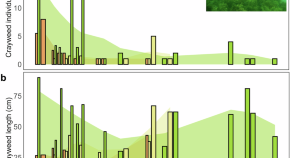
The results from the earliest site were striking. Within 36 months of transplantation at Long Bay, crayweed individuals had established up to 43 metres from the initial patch, with significantly more recruits found closer to the mat than farther away. Critically, the re-established individuals were not stunted remnants: their lengths reached the ranges documented in extant populations within three years, and the proportion of reproductive adults climbed from 50 percent at 16 months to 88 percent at 36 months. In other words, the transplanted patch did not merely persist; it seeded a new generation capable of reproducing and expanding on its own, exactly the trajectory that applied nucleation is designed to set in motion.
Across the broader programme, the picture was more nuanced. Crayweed established successfully at six of the 14 transplanted sites, a success rate of roughly 43 percent. Where establishment occurred, the re-established populations extended up to 388 metres from their initial patches after 12 years, and the area enclosed by the outer edges of the recovered population increased by approximately 96,380 percent relative to the original planted footprint. Densities of individuals within recovered patches ranged from 1 to 34 per square metre, though the site-wide average of around 2 individuals per square metre remained below the 14 per square metre recorded in reference populations outside Sydney, indicating that full recovery remains a work in progress.
The statistical modelling behind the study identified several factors that separated successful sites from failures. In the short term, recruitment measured nine months after transplantation was positively associated with the survival of the transplanted adults, which serve as both a source of gametes and a canopy sheltering recruits from excessive light and physical disturbance. Recruit length, meanwhile, was negatively associated with grazing damage on the transplants, suggesting that herbivory, even when not correlated with the raw abundance of urchins, snails or herbivorous fish, imposes real costs on early life stages. Over the longer term, a clear pattern emerged around canopy: crayweed expanding away from the original patch was found far more often than expected adjacent to other canopy-forming seaweeds, particularly the kelp Ecklonia radiata and Sargassum species, rather than on bare rock or turf-dominated substrate. This facilitation effect implies that site selection models should explicitly account for the presence of neighbouring canopy-formers, which moderate light, reduce thallus scour and possibly suppress herbivore access.
Timing also mattered. Most sites where crayweed successfully established had been transplanted between April and November, particularly during the austral winter, whereas summer transplanting attempts largely failed. This aligns with the reproductive phenology of the species: gamete release and maturity peak in winter and decline sharply in summer. When the analysis was restricted to winter transplanting events, the positive relationships between the number of transplanting events and both the extent and area of re-established crayweed became significantly stronger. Repeated transplanting, or reinforcement, also improved outcomes, echoing findings from terrestrial restoration where repeated planting buffers populations against unpredictable disturbances such as storms or grazing pulses. The researchers note that severe flooding at Kurnell in 2022 likely wiped out a successfully recruited population there, underscoring that even well-chosen sites remain vulnerable to extreme events, pollution sensitivity and ocean warming.
The team also translated their expansion rates into projections for meeting global restoration ambitions. The Kunming–Montreal Global Biodiversity Framework has prompted a target of protecting three million and restoring one million hectares of marine forests by 2040, yet only about 15,000 hectares have been restored to date worldwide. Applying their measured expansion rates to Sydney’s 56,713 metres of exposed rocky reef coastline, the researchers calculated that establishing 30 simultaneous new sites would allow crayweed to reclaim 30 percent of suitable degraded habitat in approximately 47 years, at an estimated cost of USD 95,788, based on a linear restoration cost of about USD 5.63 per metre that includes materials, transport and personnel. If only sites where crayweed has actually established are considered, the timeframe shrinks to 21 years, and excluding urchin barrens, which occupy roughly 29 percent of Sydney’s reefs and would require additional interventions such as urchin culling, would further alter the calculus. The projections do not account for potential climate-driven losses, although the spread rates inherently incorporate periodic grazing and storm-related setbacks.
The authors caution that a fundamental question remains: whether re-established crayweed forests, even at target scales, deliver the full suite of ecological functions, biodiversity and ecosystem services characteristic of extant forests. Answering this will require monitoring over 15 to 20 years, incorporating metrics of biodiversity, function and service provision, particularly as climate change reshapes the suitability of restoration sites. Future-proofing strategies under consideration include selecting thermally resilient genotypes, reinforcing restored populations, and using spatially explicit climate models to guide site selection. Meanwhile, modified green gravel techniques, in which juvenile seaweeds are seeded onto small gravel or rock substrates for outplanting, are being developed for crayweed to push scalability further.
What the study ultimately demonstrates is that small, strategic interventions can leverage natural ecological processes to achieve restoration outcomes at scales far exceeding the initial investment. Twelve- to twenty-square-metre patches of transplanted adults have, over a decade, given rise to expanding marine forests along one of Australia’s most urbanised coastlines. The findings offer a practical blueprint for practitioners worldwide confronting the decline of kelp and fucoid forests, roughly half of which have degraded over the past 50 years due to overfishing, pollution and ocean warming. From little things, as the paper’s title suggests, big things can indeed grow, provided that the biology of the target species, the ecology of the site and the realities of herbivory, seasonality and disturbance are woven into the restoration design from the outset.
Cite Scienmag News
Margaret Porter. (September 4, 2026). Applied nucleation helps restore vast marine forests from small starts. Scienmag. https://scienmag.com/applied-nucleation-helps-restore-vast-marine-forests-from-small-starts/
Margaret Porter. "Applied nucleation helps restore vast marine forests from small starts." Scienmag, 4 September 2026, https://scienmag.com/applied-nucleation-helps-restore-vast-marine-forests-from-small-starts/. Accessed 4 September 2026.
Margaret Porter. "Applied nucleation helps restore vast marine forests from small starts." Scienmag. September 4, 2026. https://scienmag.com/applied-nucleation-helps-restore-vast-marine-forests-from-small-starts/


