


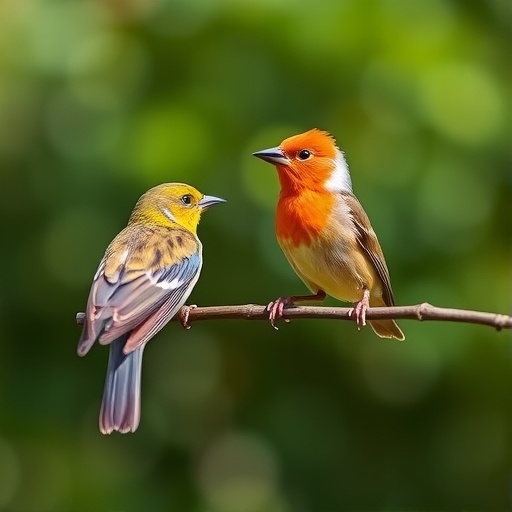
In the coldest months of the year, when much of the natural world seems to retreat, millions of people across North America head to their windows, refill their bird feeders, and settle in to watch. For many, it is far more than a hobby. A new large-scale study has found that feeding and observing wild birds appears to have a strikingly positive effect on mental wellbeing — so much so that participants rated the impact of their backyard birds more favorably than nearly every other event in their lives over a six-month period. The research, published in the journal Ambio, offers one of the most detailed portraits yet of how one of humanity’s most common intentional interactions with wildlife may shape our emotional lives.
The study, led by Kelley E. Langhans of Virginia Tech’s Department of Fish and Wildlife Conservation, together with Ashley A. Dayer, Caren Cooper, and colleagues at institutions including Cornell University’s Lab of Ornithology, North Carolina State University, The Ohio State University, the University of Georgia, and the Zoological Society of London, surveyed 3,658 participatory scientists enrolled in Project FeederWatch. That long-running program, jointly coordinated by the Cornell Lab of Ornithology and Birds Canada, enlists thousands of volunteers across the United States and Canada who count birds visiting feeders and other maintained areas from November through April. The researchers used this community as a window into a question that has been surprisingly difficult to answer: how, exactly, does feeding wild birds affect the people doing the feeding?
The context matters. The World Health Organization estimates that one in eight people worldwide now lives with a mental disorder, even as societies grow increasingly disconnected from nature and biodiversity continues its rapid decline. A substantial body of research has suggested that exposure to nature improves cognition, social skills, and mental health, and birds occupy a special place in that literature. Experiments have shown that hearing birdsong increases attention restoration and decreases stress, and smartphone-based ecological momentary assessments have found that seeing or hearing wild birds is associated with elevated wellbeing, including among people with depression. One experimental study even found that guided bird walks improved college students’ wellbeing and reduced stress more than general nature walks did. Yet the specific practice of feeding birds — an activity pursued by an estimated 56.7 million Americans over the age of 16, or roughly 22 percent of that population — had remained comparatively underexplored, particularly the pathways by which it might act on the mind.
To structure their investigation, the researchers adapted a framework developed by Arjen Buijs and Maarten Jacobs in 2021, which proposes that positive human–wildlife interactions boost subjective wellbeing through three distinct pathways. The first is Pleasure: experiencing more positive emotions, fewer negative emotions, and reduced stress, a mechanism grounded in stress reduction theory, which holds that people have an evolutionary, autonomic calming response to natural settings. The second is Engagement: the states of flow, awe, focus, and growing personal skill associated with attention restoration theory, which posits that nature engages undirected attention and restores the mental fatigue caused by the directed attention modern life demands. The third is Meaning: the sense of transcending one’s own interests, doing good, and connecting to something larger than oneself — a eudaimonic dimension of wellbeing that goes beyond simple pleasure.
The team’s design was longitudinal, capturing the same individuals before and after a full FeederWatch season. In October 2024, participants completed an online survey that included the Short Warwick–Edinburgh Mental Wellbeing Scale, a validated seven-item psychometric instrument scoring from 7 to 35 that covers both hedonic and eudaimonic aspects of mental health. In May 2025, after the season closed, participants took the scale again and answered retrospective questions about how feeding birds — and, separately, all other life events — had affected their wellbeing over the previous six months. They also rated their agreement with ten bird-specific wellbeing statements and answered an open-ended question inviting them to explain, in their own words, how the activity had shaped their answers.
The quantitative results were unambiguous. Ninety-five percent of respondents reported that feeding and observing birds had positively impacted their wellbeing over the six-month season. By contrast, only 55 percent said other events in their lives had a positive effect — a difference that was highly statistically significant in a Wilcoxon signed-rank test (p < 0.001). Respondents agreed that feeding birds made them feel useful, relaxed, able to think clearly, able to make up their minds, and able to deal with problems well, and that it brought them closer to other people. They disagreed that it made them feel anxious, distressed, or helpless. Interestingly, the mean change in SWEMWBS scores from October to May was just 0.4 points — well below the three-point threshold the researchers treated as a meaningful change — indicating that for most participants, overall wellbeing was stable even as they attributed strong positive effects to their birds.
Among the minority who did show a measurable shift, the pattern was telling. Of the respondents, 531 experienced a meaningful improvement in wellbeing and 324 a meaningful decline, while 2,803 stayed roughly steady. Those who improved rated the impact of feeding birds on their wellbeing significantly more positively than those who stayed the same (Kruskal–Wallis test, p = 0.03), linking quantitative change to participants’ own explanations of why it occurred.
The qualitative analysis, conducted on a randomly sampled subset of 440 open-ended responses — a sample size exceeding the 244 needed to generalize to the project’s population of nearly 30,000 participants with 95 percent confidence and a 5 percent margin of error — revealed the texture behind those numbers. Of the codable responses, 81 percent described a positive impact. The dominant pathway was Emotions. Positive emotion, coded in 139 responses, encompassed joy, gratitude, contentment, and hope. “Watching birds at our feeders definitely has improved my mood and made me happier and more optimistic,” one participant wrote. Stress reduction appeared in 124 responses, with participants describing the activity as “therapeutic,” calming, and a welcome escape from worries — one noted that focusing on birds distracted them “from current national news.” Another 45 responses described relief from negative emotion, including one participant recovering from major surgery who said watching feeders “brought me a lot of joy and distraction from my difficult recovery.”
Engagement, though far less common, surfaced in accounts of curiosity, focus, childlike wonder, and the mental stimulation of learning to identify new species. Meaning, the eudaimonic pathway, included doing good — the sense of helping individual birds and contributing to science through FeederWatch data — as well as connection to nature and, in a small number of cases, human connection, such as a couple who described watching birds from their porch as “great ‘together’ time in our marriage.” The study was also honest about the shadows: a handful of participants reported negative impacts, chiefly distress at seeing sick or injured birds, dislike of certain species, and grief over declining bird populations and habitat loss. “I have observed the frequency of several birds decline in the 10 years I have done FeederWatch… It makes me feel like crying,” one respondent shared.
The authors are careful about what their findings do and do not show. Because the study was observational and retrospective, it cannot prove that bird feeding causes improved wellbeing; intervention studies, ideally with real-time and biophysical measures, would be needed to establish causation. The sample also skewed older, wealthier, more female, and more highly educated than the general population, and people who join participatory science projects may simply value wildlife more than most. Even the coding process was novel: the lead author coded responses manually and then used a large language model, hosted internally at Virginia Tech to protect participant privacy, to recode half the data as a reliability check, achieving 98 percent agreement and a Cohen’s kappa of 0.92 on primary codes.
Still, the implications are considerable. Bird feeding is one of the most accessible forms of nature contact available — it requires no travel, no physical exertion, and no wild spaces, making it potentially valuable for older adults, people with disabilities, and those without access to parks. If future experimental work confirms these associations, the researchers suggest, feeding birds could serve as a genuine therapeutic tool. At the same time, they caution against a universal prescription: supplementary feeding can also harm birds through disease transmission at feeders, window collisions, predation, and altered community composition. The responsible path forward, the authors argue, is socio-ecological research that weighs costs and benefits for both humans and birds — designing feeding strategies that support people in living happy, healthy lives while minimizing risks to the creatures at the window. For thousands of FeederWatch participants, that balance already begins each cold morning, one seed-filled feeder at a time.
Cite Scienmag News
Margaret Porter. (September 4, 2026). Feeding and watching birds may boost daily wellbeing, study finds. Scienmag. https://scienmag.com/feeding-and-watching-birds-may-boost-daily-wellbeing-study-finds/
Margaret Porter. "Feeding and watching birds may boost daily wellbeing, study finds." Scienmag, 4 September 2026, https://scienmag.com/feeding-and-watching-birds-may-boost-daily-wellbeing-study-finds/. Accessed 4 September 2026.
Margaret Porter. "Feeding and watching birds may boost daily wellbeing, study finds." Scienmag. September 4, 2026. https://scienmag.com/feeding-and-watching-birds-may-boost-daily-wellbeing-study-finds/


