


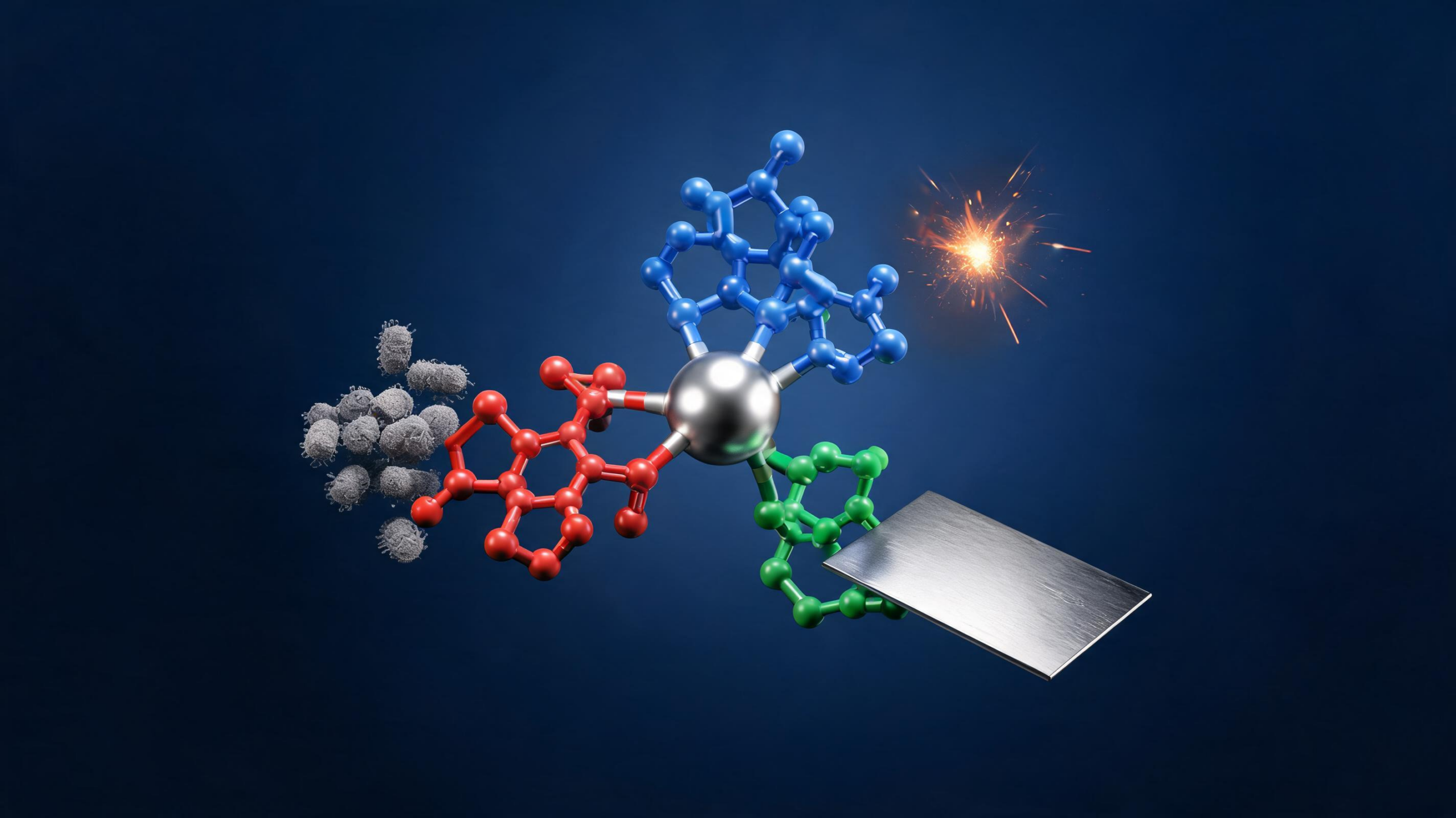
Chemists in Nigeria have unveiled a new family of metal complexes that appear to do several jobs at once: killing bacteria and fungi, mopping up damaging free radicals, slicing through DNA in ways that could inspire future drugs, and even protecting steel from rusting in harsh acidic environments. The work, published in Discover Chemistry, describes the synthesis and detailed characterization of mixed-ligand complexes of copper, manganese, iron and zinc built from two newly designed Schiff base ligands, LQ-CFNA and HN-MPD, which together form what the researchers call the LCH system. What makes the study unusual is its breadth: rather than testing a single property, the team combined spectroscopy, biological assays, corrosion experiments and quantum chemical calculations into one integrated framework.
Schiff bases are compounds formed when a primary amine condenses with an aldehyde or ketone, producing a characteristic imine, or C=N, group. They are prized in coordination chemistry because they are easy to make, structurally versatile, and able to grip metal ions through nitrogen, oxygen or sulfur donor atoms. The two ligands in this study were built from naphthalene-derived starting materials: LQ-CFNA was produced by condensing 2-hydroxy-1,4-naphthoquinone with 3-chloro-6-fluoro-2-nitroaniline, while HN-MPD came from 2-hydroxy-1-naphthaldehyde and 4-methylpiperidin-3-one. The naphthoquinone unit is particularly interesting because it is redox-active and appears in many biologically active natural products, giving the resulting complexes a built-in electronic handle for reactivity.
The researchers refluxed ethanolic solutions of the precursors at 50 degrees Celsius for several hours with a drop of acid catalyst, collecting yellow precipitates that were recrystallized and dried. The ligands were then combined with copper, manganese, iron and zinc salts in a 1:1:1 molar ratio to give the mixed-ligand complexes [Cu(LCH)], [Mn(LCH)], [Fe(LCH)] and [Zn(LCH)]. Confirmation of coordination came from infrared spectroscopy: the azomethine C=N stretching bands of the free ligands, seen at 1677 and 1615 wavenumbers per centimeter, shifted to lower frequencies of 1599, 1644, 1532 and 1539 for the copper, manganese, iron and zinc complexes respectively, indicating that the imine nitrogen binds the metal. New low-frequency bands between roughly 400 and 600 wavenumbers, absent in the free ligands, were assigned to metal-nitrogen and metal-oxygen vibrations, sealing the case for coordination through both donor types.
Other physical measurements filled in the picture. Molar conductance values of 8.77, 23.58 and 29.17 S cm2 mol-1 for the copper, manganese and zinc complexes pointed to non-electrolytic behavior in dimethyl sulfoxide solution, while the iron complex, with a strikingly high value of 279 S cm2 mol-1, behaved as a strong electrolyte, suggesting counter ions outside its coordination sphere. Magnetic susceptibility measurements at room temperature revealed paramagnetic behavior across the series. The electronic spectra and magnetic moments supported predominantly octahedral geometries, with the manganese complex showing a high-spin moment of 6.6 Bohr magnetons consistent with five unpaired electrons, while the copper complex, with a moment of 2.2 Bohr magnetons and a single low-energy d-d transition, was assigned a square planar geometry possibly with some tetrahedral distortion. The iron complex sat between high-spin and low-spin limits, suggesting an equilibrium of spin states in an octahedral field.
Nuclear magnetic resonance spectroscopy of the free ligands revealed subtle tautomeric differences. For LQ-CFNA, a downfield imine proton at 8.06 parts per million and an imine carbon signal at 184.02 parts per million pointed to the keto form, with no enol peaks in the 5 to 7 parts per million window. HN-MPD, by contrast, showed an imine proton singlet at 3.46 parts per million, consistent with the enol tautomer. The complexes also melted at far higher temperatures, between 280 and 325 degrees Celsius, than the free ligands, which the authors attribute to strong metal-ligand bonding, increased lattice energy and the rigidity that chelation imposes on the molecular framework.
The biological results were among the most eye-catching findings. In disk diffusion assays against seven bacterial strains, the manganese complex produced the largest inhibition zone of the study, 22.5 millimeters against Klebsiella pneumoniae, exceeding the streptomycin control. The free ligand HN-MPD outperformed the standard drug against Staphylococcus aureus with a 21-millimeter zone, and LQ-CFNA beat the control against Escherichia coli with 17 millimeters. Against fungi, the iron complex delivered a 19.5-millimeter zone against Aspergillus flavus, surpassing the miconazole standard, while the free HN-MPD ligand reached 24.5 millimeters against Fusarium species. The team attributes the enhanced activity of many complexes to chelation, which disperses the positive charge on the metal ion, delocalizes electrons over the ligand rings and increases lipophilicity, allowing the compounds to penetrate microbial membranes more effectively.
DNA cleavage experiments using agarose gel electrophoresis added a therapeutic dimension. HN-MPD showed clear cleavage activity, with the disappearance of the supercoiled plasmid DNA band and the appearance of nicked and linear forms, while LQ-CFNA showed no cleavage effect. The authors suggest the ligand’s conjugated pi-system and donor atoms bring it into close contact with the DNA backbone, promoting strand scission through hydrolytic pathways or, potentially, reactive oxygen species generated by redox cycling. Antioxidant testing by the FRAP assay showed that complexation generally boosted radical-scavenging power: the copper and iron complexes reached estimated IC50 values of about 5 milligrams per milliliter, comparable to gallic acid, while the manganese complex was the weakest at 25 milligrams per milliliter. The redox-active nature of copper and iron, which readily changes oxidation state to stabilize radical intermediates, explains their superior performance.
The corrosion work may prove equally consequential for industry. Using weight-loss measurements on mild steel coupons immersed in 1 molar hydrochloric acid, the team found that inhibition efficiency rose with inhibitor concentration and depended strongly on temperature. At 303 kelvin, HN-MPD was the champion, reaching 91.49 percent efficiency at 62.5 parts per million, followed by LQ-CFNA at 74.69 percent and the zinc complex at 49.29 percent. At 373 kelvin the ranking flipped, with LQ-CFNA achieving the best performance at 74.69 percent. The ligands adsorb onto the steel surface through donor-acceptor interactions between lone electron pairs and the metal, forming a protective film that slows dissolution in the aggressive acid.
Density functional theory calculations using the B3LYP functional with 6-31G(d,p) basis sets, and LANL2DZ for the metal centers, tied the experimental observations to electronic structure. The free ligands showed large HOMO-LUMO gaps of 3.48 and 3.55 electronvolts, marking them as hard, stable molecules, but complexation shrank the gap dramatically, to just 1.04 electronvolts for the manganese complex, 1.72 for iron, 1.69 for zinc and 1.81 for copper. Lower gaps, reduced chemical hardness, increased softness and higher electrophilicity all correlated with the enhanced biological activity of the complexes, since softer, more electrophilic molecules interact more readily with nucleophilic sites in DNA bases and amino acid residues. The manganese complex emerged as the softest and most electrophilic species, matching its standout antibacterial result. The authors caution that the relationship between quantum descriptors and activity is not strictly linear, and that geometry, substituents and solubility also matter, but the overall agreement between theory and experiment is striking.
By combining two electronically distinct Schiff bases in a single coordination sphere, and by evaluating antimicrobial, antioxidant, DNA-interaction and corrosion properties side by side, the study offers a template for designing multifunctional metal complexes rather than single-purpose ones. The researchers, C. Wodi and C. Festus of Ignatius Ajuru University of Education in Port Harcourt, note that single-crystal X-ray diffraction could not be performed because suitable crystals could not be grown, but argue that the combined spectroscopic, magnetic, conductance and computational evidence strongly supports their proposed structures. If the LCH framework’s performance holds up in further testing, these naphthoquinone-based complexes could find roles ranging from antimicrobial agents to green corrosion inhibitors for the oil and gas and metal-processing industries.
Beyond the specific results, the study illustrates a broader trend in coordination chemistry: the deliberate pairing of ligands with complementary electronic roles. The naphthoquinone fragment contributes low-lying π* orbitals that can accept electron density during redox cycling, while the piperidinone-derived Schiff base supplies flexible donor geometry. Together they give the metal center access to both storage and transfer of electrons, which is precisely what antioxidant and DNA-cleavage chemistry demands.
The corrosion findings also fit established adsorption theory. In acidic media, protonated heteroatoms and π-electrons of aromatic rings can bind to positively charged steel surfaces, and the temperature dependence observed here suggests a shift between physisorption at lower temperatures and chemisorption as thermal energy increases. Such plant-free, synthetic organic inhibitors are of interest because they can be effective at parts-per-million loadings, reducing the volume of chemical discharged into the environment.
Methodologically, the work shows how quantum descriptors can serve as screening tools. A small HOMO-LUMO gap and high electrophilicity index, computed cheaply before any synthesis, correlated with the strongest antimicrobial performers, hinting that computational pre-screening could prioritize which metal complexes to prepare. The authors acknowledge limitations, including the absence of crystallographic confirmation and the need for minimum inhibitory concentration measurements to complement diffusion zones, which remain a standard caveat in antimicrobial screening. As an open-access contribution, the study makes its full dataset available for groups interested in extending the LCH platform toward drug leads or industrial formulations.
Subject of Research: Synthesis, characterization and multifunctional evaluation of mixed-ligand metal(II) complexes derived from naphthoquinone-based Schiff base ligands
Article Title: Experimental and theoretical investigation of mixed ligand metal(II) complexes derived from LCH for multifunctional applications
Article References: Wodi, C., & Festus, C. (2026). Experimental and theoretical investigation of mixed ligand metal(II) complexes derived from LCH for multifunctional applications. Discover Chemistry, 3(1), Article 493. https://doi.org/10.1007/s44371-026-00950-9
Image Credits: AI Generated
DOI: 10.1007/s44371-026-00950-9
Keywords: Schiff base, mixed-ligand complexes, naphthoquinone, metal(II) complexes, antimicrobial activity, DNA cleavage, corrosion inhibition, DFT calculations, antioxidant, coordination chemistry, mild steel, spectroscopy
Cite Scienmag News
Bethany Barker. (September 3, 2026). New Mixed-Ligand Metal Complexes Show Promise as Antibiotics, Antioxidants and Corrosion Shields. Scienmag. https://scienmag.com/new-mixed-ligand-metal-complexes-show-promise-as-antibiotics-antioxidants-and-corrosion-shields/
Bethany Barker. "New Mixed-Ligand Metal Complexes Show Promise as Antibiotics, Antioxidants and Corrosion Shields." Scienmag, 3 September 2026, https://scienmag.com/new-mixed-ligand-metal-complexes-show-promise-as-antibiotics-antioxidants-and-corrosion-shields/. Accessed 3 September 2026.
Bethany Barker. "New Mixed-Ligand Metal Complexes Show Promise as Antibiotics, Antioxidants and Corrosion Shields." Scienmag. September 3, 2026. https://scienmag.com/new-mixed-ligand-metal-complexes-show-promise-as-antibiotics-antioxidants-and-corrosion-shields/


