


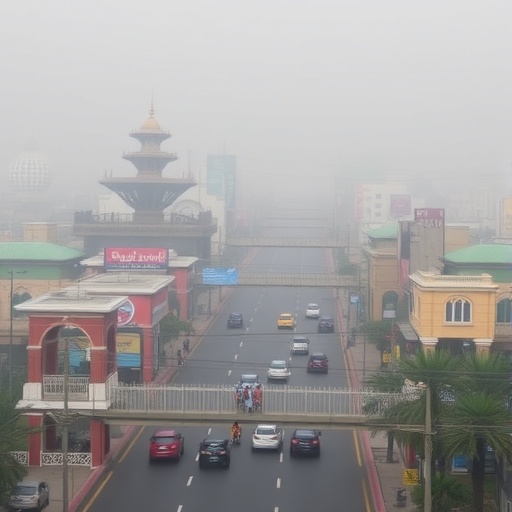
Air pollution in India is usually told as a story about Delhi and the great Indo-Gangetic Plain, but a new study argues that some of the most revealing lessons about urban air quality come from the country’s far northeast. Researchers at The Assam Royal Global University in Guwahati have carried out the most detailed analysis to date of daily Air Quality Index (AQI) records across eight major urban centres of Northeast India, covering three full years from 2022 to 2024. Their central finding is striking: rather than any steady upward or downward trend, it is the seasons that dominate the air quality story, amplifying pollution in valley cities during winter and washing it away during the monsoon. The work, published in the journal Air Quality, Atmosphere & Health, is one of the first systematic attempts to characterise pollution regimes in a region often treated as a data blind spot between the heavily studied megacities of the plains.
The eight cities examined—Agartala, Guwahati, Imphal, Aizawl, Gangtok, Shillong, and the monitoring networks of two further urban centres—span an extraordinary range of topography, from floodplain valleys of the Brahmaputra and Barak rivers to hill stations perched more than a thousand metres above sea level. Using publicly available daily average AQI data from the Central Pollution Control Board and the individual State Pollution Control Boards, the researchers assembled a three-year record and subjected it to a battery of statistical techniques: descriptive statistics, autocorrelation diagnostics, a modified Mann-Kendall trend test, a Seasonal Anomaly Index, inter-urban inequality assessment and hierarchical clustering. Each method was chosen to probe a different dimension of the pollution problem—the magnitude of exposure, the persistence of bad air days, the existence of long-term trends, the seasonal modulation of pollution, and the spatial clustering of cities with similar pollution behaviour.
The headline result is a stark heterogeneity in exposure across the region. Agartala, Guwahati and Imphal, all located in confined valley settings, consistently recorded pollution levels far above those seen in the hill cities of Aizawl, Gangtok and Shillong, where elevation, ridge-top locations and freer atmospheric ventilation keep the air cleaner. The exposure analysis quantifies just how frequently residents of the valley cities breathe degraded air: in the major valley cities, more than 40 to 50 per cent of days had an AQI of 100 or above—a level at which the Indian AQI system begins to flag health concerns for sensitive groups. In Agartala and Guwahati, more than 20 per cent of all days exceeded an AQI of 200, which corresponds to “poor” or worse conditions and is associated with breathing discomfort for most people on prolonged exposure. For cities that rarely appear on national pollution league tables, these figures represent a substantial, chronic public health exposure.
Perhaps the most conceptually important finding concerns what the data do not show. The modified Mann-Kendall test—a non-parametric method corrected for serial correlation, which is the standard tool for detecting monotonic change in environmental time series—found no statistically significant long-term trend in any of the cities over the three-year window. On one level this may reflect the brevity of the record: three years is simply too short to distinguish a genuine trend from natural year-to-year variability, and the authors are careful not to over-interpret the null result. But it also carries a practical implication. Any air quality management strategy in these cities that relies on evaluating policies through year-on-year comparisons will struggle, because the seasonal signal dwarfs the trend signal. In other words, the “noise” of the annual cycle is actually structured information, and it is where most of the action lies.
That structure is captured by the Seasonal Anomaly Index, which the study applies to quantify how much each season departs from the city’s own long-term mean. The results show a systematic winter amplification of pollution and a monsoon suppression that is remarkably consistent across the region. The physical explanation lies in two well-understood atmospheric mechanisms. In winter, cool nights over the valleys produce temperature inversions: a layer of warm air sits above cooler air near the ground, suppressing the vertical mixing that normally dilutes pollutants. At the same time the planetary boundary layer—the lowest part of the atmosphere, in which surface emissions are trapped and mixed—shrinks dramatically during the cold months, concentrating whatever is emitted into a much smaller volume. Combined with reduced wind speeds and, in several cities, seasonal biomass burning for heating and land clearing, this produces the sharp winter peaks the authors document. The monsoon reverses almost every one of these conditions: deep convective mixing, rain that scavenges particles directly from the air through wet deposition, and boundary layers that grow tall during the day all act to strip pollution from the atmosphere.
Autocorrelation diagnostics added a further layer of insight, revealing what the researchers describe as strong atmospheric memory effects in every city. In statistical terms, AQI values on consecutive days are highly correlated—today’s pollution level is a strong predictor of tomorrow’s. Physically, this reflects the fact that pollution episodes are not isolated events but build-ups: once emissions and stagnant meteorology align, the stagnant conditions and the accumulated pollutant reservoir tend to persist together for days or weeks. This “memory” has direct operational value for forecasting. Because bad air days cluster rather than arrive at random, an episode beginning in a valley city is likely to continue, giving health authorities a genuine window to issue warnings, restrict outdoor activity and stage interventions while conditions remain hazardous.
To understand how these cities relate to one another, the team performed hierarchical clustering on the seasonal profiles and an inter-urban inequality assessment. The clustering separated the valley cities—Agartala, Guwahati and Imphal—into a distinct high-AQI regime, clearly differentiated from the hill cities. The authors attribute this regime to what they call structural interactions between emission intensity and valley-confined topography: the valleys combine the region’s densest traffic, construction activity and residential fuel use with the worst natural ventilation, so emissions and confinement compound each other. The inequality analysis revealed a dynamic that is especially relevant to policy. During the monsoon, the spatial inequality between cities compresses—rain acts as a great leveller, cleaning the air everywhere and narrowing the gap between the dirtiest and cleanest cities. In winter, the opposite happens: the stability of the winter atmosphere amplifies whatever local conditions exist, widening the gap and pushing the valley cities into their unique high-AQI regime while the hill cities remain comparatively protected.
The multi-year rankings and seasonal heatmaps that summarise the analysis make Agartala, Guwahati and Imphal stand out as persistent high-risk pollution centres—not in one anomalous year but across all three. Guwahati, the region’s largest city and gateway to the northeast, has attracted growing media attention for its construction dust and traffic emissions, with recent reporting even noting transboundary contributions to its winter smog. Agartala, in the confined Tripura plains, has repeatedly recorded the region’s worst individual readings. Imphal, sitting in a bowl-shaped valley in Manipur, follows the same pattern. The consistency across years and across independent statistics strengthens the case that this is a structural problem of geography plus growth, not a fluke of monitoring or a single bad season.
What makes the study valuable beyond its regional focus is the methodological template it offers for secondary and emerging cities everywhere. The authors point out in their introduction that urban air quality dynamics in secondary and emerging cities remain underexplored even as exposure risks grow—most research effort, and most monitoring investment, concentrates on megacities. Yet hundreds of millions of people live in mid-sized cities whose pollution regimes are shaped by local topography and seasonal meteorology rather than by the emission intensities of megacities. The combination of tools used here—trend detection with autocorrelation correction, a Seasonal Anomaly Index, clustering and inequality metrics—can be applied anywhere that daily AQI records exist, and it converts routine monitoring data into a diagnostic of the physical mechanisms governing a city’s air.
For policymakers in the northeast, the implications are concrete. Because winter amplification is the dominant driver of extreme exposure, interventions should be timed seasonally: stricter controls on construction dust, biomass burning and vehicle emissions during the winter months would target the period when the atmosphere is least able to cope. Because the atmospheric memory means episodes persist, forecasting systems built on the strong day-to-day autocorrelation could deliver useful lead time for public health warnings. And because the hill-versus-valley divide is so sharp, one-size-fits-all regional policy is unlikely to work; the valley cities need aggressive emission reduction precisely because their topography cannot be changed, while the hill cities face far more benign baseline conditions. The study also implicitly argues for expanding and maintaining monitoring networks in the region, since a three-year record is still too short to resolve trends, and longer archives will be essential to judge whether future policy measures—or a changing climate—begin to shift the seasonal regime itself.
The research leaves open questions that longer records and richer data will need to address, including the specific contributions of different emission sources in each city and the role of transboundary transport from beyond the region. But its core message is already clear and, the authors suggest, widely applicable: in valley cities, the calendar matters more than the trend line. Anyone planning for cleaner air in the urban valleys of Northeast India—and in topographically confined cities around the world—must plan around winter.
Cite Scienmag News
Russell Cooper. (September 3, 2026). Seasonal shifts, not trends, drive urban air pollution extremes in Northeast India. Scienmag. https://scienmag.com/seasonal-shifts-not-trends-drive-urban-air-pollution-extremes-in-northeast-india/
Russell Cooper. "Seasonal shifts, not trends, drive urban air pollution extremes in Northeast India." Scienmag, 3 September 2026, https://scienmag.com/seasonal-shifts-not-trends-drive-urban-air-pollution-extremes-in-northeast-india/. Accessed 3 September 2026.
Russell Cooper. "Seasonal shifts, not trends, drive urban air pollution extremes in Northeast India." Scienmag. September 3, 2026. https://scienmag.com/seasonal-shifts-not-trends-drive-urban-air-pollution-extremes-in-northeast-india/


