


StackRSS Canonical Source Context
Original Article Title: Vehicle-mounted spectroscopy system detects methane in real time
Journal or Source Feed: Eurekalert | Atmospheric Science
Original Publication Date: Not provided
Canonical Source URL:
Canonical DOI: Not provided
Context Rule: These fields identify the source article. DOIs inside the bibliography identify cited works and must not replace the canonical DOI above.
News Release
27-Aug-2026
Vehicle-mounted spectroscopy system detects methane in real time
New system could help locate hidden methane emissions that contribute to climate change and pose safety risks
Peer-Reviewed Publication
Optica

view more
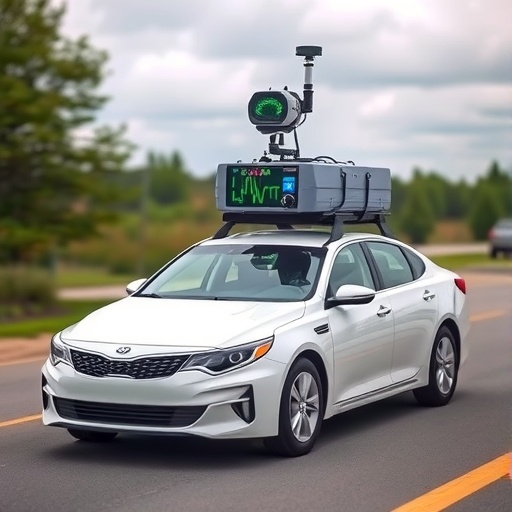
Credit: Daping Luo, Chenglin Gu, and Wenxue Li, East China Normal University
WASHINGTON — Researchers have developed a vehicle-mounted spectroscopy system that can reliably detect methane in real time while driving. Using a moving vehicle to detect methane could make it easier to locate hidden methane emissions across large areas.
Methane is a potent greenhouse gas released from sources such as natural gas infrastructure, livestock farms, landfills and coal mines. Leaks from natural gas infrastructure, which are typically invisible to the naked eye, can also create fire and explosion hazards.
“Dual-comb spectroscopy uniquely enables simultaneous, high-precision measurement of multiple gases, but is sensitive to environmental noise, which can degrade its performance. Our work addresses and overcomes this key challenge,” said research team leader Wenxue Li from East China Normal University. “SUVs equipped with our spectroscopy system could cruise residential streets day and night. If an underground gas pipeline has a methane leak, the system could capture the concentration of the gas, record the GPS coordinates and notify maintenance crews.”
In the Optica Publishing Group journal Optics Express, the researchers describe their new vehicle-mounted system, which is based on mid-infrared dual-comb spectroscopy. They show that it can identify simulated natural gas leaks and map the 2D gas diffusion distribution around emission sources across multiple outdoor sites and road environments.
“With further development, this technology could help cities and industries quantify hard-to-detect greenhouse gas emissions, providing data to support emissions-reduction policies,” said Li. “More accurate methane leak localization could enable targeted repairs, reduce resource waste and improve air quality for nearby residents. The technology could also be integrated into unmanned aerial vehicles, allowing methane detection in off-road areas and further expanding potential applications.”
From the lab to the road
Mid-infrared dual-comb spectroscopy detects gases using two precisely matched frequency combs — light sources that produce many evenly spaced wavelengths. The mid-infrared region is especially useful because many molecules have strong, distinctive absorption signatures there, making it well suited for sensitive gas detection.
While dual-comb systems are commonly used in laboratories, taking the technology into the field is challenging. The systems typically rely on precisely aligned optics, including fixed telescopes and mirrors, which limit their ability to move freely and search for unknown leak sources. In real-world settings, emission sources can be scattered across an area and shift with changing wind direction.
To address this challenge, the team combined several advances to create a compact system that can perform high-precision gas detection reliably on a moving vehicle. The frequency combs are generated by specially designed, vibration-resistant fiber lasers. The researchers also developed a method that allows the two frequency comb light sources to stay naturally synchronized, eliminating the need for complex hardware to actively keep them in phase.
The mid-infrared light enters a compact, open-path gas cell that provides an effective 25-meter path through air drawn from the surroundings, increasing the system’s sensitivity without requiring a large instrument.
“Our system requires no pre-deployed hardware at the field site, maintains near-laboratory-grade detection accuracy while in motion, supports vehicle speeds up to 100 km/h and can geolocate gas plume hotspots,” said Luo. “In addition, the overall hardware is compact, relatively low in power consumption and has a modular plug-and-play design.”
Road-testing the system
To test the new system, short drives were carried out on a university campus at approximately 20 km/h while collecting data at multiple locations. This was followed by a one-hour, 47-km road test conducted on urban roads and expressways at speeds up to 100 km/h, with readings taken every second.
The system achieved a figure of merit of 3.4 × 10⁶ Hz, which is comparable to typical laboratory‑based mid-infrared dual-comb spectroscopy systems. It also measured methane with a precision of 66 ppb and water vapor with a precision of 114 ppm. During the long-distance urban measurements, background methane averaged 1.815 parts per million (ppm), while water vapor averaged 1.072%. The measurements remained consistent, providing a stable baseline for identifying localized increases in gas concentrations.
The researchers also conducted controlled methane-release tests, driving past two simulated leaks to detect and locate the plumes. They drove in circles around one of the leaks to create a 2D concentration map, which closely matched local wind patterns.
The testing confirmed that the hardware withstands the vibration and outdoor weather conditions of real roads and can accurately detect both atmospheric background concentrations and high-concentration gas plume signals from controlled leak sources.
To advance the research prototype, the researchers plan to improve performance by expanding spectral coverage to enable simultaneous detection of multiple trace gas species and further suppressing baseline drift during long integration times. They also plan to develop automated analysis software optimized for massive volumes of mobile data and continue miniaturizing the system to reduce its size, weight and cost. Ultimately, they hope to integrate the system onto drone platforms for monitoring off-road areas.
Paper: X. Jing, K. Wei, C. Gu, X. Qin, J. Li, X. Yang, Z. Huang, J. Zhang, C. Sun, C. Liu, Z. Zhu, D. Luo, W. Li, H. Zeng, “Vehicle-mounted mid-infrared dual-comb spectroscopy for on-road trace gas detection,” Opt. Express, 34
Cite Scienmag News
Russell Cooper. (August 31, 2026). Vehicle-mounted spectroscopy system detects methane in real time. Scienmag. https://scienmag.com/vehicle-mounted-spectroscopy-system-detects-methane-in-real-time/
Russell Cooper. "Vehicle-mounted spectroscopy system detects methane in real time." Scienmag, 31 August 2026, https://scienmag.com/vehicle-mounted-spectroscopy-system-detects-methane-in-real-time/. Accessed 31 August 2026.
Russell Cooper. "Vehicle-mounted spectroscopy system detects methane in real time." Scienmag. August 31, 2026. https://scienmag.com/vehicle-mounted-spectroscopy-system-detects-methane-in-real-time/

