


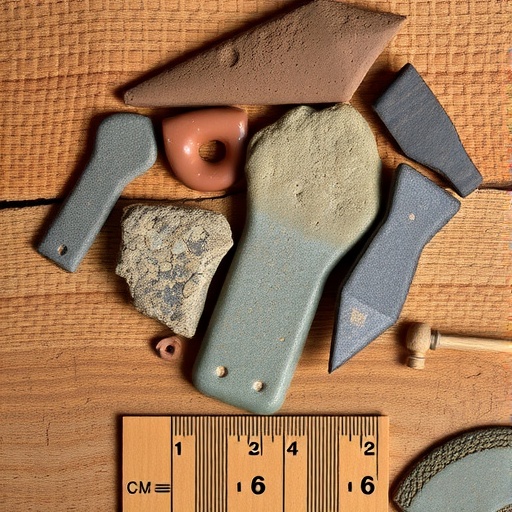
For most of the past century, one of northeastern Africa’s most enigmatic stone tools has kept its secret. The rhyolite gouge—an adze-like implement with a curved, chisel-like transverse cutting edge and a rounded back—appears abruptly in the archaeological record of central Sudan around 5000 BCE, spreads across dozens of sites along the Middle Nile, and then vanishes completely by about 3800 BCE. Since the first excavations, archaeologists have argued over what these tools were actually for: heavy woodworking implements for hollowing tree trunks into dugout canoes, or hoes dragged through moist floodplain soil by some of Africa’s earliest food producers. A new study, published in the African Archaeological Review, has settled the question the only rigorous way possible—by making the tools again from the same rock, using them in controlled tasks, and comparing the microscopic wear they accumulated with the traces preserved on the ancient originals. The verdict is unambiguous: the gouge was, above all, a woodworking tool.
The gouge is inseparable from the Khartoum Neolithic, the Early Neolithic culture of central Sudan dated between roughly 5000 and 3800 BCE, when the region’s first food-producing communities emerged during the closing phase of the African Humid Period. A. J. Arkell, who excavated the type sites of Khartoum and Shaheinab in the 1940s and 1950s, initially defined the culture through its signature implement, envisioning the tools mounted in handles and struck downward like adzes “for hollowing tree-trunks to make dug-out canoes”—a natural image for people who exploited the Nile intensively. Three decades later, the Norwegian archaeologist Randi Haaland proposed instead that the gouges served as hoes for tilling soil, an idea supported by the observation that sites richest in gouges also yielded the largest numbers of grinding stones. But when Anwar Magid examined 100 randomly selected pieces under the microscope in the late 1980s, he concluded they were woodworking tools after all. What every interpretation lacked was an experimental reference collection that could tie specific wear traces to a specific worked material—until now.
An international team led by Katarína Kapustka of the Institute of Archaeology of the Czech Academy of Sciences and Charles University’s Czech Institute of Egyptology, working with colleagues from the Poznań Archaeological Museum, the University of Khartoum and Charles University in Prague, set out to close that gap. Their approach pairs experimental archaeology—the replication of both the tool forms and the activities hypothesized for them—with use-wear, or traceological, analysis: the microscopic reading of the smoothing, abrasion, polish, gloss and striations that a stone acquires from the material it touches and the motion that drives it. The method descends from Semenov’s pioneering traceology, Keeley’s high-power microwear programme and the French chaîne opératoire tradition, which treats each artifact as the endpoint of a complete operational sequence running from raw-material procurement through manufacture, use, maintenance and discard. Crucially, the design controlled the single most consequential variable in wear formation: the raw material itself. Every known gouge from the central Sudanese Early Neolithic is made of rhyolite, predominantly the red variant—87 percent of the studied pieces—so the replicas were knapped from Sabaloka rhyolite, the same geological source as the archaeological artifacts.
The rock dictated the terms of the whole experiment. Sabaloka rhyolite is extremely hard—hard enough to make knapping difficult and polish formation slow, yet equally effective at preserving fine microscopic wear traces over millennia, which is precisely what traceological comparison requires. In the spring of 2017, the experienced flintknapper Pavel Zítka produced ten replicas following the sequence documented in the archaeological record: large flakes first detached by hard-hammer percussion, then shaped by soft-hammerstone percussion and direct blows with organic billets, with occasional pressure-flaking recognizable by its regular, parallel scars. The finished pieces matched the dimensions of fresh archaeological examples—typically 10 to 12 centimetres long, with collection-wide means of about 41 millimetres in width and 19.3 in thickness—and, like most ancient pieces, were left unpolished. That detail mattered, because microscopy indicates that the surface polish seen on many archaeological gouges was applied during reworking, when damaged or shortened pieces were ground down and resharpened, rather than during manufacture. No prehistoric handle has ever been found, so the team reconstructed hafting from the tools’ standardized backs and analogies with other transverse-edged implements.
The archaeological comparison rested on two of the best-researched Early Neolithic sites in central Sudan. Fox Hill, a granite outcrop on the west bank of the Nile some 70 kilometres north of Khartoum, preserves sixteen settlement platforms between 2 and 29 metres above the surrounding plain; explored since 2011 by the Charles University Sabaloka Expedition, it has yielded 321 gouges—the largest and most diversified assemblage in the region—spanning every stage of production barely a kilometre from the rhyolite source. Kadero, a low sand mound on the east bank of the Nile about 20 kilometres north-northeast of modern Khartoum, was excavated over 17 seasons between 1972 and 2003 and yielded 234 gouges alongside evidence of intensive cattle herding, hunting, fishing and a cemetery of some 250 graves whose richly furnished minority points to emerging social inequality. From these assemblages, 39 gouges—24 from Fox Hill and 15 from Kadero—were selected for microscopic analysis, deliberately chosen to cover complete and reworked pieces, polished and unpolished surfaces, and the full range of sizes.
Five of the largest replicas were then hafted onto wooden handles with their flat face against the wood and lashed with rawhide. Because political instability in Sudan prevented any field trial there, the experiments took place in Czechia, with substitutions chosen for maximum ecological similarity: black locust (Robinia pseudoacacia), a close relative of the unavailable acacias, stood in for Nile valley woodland, while the sandy terraces of the river Elbe served as the nearest analogue to the moist Nile floodplain. One tool cut and chopped wood; another loosened soil; a third chopped pork bone; and two were deliberately run through successive tasks—digging then woodwork, woodwork then digging—to test how later wear overwrites earlier traces. Each piece was examined before and after use under Olympus stereoscopic and metallographic microscopes at magnifications from 6.3x to 200x, and every replica survived its ordeal without serious damage, performing much like a light axe.
The resulting wear signatures proved sharply distinct. Soil digging produced the most conspicuous alteration of all: a matte, diffuse polish concentrated on the working edge and spreading across adjacent surfaces, fine striations, and—crucially—an absence of deep scratches or abrasions, the signature of soft, stone-free soil; the rawhide lashing and wooden handle added their own smoothing and polish where they rubbed against the stone. Woodworking generated a different record: localized, brighter polish confined largely to the transverse edge, minor micro-flaking and edge rounding, a glossy band of hafting wear across the central lower surface, and directional micro-striations when the edge was used to strip bark. Bone chopping left the faintest traces of all, mostly edge smoothing with occasional small chips that, paradoxically, kept the tool sharp while erasing the microscopic evidence. Most consequential were the multifunctional trials: when a single gouge moved between materials, the later traces dominated and largely masked the earlier polish—a lesson that would prove decisive for reading the ancient tools.
Measured against this experimental yardstick, the archaeological gouges told a strikingly consistent story. At Fox Hill, several complete, unpolished pieces displayed exactly the combination predicted for woodworking: hafting traces on the lower, flatter surface—sometimes accompanied by discoloration likely reflecting the handle—paired with polish and minor abrasion on the transverse edge characteristic of contact with wood. Reworked fragments bore wear on both their long transverse edges and their shorter sides, indicating that broken pieces were reshaped and returned to service, plausibly as chisels or wedges for splitting wood; one notched tool carried abrasion and polish closely resembling the wear of scraping leather. At Kadero, better-preserved specimens matched the same signature, although many predominantly surface-collected pieces had degraded too far for confident microscopic reading. What the assemblages conspicuously lacked was the diagnostic damage of bone work: the chipped, uneven edges with faint polish produced on pork bone in the experiments were essentially absent, effectively ruling out butchery and marrow processing as primary functions, while soil-related polish, though clearly present, remained everywhere subordinate to the dominant woodworking signal.
The study also revealed how the tools were engineered and managed across their working lives. Hafting traces on several Fox Hill gouges confirmed the reconstruction in which the flat face was set against the handle, and the standardized, rounded backs of many pieces imply handles into which a damaged bit could be replaced—a composite design that made each stone a renewable insert. Surface polish, long assumed to be a manufacturing step, emerged instead as a marker of maintenance and reuse: the proportion of polished pieces rises with distance from the raw-material source, and polished specimens tend to be shorter, indicating that worn or broken gouges were ground smooth, reshaped and kept in circulation as they travelled, or were traded, outward from Sabaloka. Broken and shortened pieces were further repurposed for different tasks—as chisels, wedges, even a leather scraper in one case—within what the researchers interpret as a specialized knapping tradition, its remarkable standardization pointing to skilled craftspeople who knew the peculiarities of hard rhyolite intimately.
The deepest insight, however, is ecological. The gouge flourished only during the Khartoum Neolithic, between roughly 5000 and 3800 BCE, within the closing phase of the African Humid Period—a time when central Sudan received more than 400 millimetres of rain a year, wooded savannah and gallery forest lined the Nile, and the fauna recovered at Shaheinab alone included 32 mammal species dominated by buffalo, giraffe and hippopotamus. In such a landscape, a heavy woodworking tool repaid its considerable manufacturing cost: for hollowing and splitting timber for canoes, huts and fences in a world where the Nile was the great highway. Equally telling is where gouges never appear—not in preceding hunter-gatherer assemblages, not in later post-Neolithic contexts, and not in the Neolithic of northern Sudan, where palaeoenvironmental records point to sparse tree cover and economies built on pastoralism, fishing and flake technology. The gouge, the authors conclude, was never merely a stylistic choice. It was a technological response to a greener Nile corridor—an implement whose rise and disappearance tracked the advance and retreat of the region’s trees, and whose surfaces still carry, in wear traces five millennia old, the microscopic memory of a vanished, greener world.
Cite Scienmag News
Courtney Benton. (August 30, 2026). Wear analysis reveals Neolithic Sudan stone tools dug wood and soil. Scienmag. https://scienmag.com/wear-analysis-reveals-neolithic-sudan-stone-tools-dug-wood-and-soil/
Courtney Benton. "Wear analysis reveals Neolithic Sudan stone tools dug wood and soil." Scienmag, 30 August 2026, https://scienmag.com/wear-analysis-reveals-neolithic-sudan-stone-tools-dug-wood-and-soil/. Accessed 30 August 2026.
Courtney Benton. "Wear analysis reveals Neolithic Sudan stone tools dug wood and soil." Scienmag. August 30, 2026. https://scienmag.com/wear-analysis-reveals-neolithic-sudan-stone-tools-dug-wood-and-soil/


