

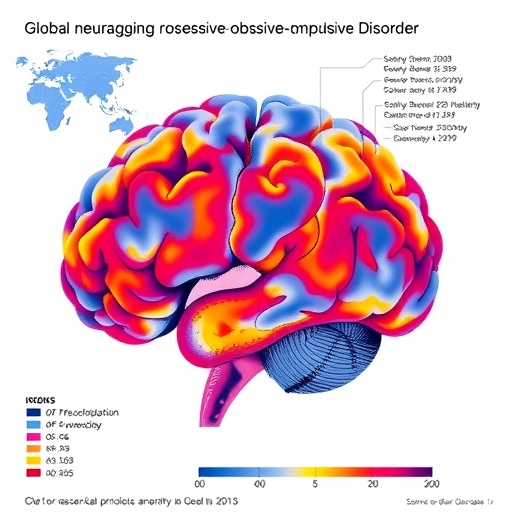
Few psychiatric conditions have been scanned, mapped, and modeled as persistently as obsessive-compulsive disorder, yet the field itself has never been charted with this level of detail. A sweeping new bibliometric analysis published in Annals of General Psychiatry has dissected 2,000 neuroimaging papers on OCD published between 2000 and 2024, tracing how a niche endeavor built on positron emission tomography scans of glucose metabolism grew into a data-intensive enterprise dominated by functional MRI, artificial intelligence, and worldwide brain-imaging consortia. The study, led by Cong Zhou and senior author Sen Li of Jining Medical University in China, portrays a discipline in vigorous expansion — one that has overturned its own theoretical models roughly every decade — but also one whose picture of the disordered brain is being drawn overwhelmingly by wealthy nations, raising uncomfortable questions about whose brains the science actually describes.
The research team mined the Web of Science Core Collection, running a structured query that paired every variant of “obsessive-compulsive disorder” with a battery of imaging terms spanning MRI, functional and structural MRI, diffusion tensor imaging, electroencephalography, event-related potentials, and positron emission tomography. The raw search returned 2,211 records, which the researchers filtered down to 2,000 English-language articles and reviews dated from January 1, 2000 to December 31, 2024. They then applied two widely used network-mapping programs: CiteSpace, developed by Chaomei Chen, which detects emerging trends, hotspots, and citation bursts, and VOSviewer, a Java-based tool created by Nees Jan van Eck and colleagues in 2010 that visualizes co-authorship, co-citation, and keyword co-occurrence networks. Author-supplied keywords were standardized to merge synonyms — “fMRI” and “functional magnetic resonance imaging,” for example — and only terms appearing at least 15 times across the corpus entered the final co-occurrence network, a threshold chosen empirically to keep the maps interpretable while preserving meaningful themes.
The output curves tell a story of relentless growth. Publication volume and citation frequency climbed in a fluctuating upward trajectory before peaking in 2021, when the field produced 155 papers that accumulated 8,457 citations in a single year. Although output dipped slightly after 2021, citation efficiency stayed remarkably high: in several years — 2015, 2017, and every year from 2021 through 2024 — the citation-to-publication ratio exceeded 50, indicating sustained high average impact per article. Crucially, the years of highest productivity, from 2019 to 2022, did not come at the cost of influence, since elevated citation ratios persisted throughout the expansion. To formalize the trajectory, the team fitted a sixth-order polynomial regression to the cumulative data, achieving a goodness-of-fit coefficient of R² = 0.9997 — an almost perfect fit suggesting the field remains in a phase of vigorous development and will keep attracting researchers for the foreseeable future.
Beneath the growth curve, the analysis documents a profound conceptual migration. In the early years, keywords like “glucose metabolic rates” and “symptom provocation” burned brightest, sustaining citation bursts from 2000 to 2013 — echoes of the PET studies from the late 1980s that first linked OCD to metabolic abnormalities in cortico-striatal pathways. “Cerebral blood flow” registered the single most intense burst in the dataset, with a burst strength of 24.31, followed by “glucose metabolic rates” at 21.08 and “positron emission tomography” at 20.82. Then the ground shifted. The arrival of functional MRI and diffusion tensor imaging moved the field from isolated regional measurements toward whole-network analyses of the cortico-striato-thalamo-cortical loops long implicated in the disorder. “fMRI” appeared as a keyword 230 times and “functional connectivity” 72 times, while a newer cluster of terms — “voxel-based morphometry,” “regional homogeneity,” and “resting-state fMRI” — garnered significant attention only in recent years, marking the current frontier from psychological and neuroscientific perspectives.
The most-cited papers recapitulate this intellectual evolution. At the top sits a 2002 study by van Veen and Carter, “The anterior cingulate as a conflict monitor: fMRI and ERP studies,” which used functional MRI and event-related potentials to cast the anterior cingulate cortex as the brain’s cognitive-conflict detector. Second, with 941 citations, is the 2015 JAMA Psychiatry meta-analysis by Goodkind and colleagues, which identified a common neurobiological substrate for mental illness: gray-matter reductions in the dorsal anterior cingulate cortex and bilateral insula shared across schizophrenia, bipolar disorder, depression, addiction, OCD, and anxiety. Third, with 874 citations, is Menzies and colleagues’ 2008 review revisiting the orbitofronto-striatal model of OCD — a paper whose citation burst strength of 55.56 was the highest in the entire 25-year record. Structural findings have since crystallized through the ENIGMA consortium’s mega-analyses: increased gray matter volume in the thalamus and striatum, reductions in the medial prefrontal and anterior cingulate cortex, and convergent multimodal abnormalities centered on the insula as a central node of pathophysiology.
But the atlas of OCD neuroimaging has a pronounced geographic tilt. The United States led all countries with 729 articles — 36.5 percent of global output — and 40,208 citations, far outpacing the United Kingdom’s 223 papers and 16,689 citations, Germany’s 237 papers, China’s 265 papers, and Canada’s 161. China’s rise is striking, as it now ranks second in volume, yet its institutions entered deep international collaboration only after 2015, hinting at persistent barriers in knowledge exchange. More troubling, low- and middle-income countries, where lifetime OCD prevalence of 2 to 3 percent matches that of richer nations, remain largely absent from the literature despite a comparable disease burden. Brazil stands out as an instructive exception: the University of São Paulo, though modest in output, achieved relatively high citation counts through strategic partnerships with North American and European laboratories. The authors warn that findings drawn almost exclusively from high-income populations may not generalize across the genetic, environmental, and sociocultural contexts that shape how the disorder manifests worldwide.
The analysis also maps the people and places steering the science. Jun Soo Kwon of Seoul National University in South Korea tops productivity with 52 papers, while Odile A. Van Den Heuvel of the Netherlands ranks second with 43 publications and the highest total link strength in the field — a score of 162 reflecting her extensive international collaborations. Author networks cluster tightly around institutions: a Seoul-centered group around Kwon, a Barcelona group around Carles Soriano-Mas, an Amsterdam cluster including Dick J. Veltman, a Harvard-Brown group anchored by Scott L. Rauch and Sabine Wilhelm, and a Michigan-centric cluster tied to the OCD Foundation Genetics Consortium. King’s College London leads institutional output with 70 papers, followed by Harvard University with 67 and Massachusetts General Hospital with 54, while Yale University — birthplace of the Yale-Brown Obsessive Compulsive Scale and early SSRI trials — holds 51 papers and 6,435 citations. Notably, the Chinese and South Korean institutional clusters remain geographically self-contained, collaborating mostly within their own borders.
Where the science is published matters as much as who produces it. Psychiatry Research-Neuroimaging led all journals with 82 OCD neuroimaging papers, trailed by Biological Psychiatry and Frontiers in Psychiatry with 58 each and the Journal of Affective Disorders with 55. Citation gravity, however, concentrated in the flagship psychiatry venues: Archives of General Psychiatry accumulated 5,523 citations, Biological Psychiatry 5,435, Neuroimage 4,827, and the American Journal of Psychiatry 4,236. The analysis exposes a visibility paradox — specialized outlets like the Journal of Obsessive-Compulsive and Related Disorders, with an impact factor of 1.9 and a Q3 quartile ranking, publish deeply focused OCD work yet struggle for attention, while broad-scope journals with impact factors reaching 15.1 absorb the field’s most-cited findings. A dual-map overlay of journal citations showed journals focusing on molecular biology and on psychology, education, and health citing psychology-and-social-science venues more heavily than molecular-biology-and-genetics journals, a signature of the field’s cross-disciplinary traffic, with journals like NEUROCOMPUTING emerging as bridges between artificial intelligence and clinical neuroscience.
Looking forward, the keyword and citation-burst data point to two converging frontiers. The first is neuromodulation: “deep brain stimulation” appeared 86 times, linked chiefly to clinical trials targeting the anterior limb of the internal capsule in treatment-resistant patients, including a randomized, double-blind, sham-controlled trial of stimulation at the bed nucleus of the stria terminalis. Yet a scoping review identified only 13 deep brain stimulation trials in pediatric populations — a glaring gap for a disorder that so often begins in childhood. The second frontier is transdiagnostic: rather than treating OCD as an isolated circuit dysfunction, researchers are mapping shared mechanisms such as cognitive inflexibility and aberrant threat processing across diagnostic boundaries, following evidence that frontoparietal control-network disruptions recur in attention-deficit/hyperactivity disorder and major depressive disorder alike, while salience-network abnormalities span multiple anxiety-related conditions. Machine learning is accelerating both trends — the ENIGMA OCD working group recently analyzed white-matter diffusion patterns across 1,653 individuals, and specific resting-state fMRI parameters have demonstrated predictive value for individual clinical outcomes.
The analysis ends on a cautionary note about reproducibility. Only 5 percent of the studies examined made raw imaging data available, and variability in fMRI preprocessing pipelines — particularly motion-correction strategies for resting-state scans — continues to complicate comparisons across laboratories. The authors argue that the path forward runs through open science: federated learning platforms that allow multi-site analysis without moving patient data, as the ENIGMA-OCD consortium already practices; standardized acquisition and analysis protocols endorsed by journals and professional organizations; mandatory data sharing through repositories like OpenNeuro; and deliberately designed consortia that include low- and middle-income sites from inception, drawing inspiration from initiatives like the NIH’s Fogarty International Center. Add longitudinal pediatric cohorts tracking neurodevelopment and generative AI models capable of simulating OCD circuitry and forecasting treatment response, the researchers say, and the field could finally deliver what 25 years of imaging has promised: biomarkers and therapies that work not just in Boston, London, or Seoul, but everywhere the disorder occurs.
Cite Scienmag News
Colin Clarke. (August 30, 2026). Global neuroimaging research trends in obsessive-compulsive disorder mapped over two decades. Scienmag. https://scienmag.com/global-neuroimaging-research-trends-in-obsessive-compulsive-disorder-mapped-over-two-decades/
Colin Clarke. "Global neuroimaging research trends in obsessive-compulsive disorder mapped over two decades." Scienmag, 30 August 2026, https://scienmag.com/global-neuroimaging-research-trends-in-obsessive-compulsive-disorder-mapped-over-two-decades/. Accessed 3 September 2026.
Colin Clarke. "Global neuroimaging research trends in obsessive-compulsive disorder mapped over two decades." Scienmag. August 30, 2026. https://scienmag.com/global-neuroimaging-research-trends-in-obsessive-compulsive-disorder-mapped-over-two-decades/


