


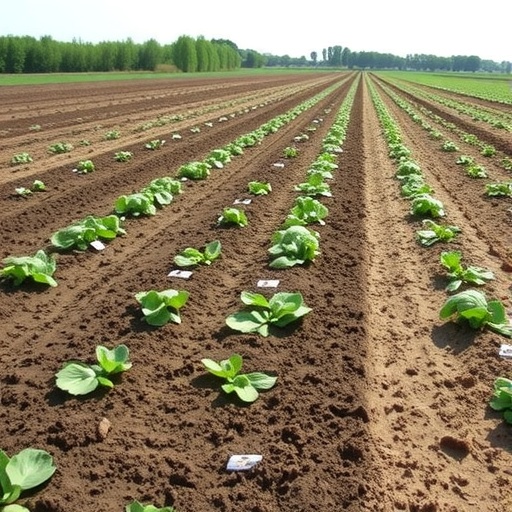
Beneath the world’s farmland lies one of agriculture’s strangest assets: an estimated 3.5 billion tons of phosphorus, quietly banked in soils after more than half a century of intensive fertilizer and manure use. Scientists call this accumulated reservoir legacy phosphorus, and its fate has become one of the most consequential questions in modern food and environmental science. Is it a dormant nutrient reserve that future crops could tap as mined phosphate rock dwindles, or a slow-motion pollutant destined to leak into rivers, lakes, and coastal waters for generations? A new study published in the journal Biogeochemistry tackles a deceptively simple question behind that debate: what chemical form does legacy phosphorus actually take in the ground, and how tightly does each soil type hold on to it? By dissecting soils from three dramatically different landscapes—acidic coastal plain fields in North Carolina, organic peat soils of the Florida Everglades, and alkaline calcareous ground in metropolitan Phoenix—a multi-university research team has shown that the answer depends almost entirely on the chemistry of the soil itself.
Phosphorus is the eleventh most abundant element in Earth’s crust, reaching roughly 1,050 milligrams per kilogram in crustal rocks and ranging from 35 to 5,300 milligrams per kilogram in mineral soils, yet it is frequently the nutrient that most limits crop growth. When phosphate binds to oxide and hydroxide minerals, it slips out of reach of plant roots, a problem that constrains productivity on more than 40 percent of the world’s arable land. To compensate, farmers have applied ever more of it: global applications of inorganic fertilizers, supplements, and organic residues roughly tripled between 1961 and 2013, according to data compiled by the International Fertilizer Industry Association and the Food and Agriculture Organization. The irony is that crops capture only an estimated 10 to 36 percent of applied phosphorus in the first growing season, leaving the remainder to accumulate year after year. Recent estimates now place the global store of legacy phosphorus in cropland and improved grassland at about 3.51 gigatons, building at a rate of roughly 10 million tons annually—a buried nutrient mountain with no natural exit strategy.
To understand what all that stored phosphorus actually looks like, a team led by first author Md. Anik Mahmud and corresponding author Jehangir H. Bhadha of the University of Florida, working with colleagues at Clemson University, the University of Arkansas, and North Carolina State University, collected 35 soil samples from 18 sites at two depths—0 to 15 and 15 to 30 centimeters—between July 2022 and March 2023. The acidic soils came from the Tidewater Research Station in Plymouth, North Carolina, where humus-rich Conaby-series Inceptisols formed from sandy and loamy marine sediments and where decades of manure-heavy tobacco cultivation pushed the state’s phosphorus loss index to 137, nearly triple the recommended critical value of 50. The organic soils came from the University of Florida’s Everglades Research and Education Center, where drained Pahokee-series Histosols containing more than 80 percent organic matter formed atop limestone bedrock after a century of conversion from flooded sawgrass prairie to sugarcane, rice, and vegetable fields. The calcareous soils came from rapidly urbanizing Phoenix, Arizona, where Maricopa-series alluvial soils carry calcium carbonate filaments and less than 1 percent organic matter. The research was funded by the National Science Foundation’s Science and Technologies for Phosphorus Sustainability Center.
The centerpiece of the analysis was a modified Hedley fractionation, a sequential chemical extraction scheme that pries phosphorus out of soil in order of increasing binding strength. First, 1.0 molar potassium chloride strips off the most soluble, plant-available pool. Next, 0.1 molar sodium hydroxide releases phosphorus chemisorbed onto iron and aluminum minerals such as goethite and gibbsite, and a parallel digestion of the same extract quantifies phosphorus locked into humic and fulvic acids, the workhorse molecules of soil organic matter. A 0.5 molar hydrochloric acid step then dissolves phosphorus associated with calcium and magnesium minerals, including compounds resembling brushite and beta-tricalcium phosphate. Finally, ignition at 550 degrees Celsius followed by digestion in 6 molar hydrochloric acid liberates the recalcitrant residual fraction—phosphorus entombed in lignin complexes and organomineral aggregates that resist everything short of brute-force chemistry. Alongside fractionation, the team measured pH, organic matter by ignition, total phosphorus, Mehlich-3 extractable phosphorus, and concentrations of aluminum, iron, calcium, and magnesium using inductively coupled plasma optical emission spectrometry, together with water-extractable phosphorus as a direct indicator of leak potential.
The results revealed three chemically distinct phosphorus worlds. In the acidic North Carolina soils, where pH measured below 5.8, humic and fulvic-bound phosphorus dominated, accounting for more than 42 percent of total phosphorus and reaching 60 percent at a swampy reference site. Mehlich-3 phosphorus, a standard agronomic index of plant-available phosphorus, spanned 7 to 62 percent of total phosphorus across sites, reflecting widely varied fertilizer histories. The authors attribute the dominance of organic-bound pools to humus-rich parent materials and long-term organic amendments: fulvic acids, with their abundant carboxyl groups and hydrophilic character, tend to harbor inorganic phosphate species, while the more hydrophobic humic acids preferentially retain organic phosphorus compounds. The practical implication is striking because phosphorus availability in these soils is strongly pH-sensitive. Raising pH through liming could unlock part of the legacy reserve for crops—but the same chemistry, if managed carelessly, could just as easily mobilize phosphorus toward drainage ditches and downstream waters.
The Everglades’ organic muck soils told a different story. Although their pH hovered in a favorable 5.4-to-6.7 window, their Mehlich-3 phosphorus represented a mere 1 to 8 percent of total phosphorus—among the lowest plant availability measured in the study. Instead, more than 62 percent of their phosphorus sat in the recalcitrant residual fraction, climbing to 70 to 81 percent at a virgin, never-farmed reference site. These soils, built from centuries of decomposed sawgrass biomass over limestone, are also unusually rich in iron, up to 14,158 milligrams per kilogram, and calcium, up to 39,491 milligrams per kilogram, both of which help immobilize phosphate. The residual pool is thought to consist largely of phosphomonoesters and diesters buried within well-decomposed peat. That composition makes these soils powerful long-term phosphorus sinks, but not invulnerable ones: high aerobic microbial activity, especially when coupled with organic fertilization regimes, can mineralize the residual fraction and release phosphorus back into circulation.
In Phoenix, the calcareous soils displayed the opposite architecture. With alkaline pH values between 7.6 and 8.6, low organic matter, and abundant calcium carbonate, they stored more than 69 percent of their phosphorus in calcium- and magnesium-bound forms, rising to 78 to 80 percent at an urban site with no agricultural history. Mehlich-3 phosphorus spanned 3 to 47 percent of total phosphorus, with the highest concentrations at a floodplain, a groundwater recharge zone, and a dairy cattle feedlot, where manure inputs left a visible fingerprint of soluble phosphorus reaching 7 percent of the total. At these elevated pH values, phosphate ions precipitate and bind with calcium and magnesium minerals, becoming essentially unavailable to plants. The flip side is that phosphorus in calcareous soils becomes mobile if the soil acidifies—a scenario that acidifying fertilizers, industrial emissions, or certain urban soil amendments could gradually create.
Because phosphorus fractions alone cannot predict how much phosphorus a soil will actually release into water, the team also calculated phosphorus saturation ratios, a metric originally developed for acidic soils. They extracted phosphorus, aluminum, iron, calcium, and magnesium with 1 molar hydrochloric acid, then computed two molar ratios: phosphorus against aluminum plus iron, and phosphorus against calcium plus magnesium. By relating each ratio to water-extractable phosphorus through segmented regression, they estimated thresholds beyond which phosphorus release accelerates. In the acidic soils, the two thresholds landed almost on top of each other—roughly 0.46 for the aluminum-iron ratio and 0.51 for the calcium-magnesium ratio—indicating that both mineral groups contribute about equally to phosphorus retention there. In the organic and calcareous soils, however, the calcium-magnesium thresholds were dramatically lower, at roughly 0.01 and 0.09, signaling that calcium and magnesium minerals do far more of the retention work, while aluminum- and iron-based sorption sites in the calcareous soils were already approaching half saturation. The authors stress that small sample sizes make these breakpoints exploratory rather than definitive, but the pattern carries a clear message: the minerals guarding legacy phosphorus differ fundamentally by soil type.
Principal component analysis reinforced that conclusion at the scale of the full dataset. At both sampled depths, the first two principal components captured 62 and 64 percent of the variance, and soil type emerged as the dominant driver of sample separation. The first axis aligned with total phosphorus, calcium-magnesium phosphorus, Mehlich-3 phosphorus, and iron-aluminum phosphorus, while the second axis tracked organic matter, calcium, magnesium, and residual phosphorus, cleanly isolating the Everglades’ organic soils from everything else. The calcareous samples scattered broadly rather than clustering, a reflection of their patchwork of urban, agricultural, floodplain, and desert land uses. In short, geochemical setting—not management alone—orchestrates where phosphorus sits in the landscape and how easily it moves.
The study’s implications reach well beyond the three sampling regions. As high-grade phosphate rock reserves tighten worldwide, legacy phosphorus is increasingly viewed as a secondary resource that could soften future fertilizer demand—but only if farmers and soil managers know which chemical pool to target and how to release it safely. The new findings point toward soil-specific strategies: raising pH in acidic soils to free humic-bound phosphorus, encouraging controlled microbial mineralization in organic soils, and guarding against acidification in calcareous ones. At the same time, the phosphorus saturation ratios offer water-quality regulators a screening tool for flagging soils that are nearing their leak point before algal blooms appear downstream. The authors caution that larger sample sizes are needed to firm up the threshold values, but the conceptual advance stands. Legacy phosphorus is not a single, uniform stockpile; it is a family of chemically distinct reservoirs, each with its own lock, key, and leak risk. Learning to read those locks may prove one of the cheapest ways to feed a growing population while keeping the world’s waters clean.
Cite Scienmag News
Violet Maxwell. (August 30, 2026). Legacy Phosphorus Risks Assessed Across Acidic, Organic, and Calcareous Soils. Scienmag. https://scienmag.com/legacy-phosphorus-risks-assessed-across-acidic-organic-and-calcareous-soils/
Violet Maxwell. "Legacy Phosphorus Risks Assessed Across Acidic, Organic, and Calcareous Soils." Scienmag, 30 August 2026, https://scienmag.com/legacy-phosphorus-risks-assessed-across-acidic-organic-and-calcareous-soils/. Accessed 30 August 2026.
Violet Maxwell. "Legacy Phosphorus Risks Assessed Across Acidic, Organic, and Calcareous Soils." Scienmag. August 30, 2026. https://scienmag.com/legacy-phosphorus-risks-assessed-across-acidic-organic-and-calcareous-soils/


