


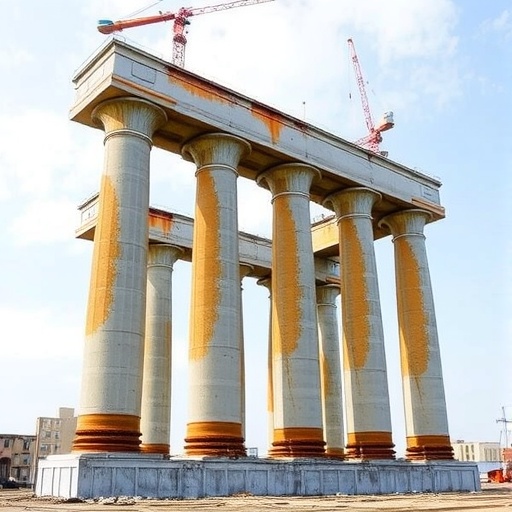
Rust rarely makes headlines, yet inside thousands of reinforced concrete buildings exposed to sea air, de-icing salts, and industrial pollution, it is quietly rewriting the odds of earthquake catastrophe. A newly published study in the Bulletin of Earthquake Engineering puts hard, probability-based numbers on that hidden threat. A team of structural engineers at Xi’an University of Architecture and Technology, working with the China Northwest Architectural Design and Research Institute, has assembled one of the most comprehensive statistical portraits to date of how corrosion degrades the earthquake resistance of a particularly vulnerable class of structural element: the intermediate short reinforced concrete column. Their conclusion is stark. As steel reinforcement corrodes, the amount of shaking-induced deformation needed to push these columns into severe damage and near-collapse steadily falls, meaning buildings that look intact from the street may no longer survive earthquakes they were once expected to withstand. For the engineers who certify aging buildings and the insurers who price their risk, the findings turn a slow chemical process into a measurable seismic variable.
The danger lies at the collision point of two slow processes that rarely share a headline: material aging and seismic hazard. Reinforced concrete structures are expected to serve for decades, but in chloride-rich environments—coastal districts, regions that spread de-icing salts on winter roads, cities whose industrial emissions acidify rainfall—chloride ions and acidic species penetrate the concrete cover and eventually destroy the passive film that normally protects embedded steel. Once corrosion initiates, the cross-sections of reinforcing bars thin, often unevenly along their length; the surrounding concrete cracks and spalls as rust products expand; the bond between steel and concrete weakens; and corroded stirrups progressively lose their ability to confine the concrete core. Each mechanism chips away at a column’s strength and deformation capacity long before any earthquake arrives. Yet conventional seismic assessment tools were largely calibrated on pristine laboratory specimens, leaving engineers who evaluate an aging building with little quantitative guidance on how much worse its columns will actually perform when the ground shakes. The new study was designed to close precisely that gap, converting corrosion from a vague caveat into a calibrated variable inside the equations of seismic risk.
To build that guidance, Song Yang, Shansuo Zheng, Liguo Liu, Liguo Dong, Yongming Li, and Yong Xiao compiled a comprehensive database of 156 quasi-static test results for corroded intermediate short reinforced concrete column specimens, drawn from 22 separate test campaigns. Quasi-static testing, the workhorse of laboratory seismic research, drives a column through repeated, reversing cycles of lateral displacement or load applied slowly enough that dynamic effects do not obscure the measurements; the resulting load–deformation loops capture stiffness degradation, strength decay, pinching of the hysteresis curves, and the ultimate displacement at which the specimen can no longer sustain load. Because corrosion in these experiments is deliberately accelerated under controlled conditions, every specimen can be assigned a corrosion level, and the team sorted the entire database into four groups: no corrosion (NC), light corrosion (LC), moderate corrosion (MC), and severe corrosion (SC). Aggregating results across dozens of independent campaigns has a further advantage: it folds the variability of different laboratories, specimen details, and loading protocols into the statistics, so the resulting fragility functions carry a realistic measure of uncertainty rather than the tidy optimism of a single test series. With corrosion severity treated as an explicit experimental variable, the stage was set for the statistical core of the study.
Intermediate short columns occupy an especially unforgiving corner of that database. Characterized by a shear span-to-depth ratio that falls between stocky short columns, which tend to fail abruptly in brittle shear, and slender columns governed by ductile flexural bending, intermediate short columns exhibit a hybrid flexure–shear response. Under cyclic loading they may crack and yield in flexure first, but their limited deformation capacity keeps sudden shear failure—wide diagonal cracking, crushing of the concrete web, and in the worst cases abrupt loss of lateral load-carrying capacity—permanently in play. Such members are widespread in older reinforced concrete frame buildings and in bridge substructures, particularly from construction eras predating modern ductility detailing requirements. Their brittleness offers little warning before damage turns severe, and corrosion makes the picture worse by stripping material from both longitudinal bars and transverse reinforcement, weakening the very mechanisms that resist diagonal tension and confine the concrete. Quantifying how rust erodes the safety margin of these members is therefore central to any credible life-safety evaluation of an aging structure, and it is exactly the quantity the fragility framework is built to express.
The team’s central contribution is a set of drift-based fragility functions calibrated separately for each corrosion level. In performance-based earthquake engineering, a fragility function expresses the conditional probability that a component will reach or exceed a defined damage state given the value of an engineering demand parameter—in this study, the drift ratio, which normalizes a column’s lateral displacement by its length. Drift is the natural currency for this purpose: it is directly measured in every quasi-static test, it correlates closely with observable cracking and crushing, and it appears explicitly in code-based deformation limits. Mathematically, each fragility function takes the form of a lognormal cumulative distribution curve defined by two parameters: the median, the drift level at which the probability of exceeding the damage state equals fifty percent, and the logarithmic standard deviation, which captures how widely the damage thresholds scatter across specimens. By pooling the experimental drift data associated with each corrosion group and each damage state, the researchers fitted these two parameters for every combination, producing a family of curves that expresses, in explicit probabilistic terms, how the vulnerability of an intermediate short column migrates as corrosion advances from negligible to severe.
Before any conclusions could rest on those curves, their statistical shape had to be verified. The team applied the Lilliefors test, a goodness-of-fit procedure related to the classical Kolmogorov–Smirnov test but modified for the common situation in which the parameters of the hypothesized distribution are estimated from the same sample being tested. Across all corrosion levels and all four damage states, the test indicated that the assumption of a lognormal distribution was valid at the five percent significance level. That validation matters more than it might first appear: every downstream calculation—probabilistic damage estimates, expected losses, retrofit cost–benefit comparisons—inherits whatever distributional assumption feeds it, so an unjustified lognormal assumption would silently corrupt every number computed from the fragility curves. With the Lilliefors results in hand, the researchers could treat the fitted medians and dispersions as statistically defensible descriptors of real experimental behavior rather than convenient mathematical fictions.
The trends that emerged are consequential. Across every damage state, the median values of the fragility functions gradually decrease as the level of corrosion increases—in plain language, corroded columns reach each damage threshold at smaller deformations than their uncorroded counterparts. The decrease is particularly pronounced for the severe damage state, designated DS3, and the near-collapse state, DS4. In probabilistic terms, the chance of an intermediate short column reaching each of the four damage states climbs steadily with corrosion level. Corrosion thus compresses the safety margin exactly where it matters most: the deformation interval separating repairable injury from outright structural failure narrows as rust deepens, leaving a corroded column less room to deform gracefully before it crosses into the near-collapse regime. Intriguingly, the logarithmic standard deviation showed no clear pattern of change as corrosion increased, indicating that the scatter of experimental outcomes remains broadly similar even as the central thresholds shift downward. Read together, the two results suggest that corrosion primarily translates the vulnerability curves toward lower drift values rather than reshaping their inherent uncertainty—a translation large enough to change damage predictions and the decisions built on them.
The analysis rested on four carefully defined damage states for intermediate short columns, each paired with a corresponding repair strategy, mirroring the ladder of post-earthquake decision-making that guides inspectors after major earthquakes: damage manageable with minor or cosmetic intervention; damage requiring structural repair; severe damage demanding major strengthening or partial replacement; and near-collapse damage that renders continued occupancy unsafe. Because corrosion lowers the drift thresholds of the upper rungs of that ladder, a corroded building is statistically more likely to leap from a quickly repairable condition into one that demands costly, time-consuming structural work—or into the category where shoring, evacuation, and demolition dominate the conversation. For emergency planners, that shift changes the expected balance between buildings that can be patched and rapidly returned to service and buildings that must be closed for the foreseeable future. For owners and insurers, it changes the expected price tag attached to any given earthquake scenario.
The practical upshot, the authors emphasize, is that neglecting reinforcement corrosion can significantly distort the results of seismic damage assessments for columns in service. A performance-based evaluation that treats a decades-old coastal building as though its reinforcement were pristine will underestimate the probability of severe and near-collapse damage under design-level shaking, and the loss estimates built on that evaluation—repair costs, downtime, casualty projections—inherit the optimism. The newly derived fragility functions offer a direct corrective: they can be embedded in seismic performance assessment frameworks and post-seismic loss calculations for in-service reinforced concrete buildings located in corrosive environments, allowing analysts to condition expected damage on the structure’s actual corrosion state rather than on an idealized as-built assumption. Component-level curves of this kind are the basic currency of modern performance-based methodology, which assembles building-level risk from the fragilities of individual members; supplying corrosion-stratified curves for one of the most brittle and failure-prone member types fills a conspicuous gap in that toolbox.
The research, financed by the National Natural Science Foundation of China under grant 52278530 and by a Key Research and Development project of Shaanxi Province, arrives as cities worldwide confront aging concrete infrastructure in ever more corrosive settings. Expanding coastal development, heavier reliance on de-icing salts, and industrial emissions that acidify rain all accelerate the electrochemical attack on embedded steel, while much of the most exposed building stock was designed under seismic codes far less demanding than those in force today. The study’s deeper message is that earthquake risk is not a fixed property stamped onto a building on completion day; it evolves year by year as corrosion advances through the reinforcement, and the tools used to judge safety must evolve alongside it. For engineers charged with screening aging structures, the drift-based fragility curves stratified by corrosion severity provide a practical instrument for deciding which columns merit detailed inspection, strengthening, or replacement before the next earthquake tests the comfortable assumption that time has left them untouched.
Cite Scienmag News
Violet Maxwell. (August 30, 2026). Corrosion raises collapse risk for short reinforced concrete columns, models show. Scienmag. https://scienmag.com/corrosion-raises-collapse-risk-for-short-reinforced-concrete-columns-models-show/
Violet Maxwell. "Corrosion raises collapse risk for short reinforced concrete columns, models show." Scienmag, 30 August 2026, https://scienmag.com/corrosion-raises-collapse-risk-for-short-reinforced-concrete-columns-models-show/. Accessed 3 September 2026.
Violet Maxwell. "Corrosion raises collapse risk for short reinforced concrete columns, models show." Scienmag. August 30, 2026. https://scienmag.com/corrosion-raises-collapse-risk-for-short-reinforced-concrete-columns-models-show/


