


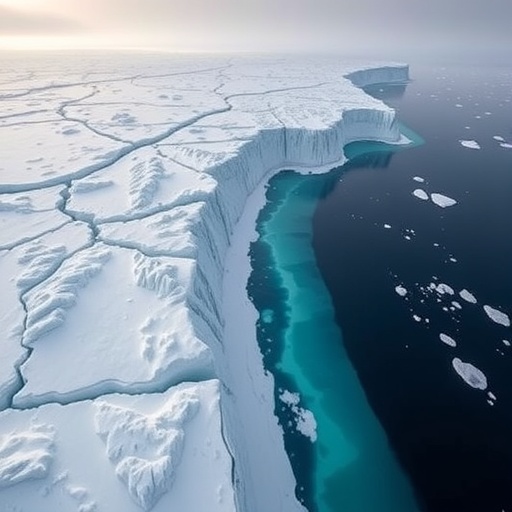
A narrow transition zone where a glacier meets the ocean in South Greenland has been identified as a “biological hotspot” in a study published in Communications Earth & Environment. The research, titled “Biological hotspot at a glacier ocean boundary in South Greenland,” draws attention to one of the most physically dynamic environments on Earth: the place where land ice, seawater, meltwater, sediment and living organisms collide. Although the available research record provides no detailed account of the study’s sampling methods or measured species, its central finding, expressed in the title, points to an ecological concentration at a boundary that is often treated primarily as a landscape of melting ice. That shift in emphasis matters. Glaciers are not only indicators of climate change; at their marine margins, they can help create unusual chemical and physical conditions that influence the productivity and distribution of life.
A glacier–ocean boundary is far more complex than a simple shoreline. Ice descending into the sea can melt at its surface, along its submerged face or at its base, where relatively warm seawater may circulate beneath the glacier. The resulting freshwater is less dense than seawater and tends to rise, creating buoyant plumes that can entrain nutrients and suspended particles from deeper layers. At the same time, the movement of ice and water can stir the surrounding environment, while sediments carried from beneath the glacier alter the chemistry and clarity of the water. These processes produce steep gradients over short distances. Temperature, salinity, pressure, turbidity, oxygen concentration and nutrient availability may change dramatically within meters. Such gradients can form ecological niches, allowing organisms with very different requirements to occupy neighboring parts of the same boundary.
The phrase “biological hotspot” generally refers to a location where biological activity, abundance or diversity is unusually high relative to nearby environments. In the South Greenland setting described by the study’s title, that activity could be linked to the circulation generated by submarine meltwater. When freshwater rises from beneath or beside a glacier, it can draw deeper seawater upward. Deep water often contains dissolved nutrients, including nitrogen, phosphorus and trace elements, that have accumulated as organic matter decomposes and sinks. If those nutrients reach the sunlit surface, microscopic algae called phytoplankton can use them for photosynthesis. Phytoplankton convert carbon dioxide into organic matter and form the base of marine food webs, supporting organisms ranging from tiny grazers to fish, seabirds and marine mammals. The physical mechanism is well established in glacial fjords, but the strength and ecological importance of the effect can vary widely between locations and seasons.
South Greenland is particularly important for studying these interactions because its coastline contains numerous fjords connected to the Greenland Ice Sheet. Fjords are long, narrow inlets carved by glaciers and later flooded by the sea. Their enclosed geometry can retain freshwater, sediments and organic material, while also allowing exchange with the wider ocean. Some fjords contain layered water masses: a fresher surface layer, a denser marine layer below and intermediate waters whose movement depends on tides, winds and the shape of the seafloor. A glacier at the head of such a fjord can act as a powerful local engine, driving circulation through meltwater discharge. Yet no two fjords behave identically. The depth of the basin, the presence of a sill at its mouth, the amount of meltwater and the temperature of incoming seawater can determine whether nutrients are concentrated near the ice or dispersed through the fjord.
The ecological consequences of these processes begin with microbes. Phytoplankton respond rapidly to changes in light and nutrient supply, sometimes forming dense blooms when conditions align. Their growth can be measured through chlorophyll concentrations, oxygen production, carbon uptake or changes in the composition of microscopic communities. Bacteria then consume some of the organic compounds released by phytoplankton, recycling nutrients through what scientists call the microbial loop. Small grazers, including zooplankton, feed on the resulting biomass, transferring energy to larger animals. At the same time, glacial sediments can provide surfaces for microbial communities and can carry iron and other elements that influence productivity. The boundary may therefore function not simply as a place with more organisms, but as a zone where physical transport and biological transformation are tightly coupled.
The discovery is also significant because glacier margins are changing rapidly. As the climate warms, many Greenland glaciers are retreating, thinning or discharging more meltwater, although the response of an individual glacier can depend on ocean temperature, bedrock geometry, snowfall and ice dynamics. Retreat does not automatically mean that biological productivity will rise. Increased freshwater can enhance nutrient delivery in some circumstances, but it can also strengthen surface stratification, separating sunlit water from nutrient-rich depths. Heavy sediment loads may reduce light penetration and inhibit phytoplankton growth. A retreating glacier can also remove the physical source of upwelling that once sustained a local hotspot, while exposing newly flooded seabed that may later be colonized by different communities. The ecological response is therefore likely to be highly sensitive to timing and location.
A biological concentration at a glacier–ocean boundary could also influence how carbon moves through the coastal system. When phytoplankton grow, they remove carbon dioxide from surface water and incorporate carbon into organic molecules. Some of that material is consumed near the surface, while some sinks as particles into deeper water or becomes trapped in sediments. This process, known as the biological carbon pump, can transfer carbon away from the atmosphere for varying periods. However, the net climate effect of a glacial fjord cannot be inferred from the existence of a hotspot alone. Carbon may be released from sediments, transported in meltwater or returned to the atmosphere through respiration. Determining whether the system is a net sink or source requires direct measurements of carbon chemistry, biological production, respiration and export—information not included in the supplied record of the South Greenland study.
The result also highlights why boundaries are increasingly central to marine science. Ecosystems are often mapped as broad regions—open ocean, coastal shelf, fjord or glacier—but the most intense interactions can occur at their edges. At a glacier front, energy from tides, meltwater buoyancy, ice movement and ocean currents is compressed into a small area. Organisms that would rarely encounter one another elsewhere may be brought together by circulation, while steep environmental gradients create opportunities for specialized communities. For researchers, such locations are difficult to study: ice can obstruct vessels, weather can change quickly, visibility may be poor and instruments must operate in cold, sediment-laden water. Yet the very difficulty of reaching these sites has left major gaps in knowledge about how life responds to the rapid transformation of Greenland’s marine margins.
The South Greenland finding therefore carries a message larger than the boundary itself. It suggests that the ecological importance of a glacier should not be judged only by its rate of retreat or its contribution to sea-level rise. The submerged edge may be an active biological interface, capable of concentrating nutrients, organisms and chemical reactions in ways that influence an entire fjord. The study’s title establishes that such a hotspot exists, but the supplied information does not specify its organisms, productivity, spatial extent, seasonality or sensitivity to future change. Those details will determine whether the site represents a widespread feature of Greenland’s glacier fjords or an unusual local phenomenon. Either way, the research directs attention to a hidden dimension of a warming Arctic: as ice meets ocean, the boundary is not empty. It is a living system, and its future may change as quickly as the glacier above it.
Cite Scienmag News
Eleanor C. (August 28, 2026). Scientists discover biological hotspot where Greenland glacier meets the ocean. Scienmag. https://scienmag.com/scientists-discover-biological-hotspot-where-greenland-glacier-meets-the-ocean/
Eleanor C. "Scientists discover biological hotspot where Greenland glacier meets the ocean." Scienmag, 28 August 2026, https://scienmag.com/scientists-discover-biological-hotspot-where-greenland-glacier-meets-the-ocean/. Accessed 28 August 2026.
Eleanor C. "Scientists discover biological hotspot where Greenland glacier meets the ocean." Scienmag. August 28, 2026. https://scienmag.com/scientists-discover-biological-hotspot-where-greenland-glacier-meets-the-ocean/


