

Friday, February 6, 2026
Science
No Result
View All Result
  • Login
  • HOME
  • SCIENCE NEWS
  • CONTACT US
  • HOME
  • SCIENCE NEWS
  • CONTACT US
No Result
View All Result
Scienmag
No Result
View All Result
Home Science News Climate

Habitat connectivity drives panda recovery: Study

August 22, 2024
in Climate
Reading Time: 2 mins read
0
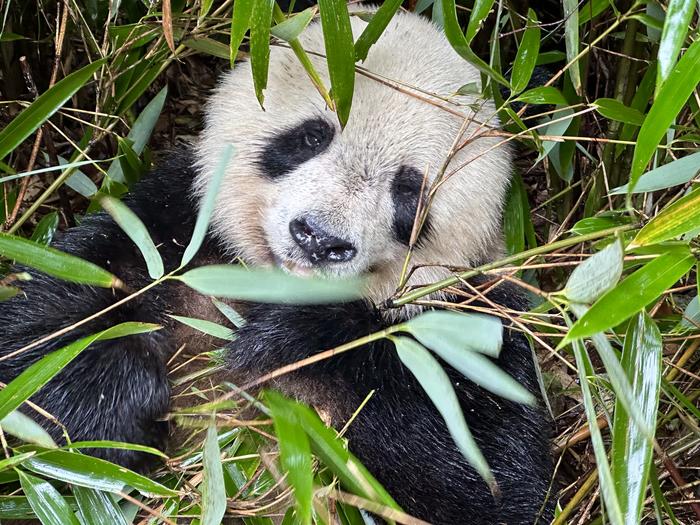
A giant panda in Shaanxi Foping National Nature Reserve eating bamboo shoots
67
SHARES
605
VIEWS
Share on FacebookShare on Twitter
ADVERTISEMENT

In a study published in Current Biology on Aug. 9, a research team led by Prof. WEI Fuwen from Jiangxi Agricultural University and the Institute of Zoology of the Chinese Academy of Sciences has revealed the importance of habitat connectivity in recovery of the giant panda (Ailuropoda melanoleuca).

A giant panda in Shaanxi Foping National Nature Reserve eating bamboo shoots

Credit: Photo by HUANG Kai

In a study published in Current Biology on Aug. 9, a research team led by Prof. WEI Fuwen from Jiangxi Agricultural University and the Institute of Zoology of the Chinese Academy of Sciences has revealed the importance of habitat connectivity in recovery of the giant panda (Ailuropoda melanoleuca).

Specifically, the study showed that conservation efforts have helped improve landscape connectivity and subsequently gene flow.

“If these processes can be sustained and improved, the panda’s path to recovery will be less encumbered by loss of genetic diversity, fostering hope that the present rate of recovery will not be stalled,” said Prof. WEI, corresponding author of the study.

In 2016, the giant panda reached a milestone rarely achieved in species conservation, i.e., downlisting by the IUCN from Endangered to Vulnerable. However, studies of ecological and population genetics mechanisms underlying population trends and conservation strategies have been lacking—making it difficult to develop next-phase conservation strategies for panda recovery.

To address this lack of information, Prof. WEI Fuwen’s team used data from China’s 3rd and 4th Giant Panda National Surveys along with DNA sampling data to better understand issues related to giant panda conservation. Their work revealed that China’s effort to mitigate anthropogenic disturbances by improving habitat quality and reducing habitat fragmentation was associated with increased panda population density.

Furthermore, the research showed that enhanced landscape connectivity overall reduced inbreeding via improved gene flow even though inbreeding increased temporarily due to high local panda density.

Findings from this study will help guide future giant panda conservation management. Specifically, it will show how a detailed examination of genetic processes can contribute to more effective strategies for recovering endangered species.


Journal

Current Biology

DOI

10.1016/j.cub.2024.07.037

Article Title

Habitat connectivity drives panda recovery

Article Publication Date

9-Aug-2024

Share27Tweet17
Previous Post

Fighting coastal erosion with electricity

Next Post

Will EEG be able to read your dreams? The future of the brain activity measure as it marks 100 years

Related Posts

blank
Climate

Growing Indo-Pacific Freshwater Shift in South Indian Ocean

February 3, 2026
blank
Climate

Warming Accelerates Leaf-Onset in Boreal Broadleaf Forests

February 2, 2026
blank
Climate

Biodiversity Risks of Land-Heavy Carbon Removal

January 30, 2026
blank
Climate

Ocean Front Trends Affect CO2 Flux, Chlorophyll Levels

January 22, 2026
blank
Climate

More Deciduous Trees Cut Boreal Wildfire Emissions

January 15, 2026
blank
Climate

Ocean impacts nearly double carbon’s social cost

January 15, 2026
Next Post
EEG predictions table.

Will EEG be able to read your dreams? The future of the brain activity measure as it marks 100 years

  • Mothers who receive childcare support from maternal grandparents show more parental warmth, finds NTU Singapore study

    Mothers who receive childcare support from maternal grandparents show more parental warmth, finds NTU Singapore study

    27610 shares
    Share 11040 Tweet 6900
  • University of Seville Breaks 120-Year-Old Mystery, Revises a Key Einstein Concept

    1017 shares
    Share 407 Tweet 254
  • Bee body mass, pathogens and local climate influence heat tolerance

    662 shares
    Share 265 Tweet 166
  • Researchers record first-ever images and data of a shark experiencing a boat strike

    529 shares
    Share 212 Tweet 132
  • Groundbreaking Clinical Trial Reveals Lubiprostone Enhances Kidney Function

    515 shares
    Share 206 Tweet 129
Science

Embark on a thrilling journey of discovery with Scienmag.com—your ultimate source for cutting-edge breakthroughs. Immerse yourself in a world where curiosity knows no limits and tomorrow’s possibilities become today’s reality!

RECENT NEWS

  • Nanophotonic Two-Color Solitons Enable Two-Cycle Pulses
  • Cannabidiol’s Sex- and Dose-Dependent Impact on Cocaine Use
  • Winter Teleconnection Shifts Explain Ice Age Oxygen Signals
  • Microbiota-Derived IPA Boosts Intestinal Ketogenesis, Healing

Categories

  • Agriculture
  • Anthropology
  • Archaeology
  • Athmospheric
  • Biology
  • Biotechnology
  • Blog
  • Bussines
  • Cancer
  • Chemistry
  • Climate
  • Earth Science
  • Editorial Policy
  • Marine
  • Mathematics
  • Medicine
  • Pediatry
  • Policy
  • Psychology & Psychiatry
  • Science Education
  • Social Science
  • Space
  • Technology and Engineering

Subscribe to Blog via Email

Enter your email address to subscribe to this blog and receive notifications of new posts by email.

Join 5,190 other subscribers

© 2025 Scienmag - Science Magazine

Welcome Back!

Login to your account below

Forgotten Password?

Retrieve your password

Please enter your username or email address to reset your password.

Log In
No Result
View All Result
  • HOME
  • SCIENCE NEWS
  • CONTACT US

© 2025 Scienmag - Science Magazine

Discover more from Science

Subscribe now to keep reading and get access to the full archive.

Continue reading
