


One hundred years after the human brain’s electrical activity was first recorded, experts are celebrating the legacy of its discovery and sharing their predictions and priorities for its future.

Credit: One hundred years of EEG for brain and behaviour research, Nature Human Behaviour
One hundred years after the human brain’s electrical activity was first recorded, experts are celebrating the legacy of its discovery and sharing their predictions and priorities for its future.
Since the first recording in July 1924, human electroencephalography (EEG) has been integral to our understanding of brain function and dysfunction: most significantly in the clinical diagnosis of epilepsy, where the analysis of the EEG signal meant that a condition previously seen as a personality disorder was quickly redefined as a disorder of brain activity.
Now, a century on, more than 500 experts from around the globe, have been asked to reflect on the impact of this groundbreaking methodology, as well as on the challenges and priorities for the future.
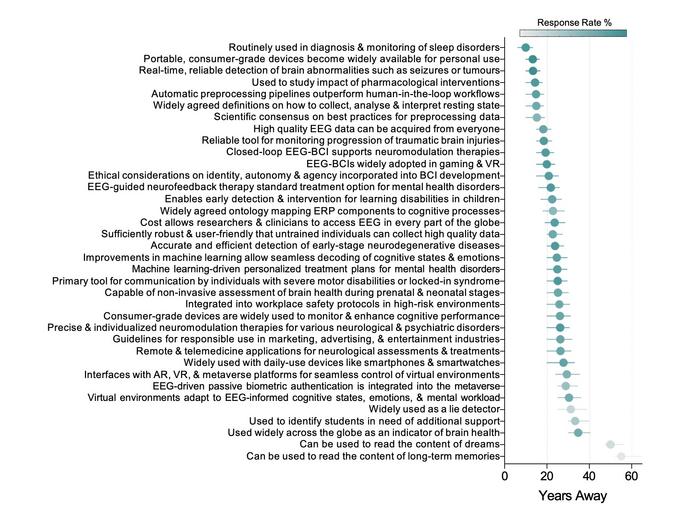
A survey, led by University of Leeds academics, saw respondents – with 6,685 years of collective experience – presented with possible future developments for EEG, ranging from those deemed ‘critical to progress’ to the ‘highly improbable,’ and asked to estimate how long it might be before they were achieved. The results are published today (22 August 2024) in the journal Nature Human Behaviour.
Futuristic innovations
The list features an array of fascinating, futuristic innovations that experts believe could be achieved within a generation. This includes using EEG to enhance cognitive performance; early detection of learning disabilities; widespread use as a lie detector; and use as a primary communication tool for those with severe motor disabilities and locked-in syndrome.
Real-time, reliable diagnosis of brain abnormalities such as seizures or tumours is believed to be just 10-14 years away, while the probability of reading the content of dreams and long-term memories is judged to be more than 50 years away by some experts, but dismissed by many as closer to science fiction than reality.
It may be surprising to many that, according to the survey published today (22 August) in the journal Nature Human Behaviour, within a generation we could all be carrying around our own, personal, portable, EEG.
The paper’s co-author, Dominik Welke, Research Fellow at the University of Leeds, said: “They could really become something like a smartphone: where almost everybody has access to them and can use them daily – ideally improving their life by providing meaningful insight into physiological factors.”
He added: “One such positive, potential future use of EEG technology could be vigilance control for drivers or pilots. These work-safety systems could assist the user in identifying if they were falling asleep, then wake them up or tell the co-pilot they need to take over.”
The hardware involved in recording EEG is relatively basic, remaining unchanged – in principle – since it was first used by psychiatrist Hans Berger, in Germany, on July 6, 1924. What has drastically changed since then is the analysis of – and what we can do with – the now digitally-recorded data.
Consisting of just electrodes and an amplifier, EEG systems are becoming increasingly cheap to produce, as well as more portable and user-friendly. Coupled with its non-invasive nature, there is little to prevent it from becoming more accessible to a wider audience.
Reducing health inequalities
While the prospect of EEG technology being widely used in gaming and VR – predicted to be only around 20 years away – will thrill gamers, the truly exciting possibility for scientists and clinicians is that this increasing accessibility will allow them to engage with communities traditionally excluded from EEG research, crucially, in low-income countries that cannot afford more complex imaging technology.
Advances in AI-driven automation are also expected to improve and speed up analysis of complicated data.
Dr Welke said: “Looking ahead to the future: from the hardware side, it’s comparatively cheap and easy to produce, and from the analysis and software side, with these new computing technologies, all the puzzle pieces are there to really roll out EEG to a very large user base.
“As opposed to other methods out there – such as MRI, or implanted devices – EEG has the potential to make neuroimaging available to all the people in the world.”
The paper’s lead author, Faisal Mushtaq, Professor of Cognitive Science and the Director of the Centre for Immersive Technologies at the University of Leeds, said: “Nearly all the data we currently have on the human brain comes from a very small segment of the world’s population.
“There is a growing recognition that this is hampering our ability to generalise findings and improve global brain health.
“EEG stands out as the most cost-effective and logistically feasible neuroimaging tool for worldwide use across diverse settings. This would help build a neuroscience that is inclusive and representative of the global population.
He added: “Our partners at the Global Brain Consortium are laying the foundations for increasing reach in this way and I expect this will unlock new opportunities for groundbreaking discoveries on the mechanisms of brain function.”
Ethical questions
Alongside the optimism that emerging technologies are opening exciting new possibilities for EEG, the experts consulted also sounded a note of caution, with concerns that ranged from a lack of adherence to agreed standards and protocols to ethical questions created by novel commercial applications and the lure of ‘neuroenhancement’.
Dr Welke said: “I’m sure some of the multi-national tech companies might be very interested in rolling out EEG or other neuroimaging technology, just to get more information on their users that hints at their preferences and emotions 24 hours a day. But should it be used in this way?
“There are obvious concerns around cognitive freedom and mental privacy. This feeds back into the importance of ‘responsibility’ – the fact that new ways of using a technology are also likely to raise new ethical questions.”
Another objective of the survey was to identify the priorities of the EEG community for guiding future efforts. Participants rated how important major developments and advancements in various domains of EEG research would be to their work.
Professor Mushtaq said: “I think that EEG, when combined with technologies such as AI and virtual reality, could radically transform the ways in which we interact with machines, and in doing so, play an extremely important role in science and society over the next 100 years.
“But to ensure this, the neuroscience community—from academic, clinical and industry settings—must commit to promoting robust, ethical, inclusive, and sustainable practices that will help realise its enormous potential.”
The work was conducted by more than 90 authors, ranging from early career researchers to eminent figures in the field, collectively known as the EEG100 consortium.
It started out as a partnership between #EEGManyLabs – an international network of researchers from more than 30 countries assessing the replicability of the results of some of the most important and influential EEG experiments of psychological phenomena – and the Global Brain Consortium, a diverse network of brain researchers, clinicians and institutions committed to achieving improved and more equitable health outcomes worldwide.
The paper’s last author, Pedro Antonio Valdés-Sosa, Director of China Cuba Laboratory for Neurotechnology at the University of Electronic Science and Technology of China/Cuban Neuroscience Center, said: “In several countries, including Cuba, we have demonstrated that EEG can mass-screen some nervous system disorders at a population level.
“This technology is especially appropriate when resources are limited, as they are in disengaged groups worldwide.
“There are hurdles to overcome to employ EEG at a global scale, but by doing so, we can hopefully improve millions more lives.”
Dr Sadhana Sharma, Head of Bioscience for Health Strategy at the Biotechnology and Biological Sciences Research Council (BBSRC) – which funded the paper’s lead authors – said: “EEG technology has the potential to transform our day-to-day activities and how we diagnose and treat neurological conditions in the future, ensuring that insights into brain health are accessible to diverse populations worldwide.
“As we embrace developments in bioscience, our focus remains on fostering interdisciplinary collaborations that drive ethical, equitable and impactful advancements in brain science on a global scale.”
Journal
Nature Human Behaviour
Method of Research
Survey
Subject of Research
People
Article Title
100 Years of EEG for Brain and Behaviour Research
Article Publication Date
22-Aug-2024
Cite Scienmag News
Cassandra Pierce. (August 22, 2024). Will EEG be able to read your dreams? The future of the brain activity measure as it marks 100 years. Scienmag. https://scienmag.com/will-eeg-be-able-to-read-your-dreams-the-future-of-the-brain-activity-measure-as-it-marks-100-years/
Cassandra Pierce. "Will EEG be able to read your dreams? The future of the brain activity measure as it marks 100 years." Scienmag, 22 August 2024, https://scienmag.com/will-eeg-be-able-to-read-your-dreams-the-future-of-the-brain-activity-measure-as-it-marks-100-years/. Accessed 3 September 2026.
Cassandra Pierce. "Will EEG be able to read your dreams? The future of the brain activity measure as it marks 100 years." Scienmag. August 22, 2024. https://scienmag.com/will-eeg-be-able-to-read-your-dreams-the-future-of-the-brain-activity-measure-as-it-marks-100-years/

