El Niño may be entering a more volatile era. A millennium-long reconstruction built from Galápagos corals indicates that variability in the eastern Pacific has increased by approximately 36.5 percent compared with the preindustrial millennium, with the sharpest acceleration occurring during the past four decades. The result offers some of the clearest evidence yet that human-caused warming is already altering one of Earth’s most consequential climate systems. Rather than simply raising average temperatures, global warming appears to be intensifying the swings that drive El Niño-Southern Oscillation, or ENSO, increasing the likelihood of disruptive heat, rainfall, drought, and marine ecosystem extremes across much of the planet.
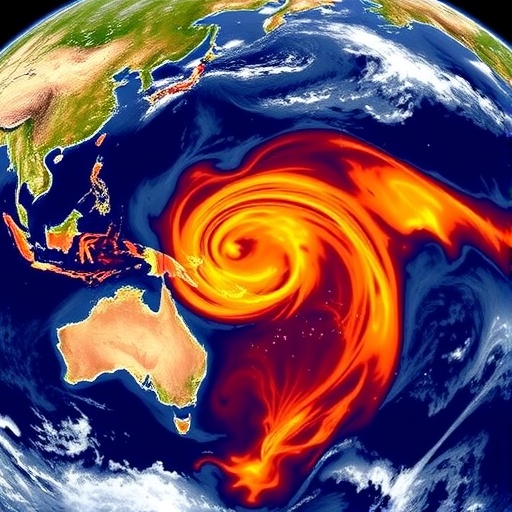
ENSO is generated by a constantly shifting relationship between the tropical Pacific Ocean and the atmosphere above it. During El Niño, unusually warm surface water spreads across the central and eastern equatorial Pacific, changing atmospheric pressure, weakening or redirecting trade winds, and reorganizing rainfall on a planetary scale. La Niña generally produces the opposite pattern, with stronger trade winds and cooler eastern Pacific waters. These alternating states influence storm tracks, monsoons, wildfire conditions, agricultural yields, disease risks, and ocean ecosystems. Because ENSO naturally varies from year to year and from decade to decade, separating a human-driven signal from the climate system’s own irregular rhythms has been one of climate science’s most difficult challenges.
Recent decades have supplied plenty of reasons for concern. Several exceptionally strong El Niño events have occurred in the modern instrumental record, including episodes associated with extraordinary global heat, destructive flooding, severe drought, and widespread coral bleaching. Yet a short observational record cannot reveal whether such events represent a temporary cluster produced by natural variability or the beginning of a persistent response to rising greenhouse-gas concentrations. Climate models have not provided a simple answer. Different simulations have projected different changes in ENSO amplitude, timing, and location, partly because the tropical Pacific involves tightly coupled processes that remain difficult to reproduce, including ocean heat storage, upwelling, cloud feedbacks, and the response of trade winds to warming.
To extend the record beyond thermometers and satellites, Julia Cole and colleagues turned to corals growing around the Galápagos Islands, an archipelago positioned near the heart of the eastern Pacific ENSO region. The researchers analyzed high-resolution geochemical signals preserved in both modern and fossilized coral skeletons, reconstructing sea-surface temperatures across roughly the past 1,000 years. Coral colonies grow in seasonal layers, and the chemical composition of those layers changes in response to the surrounding seawater. In particular, temperature-sensitive geochemical indicators can preserve a detailed history of past ocean conditions, allowing scientists to track El Niño-related warmth long before systematic instrumental measurements began.
The Galápagos record is especially valuable because the eastern equatorial Pacific is where the thermal signature of many El Niño events becomes most pronounced. As warm water accumulates and shifts eastward, the region experiences changes that can be captured in coral chemistry at seasonal resolution. The new reconstruction was compared with coral records from the central Pacific and with other paleoclimate estimates of ENSO behavior. This cross-checking allowed the researchers to test whether the Galápagos signal reflected a local anomaly or a broader change in the tropical Pacific climate system. The agreement among independent records strengthened the case that the recent increase is not simply an artifact of one site, one coral colony, or one unusual sequence of events.
The team then compared the reconstructed history with preindustrial climate simulations from 12 models. These experiments were designed to estimate how much ENSO variability could arise from natural internal fluctuations and natural external forcing in a world without modern levels of human influence. The modern increase exceeded the range produced by those simulations. According to the reconstruction, eastern Pacific ENSO variability is now about 37 percent higher than its preindustrial average, largely because El Niño events have become both more frequent and more intense. The most pronounced shift appears in the recent 40-year period, when the climate system has also experienced rapid global warming and exceptional increases in ocean heat content.
The physical explanation is not that warming mechanically creates an El Niño every year, but that it can modify the conditions governing how tropical Pacific disturbances grow. ENSO depends on feedbacks between winds, sea-surface temperatures, thermocline depth, and ocean currents. A small change in winds can alter the upwelling of cold water in the eastern Pacific; that temperature change can then influence atmospheric pressure and winds, reinforcing or suppressing the original disturbance. Warming may change the background state on which these feedbacks operate, affecting the east-west temperature gradient, the distribution of ocean heat, and the efficiency with which atmospheric disturbances trigger large oceanic responses. The precise balance of these mechanisms remains an active area of research, but the coral evidence indicates that the net effect in the eastern Pacific has recently favored stronger variability.
An intensifying ENSO would have consequences far beyond the tropical Pacific. Strong El Niño conditions can shift rainfall away from regions that depend on predictable seasonal moisture while delivering extreme precipitation elsewhere. Drought can increase the risk of wildfires, reduce water supplies, and damage crops; intense rainfall can trigger floods, landslides, infrastructure failures, and outbreaks of waterborne disease. In the ocean, warmer surface waters and altered circulation can deprive marine ecosystems of nutrients and push corals beyond their thermal limits, worsening bleaching and mortality. Fisheries may be disrupted as species track changing temperatures and food availability. The economic effects can spread through global commodity markets, insurance systems, energy demand, public health services, and supply chains, making ENSO amplification a worldwide risk rather than a regional climate story.
The findings do not mean that every future El Niño will be stronger than the last, nor do they eliminate the uncertainty surrounding long-term ENSO projections. Natural variability will continue to produce quiet periods and unusually powerful events, and the response may differ between the eastern and central Pacific. However, the new evidence establishes a longer baseline against which modern changes can be judged and gives climate models a demanding test: they must reproduce not only average tropical Pacific temperatures, but also the historical evolution of ENSO variability. By showing that recent eastern Pacific behavior is unprecedented in the last millennium of the coral record, the study suggests that climate change is no longer merely a future threat to the world’s most influential natural climate pattern. It may already be turning El Niño into a more powerful and unpredictable engine of extreme weather.
Cite Scienmag News
Alan Morgan. (August 28, 2026). Global warming is intensifying eastern Pacific El Niño variability. Scienmag. https://scienmag.com/global-warming-is-intensifying-eastern-pacific-el-nino-variability/
Alan Morgan. "Global warming is intensifying eastern Pacific El Niño variability." Scienmag, 28 August 2026, https://scienmag.com/global-warming-is-intensifying-eastern-pacific-el-nino-variability/. Accessed 28 October 2026.
Alan Morgan. "Global warming is intensifying eastern Pacific El Niño variability." Scienmag. August 28, 2026. https://scienmag.com/global-warming-is-intensifying-eastern-pacific-el-nino-variability/