

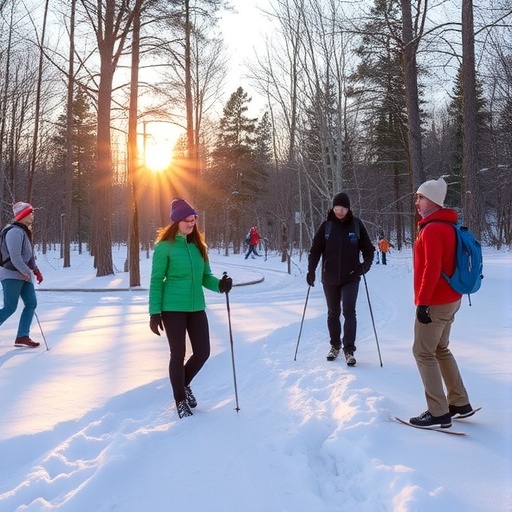
A new regional science initiative is set to transform how snow is measured, modeled and understood across northern New England. The University of Vermont, the University of New Hampshire, the University of Maine and eight additional academic, government and industry partners have received $5.9 million from the National Science Foundation to investigate the connections between mountain snow, water resources, weather hazards and the outdoor recreation economy. The project, known as Snow STORE—Science and Technology for Operations, Research, and Economic Development in Northern New England—will establish a coordinated observing and modeling network across Vermont, New Hampshire and Maine. UVM will lead the effort with $3.3 million in support, while UNH will receive $2.6 million as a collaborating institution.
The award targets a major blind spot in American snow science. Western states have long benefited from extensive snow-monitoring programs, but northern New England lacks a standardized, automated system capable of tracking how snow accumulates, changes and disappears across mountains and watersheds. That gap matters because snow in the region is not simply a seasonal feature. It acts as a temporary water reservoir, stores precipitation in frozen form, influences spring runoff, affects flooding and supports a multibillion-dollar winter recreation sector. Yet snow depth and snow-water equivalent—the amount of liquid water contained in a snowpack—can vary dramatically over short distances because of elevation, wind exposure, vegetation, slope orientation and local temperature patterns.
Snow STORE will address that complexity by linking monitoring sites that already operate in different scientific and recreational environments. Researchers plan to enhance observations at the Mount Washington Observatory, the Sleepers River Research Watershed and Hubbard Brook Experimental Forest, while also working with winter recreation areas such as Stowe Mountain Resort, Wildcat Mountain Resort and Sugarloaf Mountain. Additional stations will be supported at the University of Vermont’s Jericho Research Forest and Mount Mansfield. Together, these locations span a wide range of elevations, landscapes and microclimates, allowing scientists to compare snow behavior from managed ski slopes to remote mountain ecosystems and long-term hydrological research sites.
The planned infrastructure is designed to replace isolated, occasional measurements with continuous information. Snow depth has traditionally been measured by hand, a method that can be accurate at a particular location but cannot capture rapid changes across complex terrain. Automated instruments can record snow depth and weather conditions at much shorter intervals, revealing how snowfall, compaction, melting and refreezing alter the snowpack over time. Measurements of temperature, precipitation, wind and humidity can be combined with snow observations to determine whether a storm produces light, dry powder or dense, water-rich snow. Such distinctions are critical for calculating water availability, predicting runoff and understanding why two nearby mountains can experience very different snow conditions during the same storm.
The project’s scientific challenge extends beyond collecting more data. Snow models must represent physical processes that occur at scales ranging from individual snow grains to entire watersheds. As snow settles, its crystals change shape, its density increases and liquid water may move through or refreeze within the pack. Wind can redistribute snow from exposed ridges into sheltered hollows, while forests intercept snowfall and alter the timing of melt. Warmer winter temperatures can produce more rain-on-snow events, in which rainfall and rapid melting combine to generate sudden runoff and flooding. By unifying field observations with computer simulations, the researchers hope to improve predictions of snowpack evolution, mountain weather and water movement across northern New England.
The initiative will also create a shared system for turning scientific observations into practical decisions. Its partners envision a real-time, one-stop data resource that aggregates information from weather stations, ski areas, research sites and forecasting networks. Rather than leaving measurements in separate databases, Snow STORE will synthesize them into dashboards and decision-support tools. Ski-area operators could use the information to refine snowmaking strategies, which depend on temperature, humidity, wind and the amount of natural snow already present. Forecasting agencies could use improved observations to assess winter hazards, while communities could gain better information about changing flood risks and the timing of spring runoff.
For the outdoor recreation industry, the value of more precise snow intelligence may become increasingly important as climate conditions shift. Ski areas and other winter businesses must make operational decisions under highly variable weather, often with only limited information about conditions a few kilometers away or at a different elevation. A regional monitoring network could help operators distinguish between temporary fluctuations and longer-term changes in snow reliability. Better data may support more efficient snowmaking, improve visitor advisories and help businesses plan staffing, transportation and infrastructure use. The project’s economic research will examine how snow conditions influence recreation patterns and regional development, connecting atmospheric measurements to the decisions made by businesses, workers, visitors and public agencies.
Snow STORE is organized around four linked goals: advancing snow and runoff modeling, improving awareness of mountain weather, delivering actionable information to decision-makers and strengthening the outdoor recreation economy. Achieving those goals will require more than instruments and software. The collaboration includes Ski Vermont, Ski NH and the Ski Maine Association, state outdoor recreation offices, the National Weather Service’s Burlington Weather Forecast Office and Northeast River Forecast Center, the Appalachian Mountain Club and the Consortium of Universities for the Advancement of Hydrologic Science. These partners bring operational experience that can help researchers determine which measurements are most useful in real-world settings and how technical information can be communicated clearly during rapidly changing conditions.
The project also has a workforce and education mission. By connecting universities, federal agencies, research forests, observatories and recreation companies, it will give students and early-career scientists experience with field instrumentation, snow physics, hydrological modeling, weather forecasting, cyberinfrastructure, economics and social science. The resulting network could provide a durable scientific foundation for northern New England, where snow influences ecosystems, reservoirs, rivers, forests, transportation and local economies at the same time. Researchers say the ultimate objective is to understand how the region’s snow is changing and to make that knowledge useful before hazards develop or opportunities are lost. With a coordinated observing system in place, a storm on a mountain ridge, a shift in snowpack density or an approaching rain-on-snow event could become part of a shared regional picture—one capable of linking atmospheric processes to water security, public safety and the future of winter recreation.
Cite this news
SCIENMAG. (August 28, 2026). New England Team Wins $5.9 Million to Study Snow and Outdoor Economy. https://scienmag.com/new-england-team-wins-5-9-million-to-study-snow-and-outdoor-economy/
SCIENMAG. "New England Team Wins $5.9 Million to Study Snow and Outdoor Economy." Scienmag, 28 August 2026, https://scienmag.com/new-england-team-wins-5-9-million-to-study-snow-and-outdoor-economy/. Accessed 28 August 2026.
SCIENMAG. "New England Team Wins $5.9 Million to Study Snow and Outdoor Economy." Scienmag. August 28, 2026. https://scienmag.com/new-england-team-wins-5-9-million-to-study-snow-and-outdoor-economy/


