

When Envy Spreads Through the Workplace, Innovation Can Pay the Price
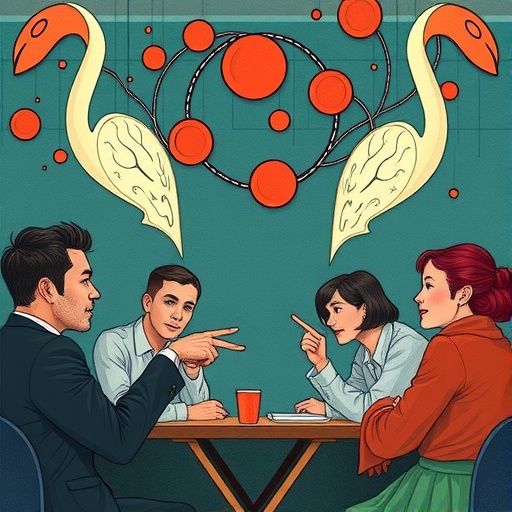
Envy is often treated as a private feeling—an uncomfortable flash of comparison when a colleague receives praise, wins a promotion or unveils an exciting idea. But new research suggests that envy can become a social force with consequences far beyond the individual who experiences it. In a study of 209 employees working in public- and private-sector organizations, researchers found that envy was associated with more negative interpersonal behavior, including speaking badly about colleagues and excluding them from social or professional interactions. Those behaviors, in turn, were linked to lower engagement in innovative activities. The findings point to a potentially self-reinforcing pattern in modern workplaces: the very creativity that organizations seek to encourage may provoke envy, while envy can then damage the relationships and psychological conditions needed for further innovation.
The study, published in Discover Psychology by Cicero Eduardo Walter of Brazil’s Federal Institute of Education, Science, and Technology of Piauí, Débora Agllys da Costa and Manuel Au-Yong-Oliveira, examined how a negative social emotion travels through workplace interactions. Rather than measuring envy solely as an internal reaction, the researchers analyzed its relationship with observable social behaviors and innovative engagement. Their central argument is that envy can influence performance indirectly. A person who feels threatened by another employee’s success may not simply work harder or lose motivation; they may also spread negative word-of-mouth or participate in ostracism. These actions alter the social environment around the targeted colleague, potentially making it more difficult for that person to propose, test or champion new ideas.
Psychologists generally distinguish envy from related emotions such as admiration, jealousy and resentment. Envy arises when someone compares themselves with another person who appears to possess a desirable advantage, whether that advantage is status, recognition, expertise, income or access to opportunities. Social comparison is not inherently destructive. Comparing oneself with a high-performing colleague can reveal a path for improvement and motivate learning. The danger emerges when the comparison is interpreted as a threat to self-worth or social standing. In that situation, the envious individual may attempt to reduce the perceived gap not by developing their own abilities, but by diminishing the other person’s reputation or access to the group. The new study focuses on precisely those interpersonal pathways.
One pathway is negative word-of-mouth: comments, rumors or critical statements that circulate among colleagues and shape how others view a target. Such communication can be subtle, appearing as casual skepticism about someone’s competence, motives or achievements, yet it may gradually undermine trust. A second pathway is ostracism, which involves ignoring, excluding or socially isolating a person. In a workplace, ostracism can mean leaving someone out of meetings, withholding informal information, failing to acknowledge their contributions or excluding them from collaborative discussions. These behaviors matter because innovation is rarely an isolated act. New ideas often require feedback, access to resources, cooperation across teams and the freedom to make mistakes in front of others. Social punishment can therefore suppress innovation even when the targeted employee remains technically capable and motivated.
To test the proposed relationships, the researchers used survey responses from employees in both public and private organizations. They analyzed the data with partial least squares structural equation modeling, or PLS-SEM, a statistical approach commonly used to examine networks of relationships among psychological and organizational variables. In a model of this kind, researchers estimate how strongly one measured construct predicts another while assessing several linked pathways at once. Here, the framework connected envy with negative word-of-mouth and ostracism, and then connected those behaviors with innovative engagement. The researchers also used multigroup PLS-SEM to determine whether the patterns differed between public- and private-sector settings. According to the study, the relationships were broadly consistent across the two organizational contexts.
The results support a chain in which envy increases harmful interpersonal behavior, and harmful interpersonal behavior reduces participation in innovation. The analysis does not mean that every envious employee will deliberately sabotage a colleague, nor does it establish that envy alone directly causes an individual to stop innovating. Survey-based modeling can identify associations and plausible explanatory pathways, but it cannot provide the same level of causal certainty as a controlled experiment or a long-term study that tracks behavior over time. Even so, the pattern is important because it shifts attention away from the idea that innovation depends only on personality, talent or financial incentives. An employee may be willing to generate novel ideas, yet become less likely to do so when the surrounding social climate communicates that visibility brings risk.
The authors describe this feedback pattern as the “envy–innovation duality.” Innovation can make an employee conspicuous by attracting praise, promotions, influence or access to influential decision-makers. That visibility may trigger comparisons among colleagues who feel overlooked or disadvantaged. Once envy is activated, negative talk and exclusion can weaken the innovator’s position, reduce collaboration and discourage future experimentation. The resulting decline in innovation may then create a new competitive atmosphere in which recognition and opportunities appear even scarcer. The cycle is not inevitable, but it illustrates how a workplace can undermine its own creative ambitions. A culture that publicly rewards originality without managing the social consequences of unequal recognition may unintentionally intensify the comparisons that fuel resentment.
The findings also help explain why innovation programs sometimes produce disappointing results despite adequate funding, technical expertise and formal encouragement from managers. Organizations frequently describe innovation as an individual trait or a measurable output, such as the number of ideas submitted, patents filed or new products launched. Yet innovative behavior also depends on psychological safety—the perception that one can offer unusual suggestions, challenge established practices and disclose early failures without being humiliated or punished. Ostracism attacks that safety directly, while negative word-of-mouth can make employees cautious about becoming associated with ambitious proposals. If workers believe that success will provoke hostility, they may keep ideas private, avoid taking intellectual risks or focus on conventional tasks that attract less attention.
The study suggests several implications for organizational practice without reducing envy to a problem that can be solved through simple motivational slogans. Managers may need to monitor how recognition, promotions and access to high-profile projects are distributed, while making evaluation criteria as transparent as possible. They can also intervene when gossip or exclusion begins to isolate a colleague, rather than dismissing such behavior as ordinary office politics. Team norms that reward constructive criticism, credit shared contributions and provide structured opportunities for collaboration could reduce the likelihood that innovation is perceived as a personal threat. Crucially, these measures should not stigmatize employees for experiencing envy, which is a common human emotion. The more useful goal is to prevent the emotion from becoming a pattern of social harm.
Because the research relied on anonymous questionnaires and a sample of 209 employees, its conclusions should be tested in larger and more diverse populations. Future studies could follow teams over months or years, combine self-reports with peer evaluations and behavioral records, and examine whether leadership style, organizational culture or national context changes the strength of the observed relationships. Experimental work might also distinguish between “benign” envy, which encourages self-improvement, and more hostile forms that motivate attacks on a rival. For now, the study offers a warning to organizations eager to advertise themselves as innovative: creativity does not thrive on ideas alone. It depends on social conditions that allow successful employees to remain connected to their colleagues, and that keep comparison from turning achievement into a trigger for exclusion.
Cite this news
SCIENMAG. (August 27, 2026). How Envy Shapes Social Dynamics and Drives Innovative Behavior. https://scienmag.com/how-envy-shapes-social-dynamics-and-drives-innovative-behavior/
SCIENMAG. "How Envy Shapes Social Dynamics and Drives Innovative Behavior." Scienmag, 27 August 2026, https://scienmag.com/how-envy-shapes-social-dynamics-and-drives-innovative-behavior/. Accessed 27 August 2026.
SCIENMAG. "How Envy Shapes Social Dynamics and Drives Innovative Behavior." Scienmag. August 27, 2026. https://scienmag.com/how-envy-shapes-social-dynamics-and-drives-innovative-behavior/


