

Ghanaian Ceramics Carry Cultural Memory Into a High-Tech Future
At Ghana’s Centre for National Culture in Sekondi, a clay vessel can be far more than a container. Its patterns may encode moral principles, its shape may evoke community identity, and its surface may connect contemporary artistic experimentation with knowledge passed down through generations. A new qualitative study of ceramic production at the centre describes Ghanaian pottery as a living cultural system—one now being reshaped by electric kilns, potter’s wheels, glazing and mould casting, even as artisans confront rising costs, environmental damage and a shrinking pipeline of young practitioners. The research, by Caleb Nii Darku Dodoo, Kofi Asante-Kyei and Alexander Addae of Takoradi Technical University, argues that the future of Ghanaian ceramics will depend on preserving traditional knowledge while making room for carefully chosen technologies and stronger institutional support.
Ceramics have occupied a practical and symbolic place in Ghanaian life for centuries. Pots have been used for cooking, storing water and grain, preparing food and carrying out ceremonial activities. Archaeological fragments also provide clues about settlement, technology and social practices, because the material survives long after many organic objects have disappeared. Clay is especially revealing: it is gathered from a particular landscape, shaped by local hands and transformed by fire into a chemically and physically different material. During firing, water is driven from the clay structure, organic matter burns away and mineral components react as temperatures rise. The resulting hardness, porosity and colour depend on the clay’s composition, preparation and firing conditions. Those technical choices are not separate from culture. They determine how objects function, how long they last and how artisans express ideas through them.
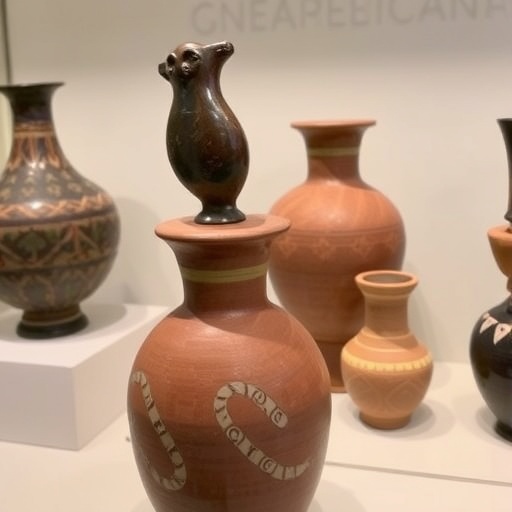
The Sekondi study focused on the meanings carried by ceramic designs, rather than treating pottery solely as a functional craft. Researchers examined motifs including Adinkra symbols, geometric forms, spirals, animal imagery and human figures. Adinkra symbols are widely associated with philosophical, moral and social concepts in Ghanaian visual culture, and their appearance on ceramics turns vessels and sculptural pieces into surfaces for visual communication. Animal forms were described as representing qualities such as strength and protection, while human figures could depict daily life, rituals, historical narratives or collective identity. Spiral patterns were linked by participants to continuity, growth and cycles of life. In this context, decoration is not merely ornamental. It acts as a cultural vocabulary through which artists can communicate values and memories to people familiar with the symbols, while also presenting Ghanaian identity to wider audiences.
To investigate how those meanings are made and maintained, the researchers used a qualitative design combining field observation, semi-structured interviews and focus-group discussions. Their sample included 20 participants: five ceramic artists, 11 pottery practitioners and four cultural officers connected with the Centre for National Culture. The artists reported 10 to 20 years of experience, the pottery practitioners 15 to 25 years and the cultural officers 10 to 15 years. At production sites, the researchers observed clay preparation, forming, decoration and firing, then compared those observations with participants’ accounts and documentary sources. The interview material was coded and organized through thematic analysis, a method used to identify recurring patterns in qualitative data. The resulting themes covered symbolism, traditional knowledge, technological innovation, economic pressure, environmental sustainability, generational change and institutional promotion.
One of the clearest findings was that traditional techniques remain active even as modern equipment enters the workshop. Practitioners continue to use hand-building and indigenous clay-preparation methods, skills generally learned through apprenticeship and repeated practice rather than through written instructions. Such knowledge can include judging the moisture of clay by touch, recognizing when a vessel wall is strong enough to support its shape, applying surface patterns without cracking the form and controlling drying so that uneven shrinkage does not cause fractures. Clay typically contracts as water leaves the body, and rapid or uneven drying can generate internal stresses. Experienced potters learn to anticipate these physical changes while preserving the cultural meanings attached to the objects. The study therefore presents apprenticeship not simply as vocational training, but as a mechanism for transmitting both technical judgment and symbolic knowledge.
At the same time, the Centre for National Culture has adopted tools that alter the speed, consistency and range of production. A potter’s wheel allows clay to be shaped through controlled rotation, producing more symmetrical vessels than many entirely hand-built methods. Electric kilns provide more precise temperature control than open firing or basic wood-fuelled kilns, potentially reducing defects caused by fluctuating heat. Temperature matters because ceramic bodies undergo a sequence of transformations as they fire: particles bond, minerals change phase and the object becomes stronger and less permeable. Glazes add another layer of technical complexity. These mixtures of glass-forming materials, fluxes and colourants melt during firing into a glassy coating that can improve durability, water resistance and visual appeal. Slip casting, in which liquid clay is poured into a porous mould, enables artists to make repeated forms more efficiently, especially for decorative or commercial products.
Those technologies, however, bring trade-offs. Electric kilns may improve firing control, but electricity costs can make them more expensive to operate than gas- or oil-based systems. The study reports that kiln firing, equipment maintenance and energy consumption reduce profitability at the centre. Where modern fuel sources are unaffordable, practitioners may rely on firewood kilns, raising concerns about deforestation and emissions. Clay extraction creates a second environmental pressure. Participants said that deposits had been damaged or contaminated by illegal mining, locally known as galamsey. Removing clay without careful planning can degrade land, disturb drainage and reduce the availability of suitable material for future production. The researchers point to controlled extraction, improved kiln efficiency and more sustainable energy systems as necessary parts of a viable ceramic economy—not optional additions to an otherwise purely artistic practice.
Economic competition adds another threat. Locally made ceramics must compete with imported, mass-produced vessels and with plastic substitutes that are often cheaper and more readily available. Industrial production benefits from economies of scale, standardized materials and automated processes that individual workshops cannot easily match. The resulting price pressure can make it difficult for Ghanaian artisans to invest in kilns, glazes, tools or marketing. Participants also described irregular and inadequate government subventions, limiting the centre’s ability to expand its activities. Yet ceramics can offer advantages that mass-produced goods cannot easily reproduce: handmade variation, local materials, cultural symbolism and direct connections to Ghanaian history. Exhibitions, tourism, craft markets, partnerships with galleries and digital promotion could help turn those qualities into economic value, especially if artists retain control over how their cultural imagery is used and represented.
The researchers identified declining youth participation as perhaps the most serious long-term danger. Many younger people view pottery as labour-intensive and financially unrewarding, leaving the workforce increasingly concentrated among older practitioners. If that trend continues, Ghana could lose not only a catalogue of recognizable forms but also the tacit skills needed to make them. Cultural heritage is therefore vulnerable even when existing objects remain safely displayed in museums or cultural centres: the knowledge of how to locate clay, prepare it, shape it, decorate it and fire it must also survive. The study argues that schools and cultural organizations could make ceramics more attractive through curriculum-based education, apprenticeships and access to modern equipment. Connecting pottery with design, entrepreneurship, tourism and digital commerce may also challenge the perception that it is an outdated occupation.
For the Centre for National Culture in Sekondi, the findings underline a role that extends beyond exhibition. The institution provides space for production, training, mentorship, craft markets and public display, allowing artisans to reach audiences and practice skills in a visible setting. Cultural officers told the researchers that showcasing ceramic artefacts and organizing trade fairs formed part of the centre’s mandate to promote Ghanaian traditions. Such institutions can help bridge the gap between heritage preservation and contemporary creative industries by documenting motifs, supporting apprenticeships, improving technical facilities and creating reliable routes to market. The study does not portray technology as an enemy of tradition, nor tradition as a barrier to innovation. Instead, it describes a negotiation: modern tools can increase efficiency and open new aesthetic possibilities, while hand-building, indigenous materials and symbolic design preserve the distinctive cultural character of the work.
The study’s conclusions are based on a small, purposively selected group at one cultural institution, so they are not a statistical survey of Ghana’s entire ceramic sector. Their value lies in the detailed accounts of practitioners and officials who experience the technical, cultural and economic realities of production directly. Taken together, those accounts suggest that Ghanaian ceramics are at a pivotal moment. The objects remain functional, visually striking and rich in cultural meaning, but their continuity is not guaranteed by symbolism alone. Protecting the tradition will require affordable energy, responsible clay sourcing, stronger markets, youth training and sustained institutional investment. If those conditions can be created, Ghana’s ceramic heritage may do more than survive: it may evolve into a globally visible art form whose newest technologies help carry its oldest stories forward.


