


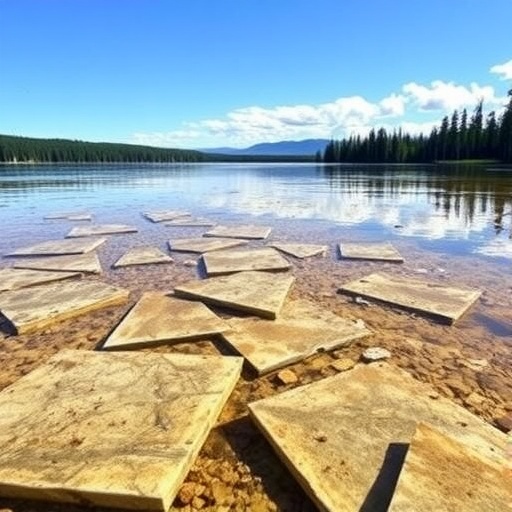
Phosphorus is the nutrient that can quietly transform a lake from a clear, oxygen-rich ecosystem into a green, algae-choked danger zone. Now, scientists have reported evidence that a rare chemical fingerprint preserved in lake sediments could reveal how phosphorus entered ancient waters and how it moved through ecosystems long after the original events disappeared from historical records. The method tracks the oxygen isotope composition of phosphate, written as δ¹⁸O-PO₄, and a new study suggests that this signal can remain remarkably stable inside a particular mineral-bound phosphorus fraction. If confirmed across different lakes and climates, the approach could give researchers a new way to reconstruct centuries or even millennia of eutrophication, wastewater pollution, agricultural runoff and natural nutrient change.
The study, published in Biogeochemistry, examined sediment from Lagoon 3 at Rutland Water Nature Reserve in the United Kingdom. The shallow, nutrient-rich lagoon is unusual because much of its water originates from treated effluent discharged by Oakham Water Recycling Centre. Unlike a lake receiving water from a broad and complex watershed, Lagoon 3 is relatively isolated from surrounding catchments, making it a useful natural laboratory for examining phosphorus dynamics. The lagoon is less than four metres deep, has an alkaline pH of approximately 8.85, and experiences an annual mean surface-water temperature of about 13.3 degrees Celsius. These conditions create an environment where phosphorus can be repeatedly taken up by organisms, released, transformed and eventually buried in sediment.
Phosphorus is essential for life because it forms part of DNA, RNA, cell membranes and the energy-carrying molecule ATP. In lakes, however, even modest increases in phosphorus can stimulate excessive growth of algae and cyanobacteria. The nutrient may arrive from sewage treatment discharges, fertilised fields, eroding soils, atmospheric deposition or internal recycling from bottom sediments. Once deposited, phosphorus does not necessarily remain locked away. Changes in oxygen availability, acidity, temperature, microbial activity and redox conditions can release sediment-bound phosphorus back into the water column, creating a feedback loop that sustains algal blooms even after external pollution has been reduced.
Traditional sediment studies usually measure the total amount of phosphorus or separate it into chemical pools. The Rutland investigation used a sequential extraction procedure that distinguishes four broad fractions. Resin-extractable phosphorus represents a highly mobile and bioavailable pool associated with particle surfaces and pore water. A hexanol extraction targets microbial phosphorus, including compounds linked to cell material. Sodium hydroxide and ethylenediaminetetraacetic acid extract phosphorus associated with organic compounds and iron or aluminium oxides. Hydrochloric acid, or HCl, dissolves a more resistant fraction dominated by apatite and carbonate-associated phosphorus. Because this last pool is less readily available to organisms and can become incorporated into stable minerals, the researchers tested whether its oxygen-isotope signature might survive burial and preserve a record of earlier phosphorus cycling.
Oxygen isotopes provide information because phosphate contains oxygen atoms whose isotopic composition can be altered during biological reactions. Enzymes such as phosphatases break down organic phosphorus compounds, while intracellular reactions involving inorganic phosphate and pyrophosphate can promote oxygen exchange between phosphate and surrounding water. When exchange proceeds extensively, phosphate may approach a temperature-dependent isotopic equilibrium with the water in which it is cycling. The researchers calculated this theoretical equilibrium using a relationship in which the expected phosphate isotope value declines by approximately 0.17 parts per thousand for every degree Celsius increase in temperature, with an additional constant of 26.5 parts per thousand plus the isotope composition of the water. A phosphate sample close to this equilibrium is interpreted as having undergone substantial biological turnover, although the timing and location of that turnover cannot be determined from the isotope value alone.
To test whether the sedimentary signal could be altered after burial, the team collected three short cores from Lagoon 3 in February 2024. Core 1 was immediately sliced into one-centimetre intervals and analysed as a baseline. Core 2 was also sliced, but each section was placed in a tube containing isotopically enriched water with a δ¹⁸O value of plus 28.0 parts per thousand. The material was shaken to maximise contact between sediment, pore water and the enriched solution, then stored for six months at between 4 and 7 degrees Celsius. Core 3 was left intact. Its surface water was replaced with the enriched solution, allowing the modified water to diffuse gradually through the sediment in a more natural configuration. Both treated cores were designed to create an exaggerated opportunity for phosphate-water exchange.
The water isotope results confirmed that the experiment had substantially changed the surrounding environment. In the baseline core, pore-water δ¹⁸O values ranged from minus 6.70 to minus 4.61 parts per thousand. After incubation, Core 2 developed values between plus 23.31 and plus 24.44 parts per thousand, demonstrating extensive mixing with the enriched water. In Core 3, the enriched signature penetrated through almost the entire sediment column, producing values from minus 5.77 parts per thousand at the base to plus 13.55 parts per thousand near the top. The deepest layer remained close to its original value, probably because the sealed base of the core restricted further diffusion. The findings reveal how readily water can move through stored sediment cores, a process that could matter not only for isotope studies but also for investigations involving environmental DNA and other fragile biological signals.
Despite the dramatic change in pore-water chemistry, the phosphate isotope composition of the HCl-extractable pool barely moved. Core 1 displayed δ¹⁸O-PO₄ values from plus 18.36 to plus 22.08 parts per thousand, with an average near plus 19.93 parts per thousand. The treated cores retained similar average values: approximately plus 19.93 parts per thousand in Core 2 and plus 19.96 parts per thousand in Core 3. This was striking because the theoretical phosphate-water equilibrium shifted by about 29.19 parts per thousand in Core 2 and 13.46 parts per thousand in Core 3. In other words, the surrounding water changed dramatically, and the calculated equilibrium signal moved with it, but the mineral-associated phosphate continued to carry its original isotopic fingerprint.
The concentration data support the idea that the sediment was still biologically active, but that the most stable phosphorus fraction was protected from rapid exchange. In the untreated core, sodium hydroxide–EDTA and HCl phosphorus together accounted for roughly 99 percent of the measured phosphorus, while the resin and hexanol pools contributed about 1 percent. After six months, the minor bioavailable pools declined. Average resin phosphorus fell from approximately 7.34 micrograms per gram in the baseline material to 2.20 micrograms per gram in Core 2, while hexanol phosphorus decreased from about 3.75 to 1.71 micrograms per gram. These losses are consistent with microbial turnover and remineralisation. Yet the HCl-bound phosphate isotope values remained stable, suggesting that biological activity continued around the mineral fraction without substantially rewriting its oxygen-isotope record.
The result does not mean that every phosphate isotope signal in every lake sediment is permanently protected. The experiment lasted six months, not thousands of years, and it examined one shallow, alkaline, nutrient-rich lagoon under cool storage temperatures. Warmer conditions, strong changes in acidity, repeated oxygen exposure, intense microbial activity or different mineral compositions could produce different outcomes. The study also found that the uppermost and deepest layers of the baseline core diverged from calculated equilibrium. The surface may have been affected by mixing with lake water and incompletely cycled phosphate, while the basal anomaly could reflect conditions during the lagoon’s early history or incomplete chemical purification. These uncertainties underline the need for longer experiments, more sites and independent age models.
Nevertheless, the study offers a compelling proof of concept for a new palaeoenvironmental tool. If HCl-bound δ¹⁸O-PO₄ can be calibrated against known pollution histories, sediment layers could reveal when a lake began receiving increased nutrient inputs, whether phosphorus was mainly recycled internally or delivered from outside, and how strongly biological communities processed it. Such records could extend far beyond the short instrumental era, allowing scientists to compare modern eutrophication with earlier periods of natural climate change, land-use expansion or wastewater development. The method could eventually be combined with phosphorus concentrations, carbon isotopes, sediment dating, pollen, ancient DNA and biomarkers to build detailed histories of changing lake ecosystems. For now, the message from Rutland Water is both promising and precise: when phosphate becomes securely associated with calcium minerals and carbonates, its oxygen-isotope signature may survive long enough to turn the lakebed into a chemical archive of the phosphorus cycle.
Cite Scienmag News
Violet Maxwell. (August 26, 2026). Lake sediment phosphate oxygen isotopes reveal past nutrient dynamics and remain stable. Scienmag. https://scienmag.com/lake-sediment-phosphate-oxygen-isotopes-reveal-past-nutrient-dynamics-and-remain-stable/
Violet Maxwell. "Lake sediment phosphate oxygen isotopes reveal past nutrient dynamics and remain stable." Scienmag, 26 August 2026, https://scienmag.com/lake-sediment-phosphate-oxygen-isotopes-reveal-past-nutrient-dynamics-and-remain-stable/. Accessed 4 September 2026.
Violet Maxwell. "Lake sediment phosphate oxygen isotopes reveal past nutrient dynamics and remain stable." Scienmag. August 26, 2026. https://scienmag.com/lake-sediment-phosphate-oxygen-isotopes-reveal-past-nutrient-dynamics-and-remain-stable/


