


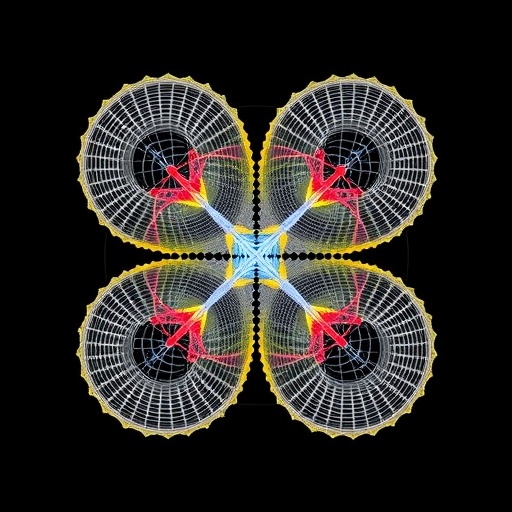
Four bodies locked in a gravitational dance may look chaotic, but a new mathematical analysis shows that some of the most elegant patterns in the four-body problem are governed by surprisingly strict geometric rules. In a study published in Celestial Mechanics and Dynamical Astronomy, Alon Drory examines “central configurations”: arrangements in which every body accelerates toward one fixed point, the system’s center of mass, with the same proportional strength. These configurations are important because they form the foundations of several special motions in celestial mechanics, including collapsing systems, expanding systems, and self-similar rotating arrangements. Drory’s work applies a recently developed “pair-space” formalism, which treats the distances between bodies as the fundamental variables rather than describing the system solely through the individual positions of the particles. The approach exposes relationships among all six mutual distances in a four-body system and reveals why repeated distances almost inevitably signal hidden symmetry. The results identify the only nonplanar solution, constrain planar arrangements, and derive mass–shape relationships for kites, rhombi, and isosceles trapeziums.
The four-body problem is notoriously difficult because every object pulls on every other object simultaneously. With four masses, there are six independent pairwise distances, and changing one distance generally affects the others through the geometry of triangles and quadrilaterals. In ordinary coordinates, researchers often choose a special arrangement first and then solve for the masses or angles that make it dynamically possible. Pair space reverses that strategy. Each relative vector, written as (\mathbf q_{ij}=\mathbf r_i-\mathbf rj), becomes an essential object, while the unavoidable triangle conditions (\mathbf q{ij}+\mathbf q{jk}+\mathbf q{ki}=0) are imposed as constraints. For Newtonian gravity, the force associated with a pair scales as the inverse square of its separation, while the central-configuration equations naturally contain inverse cubes of the distances. Drory derives six vector equations, one for each pair of bodies. They require weighted cross products of pair vectors to balance one another, and they remain valid without selecting a coordinate system. That coordinate-free feature allows the same equations to describe spatial, convex planar, and concave planar configurations.
The analysis begins with a striking result: a nonplanar four-body central configuration can only be a regular tetrahedron. In this arrangement, all six distances are equal, although the four masses need not be. The proof follows directly from the vector equations. If four bodies do not lie in one plane, certain triple products cannot vanish geometrically. The remaining factors must therefore vanish, forcing a chain of distance equalities until every pair separation is identical. The result is a regular tetrahedron, the three-dimensional analogue of the equilateral triangle in the classical three-body problem. In the tetrahedral configuration, the auxiliary pair-space terms cancel, leaving each relative vector to obey an effective Kepler-like equation. Yet the possible motion is more restricted than in the three-body Lagrange solution: according to established results in celestial mechanics, a spatial central configuration with more than three bodies can evolve only homothetically, meaning that the entire structure expands or contracts while retaining its shape.
The study also rules out a halfway state in which exactly three of the bodies are collinear while the fourth remains off the line. If three masses lie on a straight line, the relevant cross product in the central-configuration equations vanishes. The equations then force the fourth body either onto the same line or to become equidistant from all three collinear bodies. The second option is geometrically impossible: three distinct collinear points cannot all lie on a circle centered at an off-line point. Consequently, any partially collinear four-body central configuration must actually be completely collinear. Every other non-tetrahedral arrangement is therefore planar and non-collinear. This sharp division—regular tetrahedron, fully collinear system, or planar non-collinear system—provides a powerful classification before the masses or coordinates are calculated.
For planar configurations, Drory derives four mass-independent relations involving the quantities (p{ij}=1/q{ij}^{3}). These equations generalize the famous Dziobek relation, which has long been used to test whether a proposed four-body shape can be central. The relations are especially revealing when distances coincide. If three bodies form an equilateral triangle, the fourth body must be equidistant from all three, placing it at the triangle’s center. The three triangle vertices must have identical masses, while the central mass can be arbitrary. This arrangement is dynamically realizable: the outer triangle remains equilateral as it follows a common Keplerian-type evolution, and the central body stays at its geometric center. The result is a four-body counterpart of the Lagrange equilateral solution, but with one mass embedded at the center rather than occupying a fourth vertex of a tetrahedron.
A weaker symmetry occurs when three bodies form an isosceles triangle that is not equilateral. The equations force the fourth body to complete a kite. Two bodies lie on the symmetry axis, while the other two appear as mirror images on opposite sides of that axis. The mirror-paired bodies must have equal masses, but the two bodies on the axis can differ. Drory expresses their mass ratios using two angles that determine the kite’s shape. For convex kites, positivity of the masses restricts both angles to values below 60 degrees and confines the possible shapes to a sharply bounded region. Concave kites occupy different triangular regions in angle space, with two geometric branches corresponding to different placements of the fourth body. The formulas also show why singular boundaries matter: certain limiting shapes require a mass to vanish, send a body infinitely far away, or make two bodies coincide. A special symmetric case, in which the two defining angles are equal, produces a rhombus. Such a rhombus requires two pairs of equal masses situated at opposite vertices, and one mass ratio uniquely determines its internal angle.
The final family examined is the isosceles trapezium, a shape that appears when equal distances occur in opposite pairs but no individual triangle is isosceles. The geometry produces two parallel bases, equal diagonals, and mirror symmetry. The two masses at the ends of one base must be equal, and the two masses at the other base must also be equal, although the masses on the two different bases may differ. Two angles then determine the trapezium up to scale. One equation is purely geometric and selects an allowed relationship between those angles; a second equation connects the geometry to the ratio between the two mass values. Positive masses restrict the longer-base angle to lie between 60 and 90 degrees, with the companion angle confined to a narrower region. In contrast to the kite, where two independent mass ratios appear, the trapezium depends on a single ratio, making its inverse problem more manageable: choose a shape, and the necessary masses follow from the equations.
The broader message is that repeated distances are not merely numerical coincidences in the four-body problem; they are fingerprints of symmetry enforced by gravity. Drory’s pair-space framework unifies several configurations that have traditionally been studied through separate coordinate systems and specialized assumptions. It shows that the regular tetrahedron is the only spatial possibility, that a central equilateral triangle must contain an arbitrary-mass body at its center, and that planar distance equalities lead systematically to kites, rhombi, or isosceles trapeziums. The study does not claim to enumerate every four-body central configuration. Shapes with all six distances different, or with only one isolated equality, remain open territory within this program. Even so, the results offer a compact way to screen proposed configurations before solving the full dynamical problem. By turning gravitational geometry into a network of vector relations, the work transforms a tangled four-body interaction into a map of mathematically permitted cosmic patterns—precisely the kind of hidden order that makes the many-body problem both difficult and compelling.
Cite Scienmag News
Grant Pearson. (August 26, 2026). Scientists Analyze Four-Body Central Configurations Through Pair-Space Methods. Scienmag. https://scienmag.com/scientists-analyze-four-body-central-configurations-through-pair-space-methods/
Grant Pearson. "Scientists Analyze Four-Body Central Configurations Through Pair-Space Methods." Scienmag, 26 August 2026, https://scienmag.com/scientists-analyze-four-body-central-configurations-through-pair-space-methods/. Accessed 4 September 2026.
Grant Pearson. "Scientists Analyze Four-Body Central Configurations Through Pair-Space Methods." Scienmag. August 26, 2026. https://scienmag.com/scientists-analyze-four-body-central-configurations-through-pair-space-methods/


