


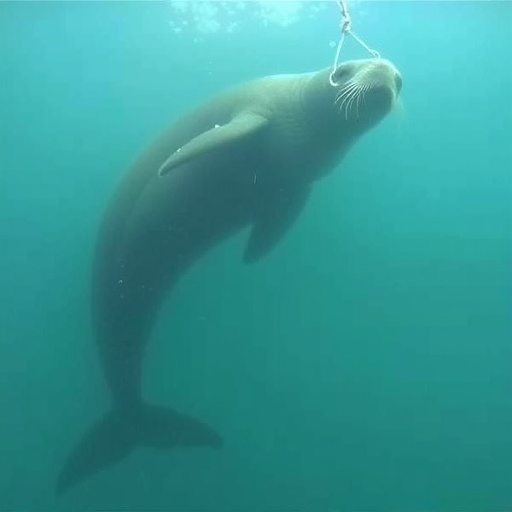
A chance recording made by underwater microphones has captured the most detailed known account of what happens when a harbour porpoise becomes trapped in a fishing net, revealing not only the animal’s desperate struggle to escape but also the acoustic signals exchanged with another porpoise nearby. The observation, made by researchers at the University of St Andrews, provides an unusually intimate view of a problem that kills dolphins, porpoises and other marine animals around the world. Bycatch— the accidental capture of wildlife in fishing gear—is widely regarded as the single largest direct human-caused threat to cetaceans, yet the events themselves are rarely witnessed. Most entanglements occur underwater, far from observers, leaving scientists to reconstruct what happened from damaged gear, stranded animals or limited monitoring data. This new record offers something different: a simultaneous acoustic and movement-based account of an entanglement as it unfolded.
The discovery emerged from a passive acoustic monitoring system deployed on a static gill net off the coast of Cornwall. Passive acoustic monitoring, commonly known as PAM, uses underwater instruments to listen to sounds produced by marine animals without actively transmitting signals into the water. Harbour porpoises rely heavily on sound because their underwater environment is often dark, murky and visually limited. They produce extremely high-frequency echolocation clicks, typically far above the range of human hearing, and interpret returning echoes to detect prey, obstacles and other features of their surroundings. The monitoring equipment was designed to study porpoise activity near the fishing gear, but it unintentionally recorded a bycatch event in exceptional detail. The resulting data allowed researchers to compare the animals’ acoustic behaviour with their movements around the net and during the entanglement.
At first, the recordings showed two harbour porpoises foraging close to the fishing gear. Their repeated movements and echolocation activity suggested that the animals were searching for prey in the area while navigating around the net. The porpoises appeared capable of detecting and avoiding the structure for several minutes, a finding that complicates the simple assumption that animals fail to sense fishing nets. Gill nets are made from thin, nearly transparent monofilament or multifilament lines that can be difficult for marine mammals to perceive, particularly when water conditions, light levels or background noise reduce the clarity of the returning echoes. The animals may have recognized the net as a potential hazard, but the researchers believe that a brief loss of attention—possibly during a rapid pursuit of prey—may have brought one porpoise into contact with it. In a moment, an animal that had been successfully navigating around the gear became caught.
Once entangled, the porpoise began a sustained effort to free itself. Movement data indicated that it was able to generate enough force to lift the net, but not enough to tear through or break the material. This distinction is important because the physical properties of fishing gear strongly influence whether an animal survives an encounter. A net that is flexible but exceptionally strong may hold an animal in place while allowing it to drag or raise a section of the gear, increasing energetic demands and restricting access to the surface. Harbour porpoises must breathe air, so every dive is constrained by the need to return to the surface. An entangled animal can become trapped below the water, lose efficient swimming ability, exhaust its oxygen reserves and drown. Even when it can reach the surface, the additional drag and stress may prevent normal breathing, escape or feeding.
The acoustic recordings provided evidence that the second porpoise remained nearby during the crisis. Both animals continued to produce echolocation clicks, which would have helped them sense the net, the surrounding seabed and one another. However, the researchers also detected rapid sequences of clicks that sounded like a buzzing signal after the recordings had been shifted into a frequency range audible to humans. Porpoise clicks are normally ultrasonic and cannot be heard directly by people. The rapid click trains identified in the recording are thought to represent communication signals, potentially associated with distress, agitation or attempts to maintain contact. Although scientists cannot determine the precise meaning of the signals from a single event, the contrast between ordinary echolocation and unusually rapid acoustic activity offers a rare glimpse into how porpoises may respond socially to danger.
The event lasted several minutes, long enough for the instruments to capture changes in movement, sound production and interaction between the two animals. Such data are extraordinarily difficult to obtain because researchers cannot safely or ethically recreate an entanglement, and direct observation in the open ocean is nearly impossible. Monitoring only a fraction of the thousands of kilometres of fishing nets deployed in UK waters, researchers say the probability of recording a bycatch event at the exact moment it occurs is extremely small. The observation therefore acts like an underwater black box, preserving a sequence that would normally vanish without a trace. It shows the animal approaching and working around the net, becoming trapped, attempting to escape and remaining acoustically connected with its companion. For conservation scientists, that sequence is more informative than a simple record that an animal was found dead or missing.
The findings could influence the design of fishing gear and acoustic deterrence technologies. One possibility is to make nets more acoustically reflective, increasing the strength or clarity of the echoes returned to a porpoise and making the net easier to detect. Researchers are also investigating modified net materials and construction methods that could allow larger or stronger animals to break free rather than remain trapped. These approaches must be tested carefully because a change intended to protect porpoises could alter the net’s performance, reduce target catches or create new hazards for other species. Another potential strategy involves biomimicry: developing warning signals inspired by naturally meaningful sounds or by the acoustic cues marine mammals already use to assess danger. The challenge is to discourage porpoises from entering a hazardous area without causing harmful stress, disrupting essential behaviour or driving animals away from important feeding grounds.
The study also highlights why practical solutions must be developed with fishing communities rather than imposed without considering the realities of working at sea. Static net fishing supports coastal livelihoods and is an important part of the fishing industry, meaning that eliminating all such gear is neither a simple nor necessarily realistic conservation strategy. The more immediate goal is to understand precisely how and why entanglements happen, then reduce the risk through evidence-based changes that fishers can use. Researchers at St Andrews work with fishing communities through the UK Bycatch Monitoring Programme, funded by the Department for Environment, Food and Rural Affairs, and through CIBBRiNA, a European Union-funded initiative focused on reducing bycatch of endangered, threatened and protected species. Collaboration can help determine which modifications are affordable, effective and compatible with real fishing conditions.
The scale of the problem makes those improvements urgent. In the United Kingdom alone, approximately 1,000 harbour porpoises are estimated to die each year after becoming trapped in static fishing nets, while global losses affect numerous species of dolphins, porpoises and whales. Harbour porpoises are small, fast-moving cetaceans with high metabolic demands, so an entanglement can become fatal quickly. Their dependence on high-frequency echolocation also means that the acoustic properties of fishing gear may be central to both the problem and the solution. The new recording does not provide a complete explanation for every bycatch event, and the meaning of the porpoises’ communication signals remains uncertain. It does, however, transform an invisible conservation threat into a documented behavioural sequence. By listening to the final minutes of an entangled animal’s struggle and the possible distress calls of its companion, scientists may be closer to designing fishing nets that marine mammals can detect, avoid or escape—turning a tragic accidental recording into a potential blueprint for saving thousands of animals.
News Publication Date: 26 August 2026
Web References: https://doi.org/10.1098/rsos.260565
References: Royal Society Open Science, “First detailed insights into harbour porpoise behaviour during a bycatch event,” DOI: 10.1098/rsos.260565
Cite Scienmag News
Margaret Porter. (August 26, 2026). First-ever bycatch recording offers crucial insights into marine mammal behavior. Scienmag. https://scienmag.com/first-ever-bycatch-recording-offers-crucial-insights-into-marine-mammal-behavior/
Margaret Porter. "First-ever bycatch recording offers crucial insights into marine mammal behavior." Scienmag, 26 August 2026, https://scienmag.com/first-ever-bycatch-recording-offers-crucial-insights-into-marine-mammal-behavior/. Accessed 3 September 2026.
Margaret Porter. "First-ever bycatch recording offers crucial insights into marine mammal behavior." Scienmag. August 26, 2026. https://scienmag.com/first-ever-bycatch-recording-offers-crucial-insights-into-marine-mammal-behavior/


