


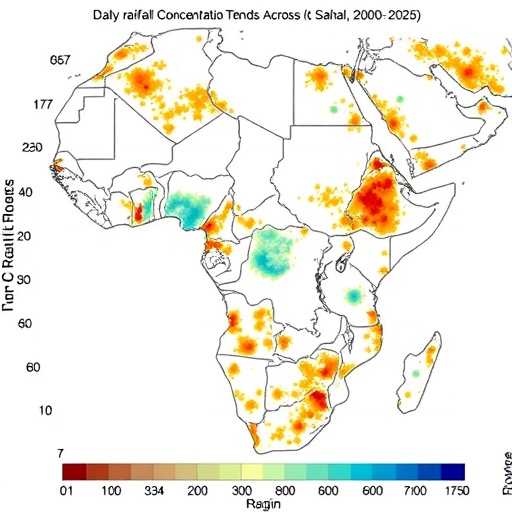
Rainfall across the Sahel is becoming more concentrated into fewer days, creating a climate signal that may be as important for communities as changes in total annual precipitation. A new study published in Regional Environmental Change examines daily rainfall concentration between 2000 and 2025 across six Sahelian countries and reports a marked increase in the concentration index, known as CI1, in several southern and central areas. The research suggests that even where annual rainfall totals appear stable—or where rainfall may be increasing—the timing and distribution of precipitation are changing in ways that could intensify flood risks, soil erosion, crop losses and seasonal water insecurity.
The Sahel is often described through its annual rainfall totals, but yearly accumulation tells only part of the story. In this semi-arid belt stretching across Africa south of the Sahara, rainfall is naturally irregular. A relatively small number of wet days—slightly fewer than half of all rainy days, according to the study—can provide most of the water received during the year. When an even larger share of annual rainfall arrives during a limited number of intense events, the consequences can be profound. Water may run rapidly across hardened or dry soils instead of infiltrating into the ground, while long interruptions between storms can leave crops exposed to moisture stress.
The study, led by Demba Gaye of Assane Seck University in Senegal, focuses on CI1, a daily rainfall concentration indicator designed to describe how unevenly precipitation is distributed across rainy days. Conceptually, the index distinguishes between a season in which rainfall is spread relatively evenly and one in which most precipitation is delivered through a handful of heavy events. A higher CI1 value indicates greater concentration. This makes the index different from a simple rainfall-total measurement: two locations can receive similar annual rainfall while experiencing very different levels of hydrological risk because the rain arrives in different patterns.
To identify trends, the researchers combined three statistical approaches: the Mann–Kendall test, Sen’s slope estimator and innovative trend analysis. The Mann–Kendall method is a non-parametric test widely used in climate science because it does not require rainfall data to follow a normal statistical distribution. It evaluates whether observations show a consistent upward or downward sequence over time. Sen’s slope estimator complements that test by calculating the median rate of change, reducing the influence of unusually wet or dry years. Innovative trend analysis, meanwhile, provides a visual and distribution-sensitive way to compare earlier and later portions of a time series and can reveal changes that conventional tests may overlook.
Together, these methods produced a geographically uneven picture. The strongest and most statistically significant increases in daily rainfall concentration were found in Burkina Faso, Niger and Senegal. In these countries, the research indicates that rainfall has increasingly been compressed into fewer or more dominant daily events. Chad and southern Mali showed more sporadic increases, suggesting that the signal is present but less spatially uniform or less persistent. By contrast, Mauritania and Saharan Mali were characterized mainly by stagnation, with no comparable broad increase in CI1 detected during the study period.
This pattern forms what the researchers describe as a north–south gradient. Southern parts of the Sahel, closer to the wetter Sudanian zones, are experiencing stronger shifts toward concentrated rainfall, while the drier northern regions remain comparatively stable. The gradient does not mean that every station follows the same trajectory. Local topography, station distribution, data quality and the highly variable nature of Sahelian storms can all influence the result. Nevertheless, the regional contrast points to a potentially important change in the organization of rainfall rather than a simple, uniform increase or decrease in precipitation.
The findings are especially significant because intense rainfall has consequences that extend far beyond meteorological records. In agricultural areas, concentrated storms can wash away seeds, erode topsoil and damage young crops, particularly where fields lack protective vegetation or water-control structures. A sequence of dry days after a major storm can be equally damaging: the landscape may briefly appear wet, yet crops can quickly return to water stress when the soil cannot retain enough moisture. For rain-fed farming systems, the agricultural value of rainfall depends not only on how much falls, but also on when it arrives, how long dry intervals last and whether the intensity allows water to enter the soil.
Urban and rural infrastructure face different but connected threats. In towns and cities with limited drainage, a small number of very heavy rainfall events can overwhelm roads, culverts and drainage channels, producing flash floods even when seasonal rainfall totals are not exceptional. In rural watersheds, rapid runoff can increase sediment transport and fill reservoirs or small retention structures. At the same time, more concentrated precipitation does not necessarily improve groundwater recharge. If rainfall intensity exceeds the infiltration capacity of the soil, much of the water may leave the watershed as surface flow, carrying soil and pollutants with it rather than replenishing underground reserves.
The study places its results within a broader scientific discussion about rainfall extremes and climate variability in West Africa. Earlier research has documented changes in heavy-rainfall events, rainfall variability and the behavior of the West African monsoon. The authors emphasize that daily concentration should be treated as a distinct climate indicator because it captures a dimension that annual totals and conventional seasonal averages can miss. They also call for additional research into possible links between CI1 trends and large-scale atmospheric and oceanic processes, including the Intertropical Convergence Zone, the African Easterly Jet, the North Atlantic Oscillation and the Western Mediterranean Oscillation. These climate systems can influence moisture transport, storm development and the position or strength of the monsoon, although the present study does not establish direct causal relationships between them and the observed CI1 changes.
For policymakers, the message is direct: adaptation strategies based solely on total rainfall may be inadequate. Water managers may need to design reservoirs, drainage systems and flood-protection measures for more abrupt rainfall delivery. Agricultural planners could place greater emphasis on soil conservation, contour farming, improved infiltration, water harvesting and crop varieties capable of tolerating both intense downpours and extended dry spells. Early-warning systems may also benefit from tracking rainfall concentration alongside drought indices and seasonal forecasts. A season with near-normal rainfall can still be hazardous if precipitation is delivered through destructive bursts separated by long rainless periods.
The researchers ultimately argue that CI1 should become an operational tool in water-resource management and climate adaptation across the Sahel. Its value lies in its ability to translate daily weather observations into a practical measure of vulnerability. A rising concentration index can signal growing pressure on farms, drainage networks, reservoirs and ecosystems before changes in annual rainfall become obvious. The study does not claim that every part of the Sahel is undergoing the same transformation, nor does it predict identical future conditions across the region. Instead, it reveals a complex spatial pattern in which southern areas are showing increasingly concentrated rainfall while northern zones remain largely stable. As climate variability intensifies and extreme rainfall continues to attract global attention, the distribution of rain across individual days may become one of the most consequential—and most overlooked—signals of environmental change in the Sahel.
Cite Scienmag News
Sloane Callahan. (August 26, 2026). Daily Rainfall Concentration Trends Across the Sahel, 2000–2025. Scienmag. https://scienmag.com/daily-rainfall-concentration-trends-across-the-sahel-2000-2025/
Sloane Callahan. "Daily Rainfall Concentration Trends Across the Sahel, 2000–2025." Scienmag, 26 August 2026, https://scienmag.com/daily-rainfall-concentration-trends-across-the-sahel-2000-2025/. Accessed 3 September 2026.
Sloane Callahan. "Daily Rainfall Concentration Trends Across the Sahel, 2000–2025." Scienmag. August 26, 2026. https://scienmag.com/daily-rainfall-concentration-trends-across-the-sahel-2000-2025/


