


A five-year precipitation experiment in a Southern California dryland has revealed that drought can leave behind a chemical and biological “memory” in soil, reshaping nitrogen cycling long after rainfall patterns return to normal. The study, published in Biogeochemistry, shows that extreme winter drought reduced the microbial production of inorganic nitrogen but did not stop it entirely. Because plants and microbes also became less able to absorb nitrogen under dry conditions, mineralized nitrogen accumulated in the soil instead of being rapidly retained in living biomass. The result was a potentially unstable reservoir of nitrate and ammonium that could later be lost through leaching or gaseous emissions. The findings offer a detailed view of how increasingly erratic rainfall may alter nutrient availability in drylands, ecosystems that already operate close to the limits imposed by water scarcity.
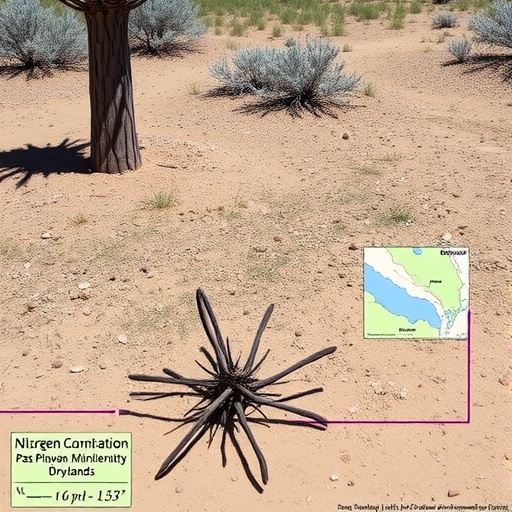
The research was conducted at the Pinyon Flats precipitation manipulation experiment in the University of California’s Philip L. Boyd Deep Canyon Desert Reserve. The site is a pinyon–juniper ecosystem that receives roughly 236 millimeters of precipitation annually, with most rainfall arriving during cool winters and smaller, monsoonal pulses occurring in summer. Researchers maintained 24 field plots under five rainfall regimes: ambient precipitation, winter drought, summer drought, additional winter water, or additional summer water. Rainfall exclusion was achieved with plastic-covered structures, while collected water was transferred to treatment plots through irrigation lines. The manipulation began in 2018, allowing the researchers to examine not only the immediate effect of drought but also the consequences carried into the following season.
The study focused on two microbial processes that determine how nitrogen becomes available in soil. Gross nitrogen mineralization converts organic nitrogen in dead plant material, soil organic matter, and microbial residues into ammonium. Gross nitrification then oxidizes ammonium into nitrate, a form that plants can use but that is also highly mobile and vulnerable to being washed downward or exported from an ecosystem. These gross rates differ from net rates because they measure production before the simultaneous consumption of nitrogen by plants, microbes, chemical reactions, and other organisms. To quantify them, the researchers used isotope pool dilution, adding nitrogen-15-labelled ammonium or nitrate to soil samples and tracking how quickly the label was diluted by newly produced, unlabelled nitrogen over four hours.
Soils collected in April 2023, during the wetter winter season, showed the clearest immediate response to drought. Excluding winter precipitation reduced gross nitrogen mineralization in the winter-drought plots to approximately 0.12 micrograms of nitrogen per gram of soil per hour, compared with about 0.30 micrograms under ambient conditions. Gross nitrification was even more sensitive. It fell to roughly 0.02 micrograms of nitrogen per gram of soil per hour in winter-drought plots, about one-tenth of the control rate of 0.19 micrograms. The sharp decline is consistent with a physical constraint of dry soils: when water films around soil particles become thin and disconnected, dissolved nutrients move less efficiently. Microorganisms may remain alive, but the ammonium and organic substrates they need become harder to reach, particularly for nitrifying organisms.
Despite these reductions, nitrogen production continued under the experimental drought. That conclusion was supported by the accumulation of nitrate in the soil and by positive net nitrogen transformations measured in 30-day field incubations. Winter-drought plots contained approximately 2.6 micrograms of nitrate-nitrogen per gram of soil, nearly six times the control concentration of about 0.5 micrograms. The pattern suggests that nitrogen sources and nitrogen sinks had become uncoupled. Microbes continued releasing some inorganic nitrogen, while dry conditions limited plant uptake and microbial immobilization, the process that incorporates ammonium and nitrate into living tissue. In other words, drought did not simply switch the nitrogen cycle off. It slowed both production and consumption, but consumption slowed more dramatically, allowing inorganic nitrogen to build up.
The chemical form of that accumulated nitrogen matters. Nitrate carries a negative charge and is not strongly held by many soil particles, making it more mobile than ammonium. Once a major rainfall event reconnects soil pores, nitrate can move beyond the reach of shallow roots and microorganisms, potentially entering groundwater or downstream waters. Wetting can also trigger pulses of nitrogen gases, including nitric oxide and nitrous oxide, through rapid microbial activity and chemical reactions in previously dry soils. Nitrous oxide is a powerful greenhouse gas. The new results therefore help explain why a drought can create the conditions for nitrogen loss not only during the dry period but also when rain finally returns.
The researchers also detected a legacy of winter drought during the following summer. Even though the winter exclusion treatment was no longer active, gross nitrogen mineralization remained approximately two times lower than in control plots. The winter-drought soils contained only about 13 micrograms of organic nitrogen per gram of soil during summer, compared with approximately 23 micrograms in the controls. This depletion may have resulted partly from reduced plant growth under severe drought, which lowered the amount of organic material entering the soil. The microbial biomass of carbon and nitrogen did not differ significantly among treatments, indicating that the legacy effect was not necessarily caused by fewer microbes. Instead, the microbes may have faced a smaller or less accessible supply of organic nitrogen to process.
The experiment revealed that not all droughts produced the same legacy. Summer drought, which was more moderate because summer soils were already adapted to heat and low rainfall, increased ammonium concentrations in the following winter to about 1.7 micrograms of ammonium-nitrogen per gram of soil, roughly twice the control value. This suggests that ammonium generated during a dry summer can persist into the next season when uptake and immobilization are restricted. However, that carryover did not produce a measurable legacy effect on gross nitrification. The authors propose that winter conditions may have stimulated plant and microbial competition for ammonium, leaving no lasting advantage for nitrifying organisms. Alternatively, drought may have damaged or altered nitrifying communities in ways that were not immediately reversed by wetter conditions.
The contrast between mineralization and nitrification was one of the study’s most important findings. Gross mineralization responded to the legacy of winter drought, particularly where organic nitrogen had been depleted, whereas gross nitrification showed no significant legacy response. During the summer, both processes were strongly linked to current soil moisture, but nitrification was especially moisture-sensitive. In wetter treatments, nitrification was associated with the availability of ammonium, suggesting that substrate supply became the main limitation once diffusion constraints were eased. In dry summer soils, by contrast, nitrification tracked water content rather than ammonium concentration. This indicates that the same microbial pathway can be controlled by different factors depending on whether the soil is limited by water movement or by chemical substrate availability.
The study also tested whether five years of altered rainfall had changed the natural abundance of nitrogen-15 in bulk soil, an indicator often used to infer long-term nitrogen losses. The researchers found no significant treatment effect and no clear relationship between soil nitrogen-15 values and cumulative annual precipitation. They suggest that several processes may have obscured an isotopic signal, including nitrogen recycling through dissimilatory nitrate reduction, which converts nitrate back to ammonium, and non-biological nitrogen losses that may produce little isotopic fractionation. The result is a reminder that soil nitrogen isotopes integrate many processes over long periods and may not respond directly to seasonal changes in rainfall.
Together, the findings point to a dryland nitrogen cycle that is less dormant during drought than it appears from conventional measurements of net change. Gross nitrogen production can continue even while the soil becomes too dry for plants and microbes to capture the newly available nutrient. Severe drought may then reduce future mineralization by depleting organic nitrogen, while moderate drought can preserve and carry ammonium into a subsequent wet season. At the same time, nitrification remains highly dependent on current moisture conditions, potentially favoring the accumulation of nitrate when nitrogen production and nitrogen uptake become mismatched. As climate change increases the frequency of droughts, intense rainfall events, and abrupt transitions between them, these precipitation legacies could make dryland nitrogen increasingly mobile and vulnerable to loss. The researchers conclude that understanding future ecosystem fertility will require tracking not only how much rain falls, but also when it falls and what biological history the soil carries from one season to the next.
Cite Scienmag News
Violet Maxwell. (August 26, 2026). Past Rainfall Patterns Alter Nitrogen Mineralization and Nitrification in Pinyon-Juniper Drylands. Scienmag. https://scienmag.com/past-rainfall-patterns-alter-nitrogen-mineralization-and-nitrification-in-pinyon-juniper-drylands/
Violet Maxwell. "Past Rainfall Patterns Alter Nitrogen Mineralization and Nitrification in Pinyon-Juniper Drylands." Scienmag, 26 August 2026, https://scienmag.com/past-rainfall-patterns-alter-nitrogen-mineralization-and-nitrification-in-pinyon-juniper-drylands/. Accessed 4 September 2026.
Violet Maxwell. "Past Rainfall Patterns Alter Nitrogen Mineralization and Nitrification in Pinyon-Juniper Drylands." Scienmag. August 26, 2026. https://scienmag.com/past-rainfall-patterns-alter-nitrogen-mineralization-and-nitrification-in-pinyon-juniper-drylands/


