


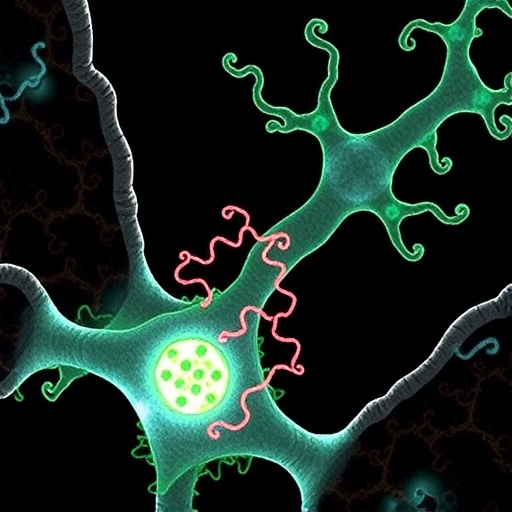
The nucleus is often portrayed as a fortress, sealed off from the rest of the cell by a protective membrane. Yet every working cell must constantly move molecules across that barrier. Messenger RNAs need to leave the nucleus, proteins must enter, and signals controlling gene activity must travel in both directions. This traffic is handled by nuclear pore complexes, enormous molecular machines embedded in the nuclear envelope. A new study by W. Zhang, A. P. Latham, P. Ronchi and colleagues now identifies a crucial physical process that turns newly reassembled nuclear pores into functional, selective transport channels: hydrophobic interactions among a specialized group of pore proteins known as FG-nucleoporins.
Nuclear pore complexes are not simple holes in the membrane. Each pore is built from dozens of proteins, called nucleoporins, arranged with remarkable symmetry around a central transport conduit. The structure must solve two apparently contradictory problems. It must be open enough to allow rapid passage of proteins and RNA molecules, yet selective enough to block most other macromolecules. The answer lies partly in the FG-nucleoporins, whose intrinsically disordered regions contain repeated phenylalanine-glycine sequences. These flexible protein chains project into the pore’s central channel and create a dynamic molecular barrier. Small molecules can diffuse through, while larger cargoes generally require transport receptors that interact transiently with the FG-rich environment.
The new work focuses on what happens immediately after mitosis, the stage of the cell cycle in which a dividing cell has separated its genetic material into two daughter cells. In many organisms, nuclear pore complexes disassemble or become reorganized during mitosis, allowing the machinery of cell division to access the chromosomes. When division ends, the nuclear envelope reforms around the daughter genomes and new pores are assembled. This rebuilding process is not merely a matter of placing proteins into pre-existing openings. The membrane must be reshaped, the pore architecture must expand, and the resulting channel must acquire the molecular properties needed for selective transport.
According to the study, hydrophobic forces involving FG-nucleoporins are essential for this transition from a nascent membrane opening to a mature transport pore. Hydrophobic interactions arise when water-avoiding chemical groups associate with one another rather than remain exposed to the surrounding aqueous environment. In the crowded interior of a nuclear pore, the aromatic phenylalanine residues within FG domains can form transient contacts. These contacts are weak individually, but their collective effect can influence the organization, flexibility and material properties of the pore interior. The research indicates that this interaction network helps drive or stabilize the dilation of the pore after mitosis, allowing the channel to reach a configuration compatible with efficient nucleocytoplasmic transport.
The finding adds an important physical dimension to the biology of nuclear pore assembly. Researchers have long known that nucleoporins are recruited in a defined sequence and that membrane curvature must be carefully controlled as the pore forms. However, assembly and function are not necessarily the same event. A pore may contain many of the correct proteins while still being too constricted, improperly organized or unable to establish a selective permeability barrier. The study suggests that FG-nucleoporins do more than act as passive gatekeepers after a pore has been built. Their hydrophobic interactions participate directly in the maturation of the channel, helping transform a membrane-embedded structure into a functional gateway.
This mechanism also helps explain why the chemical character of FG domains matters so much. Their phenylalanine residues are not simply decorative repeats in an unstructured protein sequence. They provide a tunable set of hydrophobic interaction sites whose behavior depends on local concentration, molecular crowding and contact with transport receptors. If these interactions are weakened or disrupted, the pore may fail to dilate correctly after mitosis. The result would not necessarily be a completely absent pore; instead, cells could produce channels that are structurally present but functionally compromised. Such a defect could slow the movement of essential cargoes, alter the balance between passive diffusion and receptor-mediated transport, and interfere with the rapid re-establishment of nuclear organization in newly divided cells.
The work is particularly significant because nuclear pore complexes must operate under extreme kinetic demands. After mitosis, the daughter nuclei need to regain control over gene expression, DNA maintenance and cellular signaling almost immediately. Nuclear proteins must be imported, newly transcribed RNA must be exported, and regulatory factors must be exchanged with the cytoplasm. A pore that has not yet reached its mature dimensions could become a bottleneck during this recovery period. By linking hydrophobic interactions to post-mitotic pore dilation, the study provides a molecular explanation for how cells rapidly convert newly assembled nuclear gateways into high-throughput yet selective transport systems.
The discovery may also resonate beyond the basic mechanics of cell division. Nuclear transport defects have been associated with developmental disorders, neurodegeneration, infection and cancer, while many viruses exploit nuclear pores to deliver their genomes or replication proteins into the nucleus. Viral cargoes must negotiate the same FG-rich environment used by cellular transport receptors, and changes in pore composition or permeability can influence infection. Although the study is focused on the fundamental process of pore maturation, its conclusions could eventually inform research into diseases and pathogens that disrupt nuclear transport. More broadly, it reinforces a growing view of the nuclear pore as a responsive biomolecular material: part scaffold, part membrane remodeling machine and part selective molecular filter. The ability of a few hydrophobic contacts among disordered protein chains to control the opening of an organelle-scale channel illustrates how cells build sophisticated transport systems from transient interactions rather than rigid mechanical parts.
Cite Scienmag News
Drew Townsend. (August 25, 2026). Hydrophobic FG-nucleoporin interactions expand post-mitotic nuclear pores into selective transport channels. Scienmag. https://scienmag.com/hydrophobic-fg-nucleoporin-interactions-expand-post-mitotic-nuclear-pores-into-selective-transport-channels/
Drew Townsend. "Hydrophobic FG-nucleoporin interactions expand post-mitotic nuclear pores into selective transport channels." Scienmag, 25 August 2026, https://scienmag.com/hydrophobic-fg-nucleoporin-interactions-expand-post-mitotic-nuclear-pores-into-selective-transport-channels/. Accessed 3 September 2026.
Drew Townsend. "Hydrophobic FG-nucleoporin interactions expand post-mitotic nuclear pores into selective transport channels." Scienmag. August 25, 2026. https://scienmag.com/hydrophobic-fg-nucleoporin-interactions-expand-post-mitotic-nuclear-pores-into-selective-transport-channels/


