


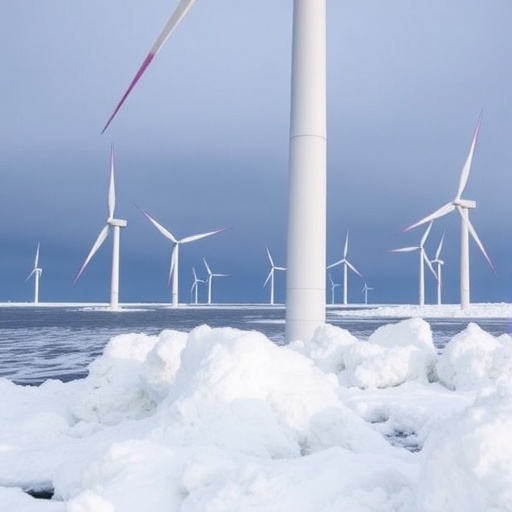
Offshore wind farms are widely presented as a cornerstone of Europe’s strategy to reduce greenhouse-gas emissions, but a new high-resolution climate-modeling study suggests that very large installations could also reshape regional precipitation patterns. Researchers at Helmholtz-Zentrum Hereon found that an extreme expansion of offshore wind energy across the North Sea and Baltic Sea could increase rainfall over wind-farm zones while reducing precipitation in nearby coastal areas. In parts of Denmark, Germany, the Netherlands, and the United Kingdom, the modeled decline in coastal precipitation reached as much as 15 percent.
The study, published in Communications Earth & Environment, examined how extensive offshore wind development could influence the atmosphere over the Northwest European shelf. The researchers used COSMO-CLM, a high-resolution regional climate model designed to simulate atmospheric processes at a scale suitable for investigating regional weather and climate effects. Rather than focusing on individual storms or isolated weather events, the team analyzed simulations covering the decade from 2008 to 2017. This long period allowed them to calculate average atmospheric behavior across many different weather conditions and reduce the influence of unusual individual years.
The model experiments included existing offshore wind farms as well as areas identified for possible future development in the North Sea and Baltic Sea. The researchers selected a deliberately extreme scenario in which every designated development area was assumed to be used at maximum technical capacity. The resulting installed capacity would substantially exceed the European Union’s currently discussed target of 300 gigawatts of offshore wind power by 2050. Such a build-out is not presented as a precise forecast of Europe’s energy system. Instead, it functions as a stress test, designed to reveal the largest potential atmospheric effects and show how those effects might change as wind farms become larger, denser, and more spatially connected.
Wind turbines affect the atmosphere because they remove some of the kinetic energy contained in moving air. As air passes through a turbine array, wind speeds are reduced and turbulence increases. The rotating blades and the physical structure of the turbines disturb the lower atmosphere, enhancing vertical mixing between air layers that would otherwise remain more separated. This interaction can influence the transfer of momentum, heat, and moisture across the atmospheric boundary layer—the lowest part of the atmosphere, which is directly affected by the Earth’s surface and plays a central role in the formation of clouds and near-surface weather.
According to the simulations, the enhanced turbulence behind large offshore wind farms can promote upward transport of moist air. As that air rises, it expands and cools. Cooler air can hold less water vapor, so some of the moisture condenses into tiny droplets or ice particles, supporting cloud formation and, under suitable conditions, precipitation. The model therefore showed a tendency toward increased rainfall over or near the offshore wind-farm areas. The effect is not caused by turbines creating new moisture; rather, the installations alter how existing moisture is transported and where it is released from the atmosphere.
The atmospheric changes become particularly important as air masses move toward the European coastline. Under the extreme expansion scenario, a larger share of the available moisture could fall as rain over the sea before the air reaches land. By the time these air masses arrive at coastal regions, they may contain less water vapor capable of producing precipitation. The simulated result was a reduction in rainfall along sections of the coasts of Denmark, Germany, the Netherlands, and the United Kingdom, with local decreases reaching approximately 15 percent. The size of the effect varies across the region because it depends on prevailing wind direction, atmospheric stability, moisture availability, turbine density, and the arrangement of individual wind farms.
The researchers emphasize that the findings describe changes in long-term weather statistics rather than a simple rule that every wind farm will cause a fixed decline in rainfall onshore. Atmospheric circulation over the North Sea and Baltic Sea is highly variable, and the influence of turbines can change with the season and with the structure of incoming weather systems. The study’s modeled values also represent an intentionally oversized technical scenario, not the expected impact of current projects alone. Actual effects would depend on which sites are developed, how many turbines are installed, their individual dimensions, the spacing between them, and the combined layout of multiple wind-farm clusters.
That distinction is important as European nations expand offshore renewable energy while attempting to balance climate goals with environmental protection, maritime transport, fisheries, coastal planning, and water management. Even modest changes in average precipitation could become relevant in areas already facing competing demands for freshwater or experiencing shifting rainfall patterns because of climate change. At the same time, the study does not suggest that offshore wind power should be abandoned. Instead, it highlights the need to consider atmospheric interactions alongside electricity generation, marine habitats, seabird movements, shipping routes, and the wider consequences of large-scale infrastructure.
Previous work by Hereon researchers has indicated that the dimensions and design of wind farms can strongly influence their atmospheric footprint. Turbine height, rotor size, spacing, density, and the overall geographic arrangement of installations can determine how efficiently momentum and moisture are mixed through the lower atmosphere. A group of small, widely separated wind farms may produce a different regional response from a nearly continuous corridor of dense turbine arrays. Understanding these differences could allow future planners to reduce undesirable effects while preserving the climate benefits of replacing fossil-fuel power generation with renewable electricity.
The researchers now plan to investigate a broader range of development pathways rather than relying on a single extreme case. Future simulations will examine how precipitation responds to different turbine densities, wind-farm sizes, and spatial distributions, as well as how offshore installations affect the ocean and marine ecosystems. Such work could help governments coordinate development across national borders, since atmospheric effects do not stop at maritime boundaries. The study’s central message is that the climate consequences of renewable infrastructure are not limited to carbon emissions: when energy systems become large enough, they can also interact with the physical processes that govern clouds, rainfall, and regional weather.
News Publication Date: 12-Aug-2026
Web References: https://doi.org/10.1038/s43247-026-03852-x
References: Communications Earth & Environment, DOI: 10.1038/s43247-026-03852-x
Cite Scienmag News
Faith Mcneil. (August 21, 2026). Offshore Wind Farms May Change Regional Rainfall Patterns. Scienmag. https://scienmag.com/offshore-wind-farms-may-change-regional-rainfall-patterns/
Faith Mcneil. "Offshore Wind Farms May Change Regional Rainfall Patterns." Scienmag, 21 August 2026, https://scienmag.com/offshore-wind-farms-may-change-regional-rainfall-patterns/. Accessed 3 September 2026.
Faith Mcneil. "Offshore Wind Farms May Change Regional Rainfall Patterns." Scienmag. August 21, 2026. https://scienmag.com/offshore-wind-farms-may-change-regional-rainfall-patterns/


