


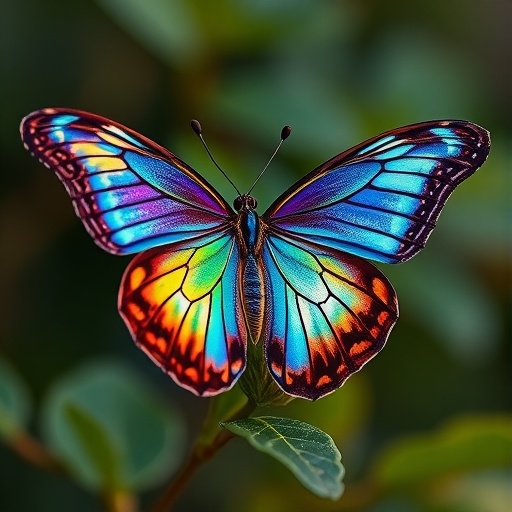
For centuries, the electric-blue wings of Morpho butterflies have seemed almost too vivid to be real. Their color is so intense that the butterflies have become icons of tropical forests—and even earned a place among the emojis on modern phones. But new research suggests that this dazzling display may be vulnerable to a warming world. Scientists at the Smithsonian Tropical Research Institute (STRI) have found that unusually high temperatures during development can make adult Morpho butterflies visibly duller, potentially changing how predators and other butterflies perceive them.
The study, published in PNAS Nexus, examined Morpho helenor, a species widely distributed across tropical regions of Central and South America. Instead of testing only adult butterflies, the researchers focused on pupae, the developmental stage in which the caterpillar transforms into its winged adult form. Pupae were exposed to three temperature conditions: the average tropical temperatures the species normally experiences, cooler temperate conditions designed to simulate development outside the tropics, and hotter conditions resembling those projected under future climate warming. The experiment allowed the scientists to investigate how temperature affects the construction of the butterfly’s famous optical signal while it is still being assembled.
The results revealed several consequences of thermal stress. Both temperate and hot conditions extended the time Morpho pupae spent developing before emerging as adults. Hot conditions were especially damaging, causing pupae to die at higher rates. Among the butterflies that survived, however, the most striking effect appeared on the wings. Adults that had developed under hot temperatures displayed a weaker, less brilliant blue iridescence than those raised under typical tropical conditions. The change was not simply a matter of the wings becoming darker or losing a pigment; it involved the microscopic architecture responsible for producing the color in the first place.
Morpho blue is a structural color, meaning it is generated by the physical arrangement of materials rather than by colored molecules that absorb and reflect particular wavelengths of light. Each wing is covered in thousands of overlapping scales, and each scale contains rows of extremely small ridges and layered structures. When light strikes these features, some wavelengths interact and reinforce one another while others are reduced through interference. The resulting optical effect sends intense blue light toward an observer. Because the color depends on geometry at the nanoscale, even very small changes in spacing, alignment, or thickness can alter the appearance of the entire wing.
The researchers compared the scale structures of butterflies raised at different temperatures and found evidence that heat changes the architecture of the wing scales during development. The distance between the nanostructures became smaller under hot conditions, narrowing the scale as a whole. That contraction appears to reduce the amount of overlap between neighboring scales. Since the layered arrangement controls how light is scattered and reflected, reduced overlap can weaken the coordinated optical effect, producing a less brilliant blue. The finding offers a physical explanation for why butterflies exposed to developmental heat emerged with visibly duller wings.
To determine whether the change would matter to animals that interact with Morpho butterflies, the scientists also considered the visual systems of likely observers. Birds, which are common predators, and butterflies of the same species do not see the world exactly as humans do. Their eyes detect wavelengths and contrasts according to their own visual sensitivities, so a color difference that seems subtle to people may be more obvious—or less obvious—to another animal. The experiments indicated that common bird predators and conspecific butterflies could detect a difference between adults developed under normal and hot conditions. The precise behavioral consequences remain unknown, but the result shows that the thermal effect is biologically visible rather than merely a laboratory measurement.
That visibility could influence both survival and reproduction. Iridescent flashes may disrupt a predator’s ability to track a moving butterfly, create confusing changes in brightness as the wings shift, or signal that an individual is difficult to capture. If heat-related dulling weakens those effects, butterflies raised in unusually hot conditions could become more vulnerable to attack. At the same time, Morpho butterflies may use color and iridescence when recognizing potential mates or members of their own species. A less intense or altered signal could therefore affect courtship, species recognition, or mate choice. The study does not establish that these outcomes occur in nature, but it identifies a potential pathway through which climate warming could reshape ecological interactions.
The findings also challenge the assumption that an animal’s appearance is determined only by genes or adult environmental conditions. In Morpho butterflies, the final visual signal depends on a developmental construction process that is sensitive to temperature. “Iridescent animals are susceptible to the environmental conditions in which they develop,” said lead author Juliette Rubin, a STRI fellow. Under a warming climate, she explained, the color of some familiar iridescent animals may be altered as the brightness of their displays fades. Such changes could be especially important for organisms whose colors are produced by delicate nanostructures, including many insects, birds, fish, and other animals.
Because the work was conducted at STRI facilities and laboratories within the natural tropical range of Morpho butterflies, the researchers were able to study the species under conditions closely connected to its real environment. The authors emphasize that the results are not a prediction that every Morpho population will lose its blue color as temperatures rise. Natural populations may differ in their ability to tolerate heat, adjust development, or evolve new structural traits. Nevertheless, the combination of longer pupal development, higher mortality, and altered adult iridescence shows that warming can influence an animal at several stages of its life cycle. The brilliant blue of the Morpho may look timeless, but its construction is dynamic—and climate-sensitive down to the scale of nanometers.
Web References: https://doi.org/10.1093/pnasnexus/pgag243
References: Rubin, J. J., Camino, L. T., López-Tacoaman, Y. F., Wagh, P. R., Hernández Campos, G. C., & McMillan, W. O. 2026. “Hot temperature during development alters iridescence in Morpho butterflies.” PNAS Nexus, 5(8), pgag243.
Cite Scienmag News
Russell Cooper. (August 21, 2026). Heat can reshape tiny structures, including the dazzling scales of Morpho butterflies. Scienmag. https://scienmag.com/heat-can-reshape-tiny-structures-including-the-dazzling-scales-of-morpho-butterflies/
Russell Cooper. "Heat can reshape tiny structures, including the dazzling scales of Morpho butterflies." Scienmag, 21 August 2026, https://scienmag.com/heat-can-reshape-tiny-structures-including-the-dazzling-scales-of-morpho-butterflies/. Accessed 3 September 2026.
Russell Cooper. "Heat can reshape tiny structures, including the dazzling scales of Morpho butterflies." Scienmag. August 21, 2026. https://scienmag.com/heat-can-reshape-tiny-structures-including-the-dazzling-scales-of-morpho-butterflies/


