


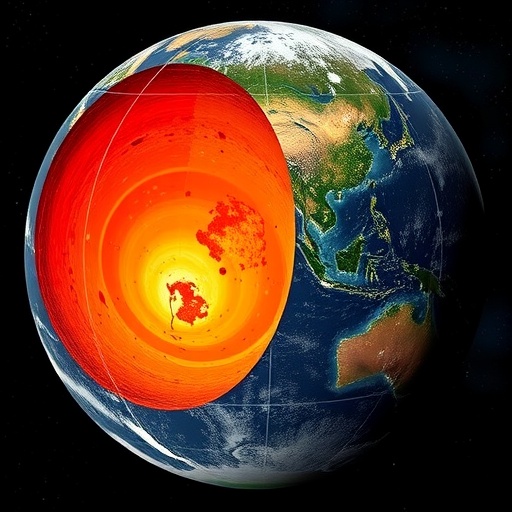
A new artificial intelligence model may offer scientists an unprecedented way to reconstruct the hidden history of Earth’s mantle, the vast layer of hot, solid rock that lies beneath the planet’s crust. Researchers at the University of Tsukuba have developed a physics-informed neural network capable of estimating how mantle temperature and circulation changed in the past, even when much of the necessary information is missing. The approach could help researchers investigate the deep processes that drive plate tectonics, earthquakes, volcanic activity, and the long-term evolution of Earth’s interior.
The mantle accounts for more than 80 percent of Earth’s total volume and behaves in ways that are both solid and fluid-like. Over geological timescales, its rocks can slowly deform and circulate, moving at rates of only a few centimeters per year—roughly the speed at which human fingernails grow. This imperceptibly slow motion transports heat from Earth’s deep interior toward the surface and helps power the movement of tectonic plates. Yet the mantle’s circulation unfolds far below the surface and over millions of years, making it impossible to observe directly in the way scientists monitor weather systems or ocean currents.
Instead, researchers have had to reconstruct mantle behavior from indirect clues. These include the present-day positions and motions of tectonic plates, geological records of ancient surface deformation, volcanic histories, mineral structures, and seismic observations. Earthquake waves provide another crucial source of information because their speed and direction change as they pass through materials with different temperatures, compositions, and physical states. Seismic tomography can therefore create three-dimensional images of the mantle, but these images are snapshots of the present and do not directly reveal how the structures formed or evolved.
The new study addresses this problem by combining artificial intelligence with the fundamental equations of geophysical fluid dynamics. Rather than training a neural network solely to reproduce patterns found in data, the researchers constructed a physics-informed neural network, or PINN, that is also required to obey the equations governing mantle convection. These equations describe how heat diffuses through rock, how buoyancy causes hotter material to rise and cooler material to sink, and how the resulting flow responds to the mantle’s physical properties. By embedding these laws into the learning process, the model is constrained to produce solutions that are physically plausible rather than merely statistically similar to its training examples.
To test the method, the researcher first created computer simulations of thermal convection in a two-dimensional mantle-like system. These simulations numerically solved the governing equations and generated a complete reference history, including the temperature field and the velocity of the circulating material at every point in the model. The simulated history represented the answer that the AI would later be asked to recover. The researchers then deliberately withheld most of that information, giving the neural network only selected observations designed to resemble the incomplete data available in real geophysics.
The model received two particularly important forms of information: synthetic measurements of mantle motion near the surface and a present-day image of the mantle’s temperature distribution. It was not shown the temperatures that existed in the past, nor was it given the flow pattern throughout the deeper mantle. This created an inverse problem, in which the model had to work backward from limited evidence to infer the processes that produced the observed state. In effect, the AI was asked to reconstruct a hidden movie of mantle convection from a small number of frames and physical rules.
The results showed that the neural network could recover the unobserved thermal and flow structures with high accuracy. It reconstructed not only the present configuration but also important aspects of the mantle’s previous evolution, including features that had never been supplied directly as input. The success of the reconstruction depended strongly on combining different types of observations. Surface-motion data helped constrain how the mantle interacts with the tectonic plates above it, while the present-day temperature field supplied information about the interior’s thermal structure. Used together, the complementary datasets gave the model enough information to distinguish realistic convection histories from physically possible but incorrect alternatives.
This finding is significant because mantle reconstruction is fundamentally underdetermined. Many different combinations of temperature, viscosity, density, and flow could potentially produce similar observations at the surface. A model based only on data fitting might therefore generate an answer that looks convincing but violates the physical behavior of mantle material. The physics-informed framework reduces that risk by penalizing solutions that fail to satisfy the governing equations. It effectively forces the AI to search for explanations that are consistent with both the observations and the known mechanics of heat transport and fluid motion.
The researchers emphasize that the current demonstration used simplified, two-dimensional simulations rather than the full complexity of Earth’s three-dimensional mantle. Realistic applications will need to account for factors such as variations in chemical composition, pressure-dependent viscosity, phase transitions, complex tectonic histories, and uncertainties in seismic imaging. Even so, the study establishes a promising foundation for using machine learning to explore deep-Earth evolution. With further development and testing against real geophysical datasets, the method could help scientists estimate how mantle plumes formed, how subducted slabs traveled through the interior, and how ancient convection influenced the surface over geological time. By turning fragmentary observations into a physically consistent reconstruction, the approach could open a new window onto the hidden engine of our planet.
News Publication Date:
6-Aug-2026
Web References:
https://doi.org/10.1029/2026JH001310
https://www.sie.tsukuba.ac.jp/eng/
References:
Journal of Geophysical Research: Machine Learning and Computation, DOI: 10.1029/2026JH001310
Cite Scienmag News
Katie Riggs. (August 20, 2026). New AI Model Combines Physics and Observations to Reconstruct Earth’s Mantle History. Scienmag. https://scienmag.com/new-ai-model-combines-physics-and-observations-to-reconstruct-earths-mantle-history/
Katie Riggs. "New AI Model Combines Physics and Observations to Reconstruct Earth’s Mantle History." Scienmag, 20 August 2026, https://scienmag.com/new-ai-model-combines-physics-and-observations-to-reconstruct-earths-mantle-history/. Accessed 3 September 2026.
Katie Riggs. "New AI Model Combines Physics and Observations to Reconstruct Earth’s Mantle History." Scienmag. August 20, 2026. https://scienmag.com/new-ai-model-combines-physics-and-observations-to-reconstruct-earths-mantle-history/


