


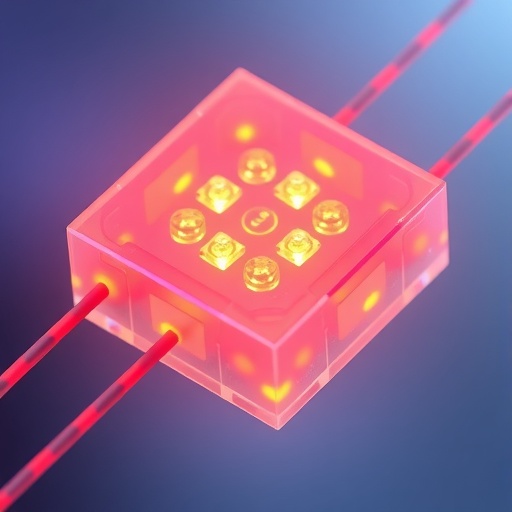
A new generation of light-controlled medical electronics could make temporary neural interfaces less invasive and easier to control. In a study published in Nature Electronics, Wan, Zhao, Luo and colleagues report “programmable polyphasic stimulation with bioresorbable phototransistors”—a technology that combines optical control, electrical stimulation and materials designed to disappear after their useful lifetime. The concept addresses a central challenge in implantable bioelectronics: how to deliver precise stimulation without leaving behind permanent hardware that may require a second operation to remove.
The device is built around a phototransistor, an electronic component whose current can be regulated by light. Unlike a simple photodetector, a phototransistor can provide internal amplification: a relatively small optical signal can produce a larger electrical response. In a biomedical setting, this property could allow wireless light signals to control stimulation electrodes positioned near nerves, muscles or other excitable tissues. Instead of relying on wired connections that pass through the skin, an optical command could activate the temporary implant and determine when and how strongly it stimulates.
The “bioresorbable” aspect is equally important. Conventional implantable stimulators are typically made from durable metals, silicon and polymers that remain in the body indefinitely. While these materials can support long-term operation, they may also create chronic inflammation, interfere with later procedures or require surgical extraction. Bioresorbable electronics are engineered to function for a defined period before gradually dissolving or being absorbed through biological processes. The timing is critical: the system must remain stable long enough to perform its therapeutic or experimental role, then vanish without leaving a persistent foreign object.
The researchers’ focus on polyphasic stimulation moves beyond the simplest form of electrical neuromodulation, in which a single voltage pulse is delivered between an active electrode and a return electrode. Polyphasic waveforms contain multiple phases, allowing the polarity, amplitude and duration of stimulation to be adjusted over time. Carefully designed multiphase signals can improve control over how excitable cells respond and may reduce the accumulation of unwanted electrical charge at the electrode–tissue interface. Charge management is particularly important for implanted systems because excessive net charge can drive electrochemical reactions, damage electrodes or irritate surrounding tissue.
Programmability gives the platform another layer of flexibility. Rather than producing one fixed pulse every time it is activated, the phototransistor-based circuit can be configured to generate different stimulation patterns. A light signal may function as a trigger, while the electronic properties of the device shape that command into a selected sequence of electrical phases. This arrangement could allow clinicians or researchers to alter stimulation parameters without physically accessing the implant. In principle, different patterns could be used to investigate distinct neural pathways, coordinate muscle activity or adapt treatment as a patient’s condition changes.
The use of light as the control channel also separates command and power functions from the implant itself. A temporary device can be placed close to the target tissue while an external optical source provides the activation signal. Depending on the system’s design, the light may be delivered through tissue or directed at the implant from outside the body. Phototransistors are attractive for this purpose because they can respond to illumination while simultaneously participating in signal processing and switching. That integration may reduce the number of components required, an advantage when engineers are trying to shrink devices for delicate biological environments.
The reported work is significant because it brings together several capabilities that are often developed separately: transient materials, optical control and advanced stimulation waveforms. A bioresorbable implant that merely records a biological signal has different requirements from one that actively stimulates tissue. Stimulation demands carefully controlled voltage or current, reliable electrode contact and safeguards against electrochemical instability. Adding optical programmability introduces another design challenge, since the phototransistor must convert light into a predictable electrical response while surviving fabrication, implantation and the intended operating period.
Such systems could eventually support temporary treatments after surgery or injury, when stimulation is needed only during a specific stage of healing. They could also be useful in neuroscience experiments, where researchers want to activate or inhibit tissue without tethering an animal to a permanent implanted connector. In peripheral nerve applications, transient stimulation might assist rehabilitation or help guide damaged tissue during recovery. In the brain and spinal cord, dissolvable electronics could offer a way to deliver short-term neuromodulation while limiting the long-term burden associated with permanent implants. These possibilities remain dependent on future testing of safety, precision, lifetime and biological compatibility.
The technology also highlights the broader direction of bioelectronics: devices are becoming less like isolated circuit boards and more like temporary, programmable interfaces between living tissue and machines. The challenge is not simply to make an electronic component disappear, but to control how it operates before disappearance begins. Its optical sensitivity, electrical output, degradation rate and interaction with tissue must all be coordinated. The study’s polyphasic approach suggests that transient implants can be designed not only to deliver stimulation, but to deliver it with the same waveform-level sophistication expected from more conventional clinical electronics.
By combining a light-responsive transistor with programmable multiphase stimulation, the researchers present a platform aimed at making temporary neural interfaces more adaptable and less dependent on permanent hardware. The work does not eliminate the broader hurdles facing implantable bioelectronics, including long-term reliability during the useful operating window, safe dissolution products and accurate delivery of stimulation in complex tissue. But it offers a striking blueprint for devices that can receive commands, shape electrical treatment and ultimately disappear. If the approach can be translated into robust biomedical systems, bioresorbable phototransistors could help turn short-lived implants from a laboratory concept into a practical tool for precision neuromodulation.
Cite Scienmag News
Denise Maddox. (August 19, 2026). Bioresorbable Phototransistors Enable Programmable Polyphasic Stimulation. Scienmag. https://scienmag.com/bioresorbable-phototransistors-enable-programmable-polyphasic-stimulation/
Denise Maddox. "Bioresorbable Phototransistors Enable Programmable Polyphasic Stimulation." Scienmag, 19 August 2026, https://scienmag.com/bioresorbable-phototransistors-enable-programmable-polyphasic-stimulation/. Accessed 4 September 2026.
Denise Maddox. "Bioresorbable Phototransistors Enable Programmable Polyphasic Stimulation." Scienmag. August 19, 2026. https://scienmag.com/bioresorbable-phototransistors-enable-programmable-polyphasic-stimulation/


