


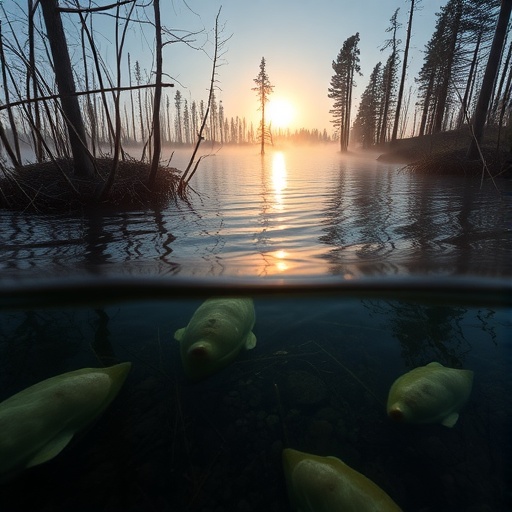
Wildfires are often described as disasters that end when the flames disappear, but their chemical influence can persist long after smoke has cleared. New research published in Communications Earth & Environment shows that wildfire-derived dissolved black carbon can fundamentally reorganize sulfur photochemistry in freshwater systems, revealing an unexpected connection between burning landscapes, sunlight, and the chemistry of rivers, lakes, and reservoirs. The study, led by Hu, Liu, Tang and colleagues, suggests that carbon compounds washed from fire-affected soils and ash are not passive remnants of combustion. Once they enter water, they can act as powerful light-absorbing and chemically reactive materials, redirecting how sulfur compounds are transformed under sunlight.
Dissolved black carbon is a mobile fraction of the carbon produced when vegetation and organic matter burn. Unlike the dark particles that settle quickly onto soil or lakebeds, this water-soluble material can be transported through streams and drainage networks, especially during the intense runoff that follows wildfire. It contains a complex mixture of aromatic molecules, oxygen-rich functional groups and quinone-like structures formed during incomplete combustion. These molecules often behave similarly to natural dissolved organic matter, but their highly condensed chemical structures give them distinctive optical and redox properties. In freshwater, wildfire-derived dissolved black carbon can therefore influence both the amount of light penetrating the water and the reactions triggered by that light.
The researchers focused on sulfur photochemistry, a group of sunlight-driven reactions that can alter sulfur between oxidation states and generate short-lived reactive intermediates. Sulfur is present in freshwater in several chemical forms, including sulfate, sulfide, elemental sulfur and organic sulfur compounds. The balance among these forms affects microbial metabolism, nutrient cycling, metal mobility and the production or consumption of gases such as hydrogen sulfide. Under illumination, dissolved organic carbon can absorb photons and enter electronically excited states. These excited molecules may transfer energy to oxygen, produce reactive oxygen species or exchange electrons with dissolved compounds. Wildfire-derived black carbon can intensify or redirect those processes, changing which sulfur reactions dominate.
The study’s central message is that black carbon from fires can serve as a photochemical “reaction hub.” When it absorbs sunlight, it may act as a photosensitizer, transferring energy or electrons to nearby molecules. This activity can produce reactive oxygen species such as singlet oxygen and hydroxyl radicals, while also promoting the formation of sulfur-centered radicals and other transient compounds. These species exist for fractions of a second, but their chemical effects can be substantial because they react rapidly with sulfide, sulfate-related intermediates and organic molecules. Rather than simply accelerating one isolated reaction, dissolved black carbon can reroute sulfur through multiple competing pathways, effectively reorganizing the chemical network operating in sunlit freshwater.
That reorganization matters because sulfur transformations are closely linked to the ecological condition of aquatic environments. Sulfide, for example, can be toxic to fish, invertebrates and microorganisms at elevated concentrations, while sulfate can serve as an electron acceptor for microbes in oxygen-poor sediments. Sulfur compounds can also bind with metals, influence mineral formation and participate in the breakdown of organic pollutants. If wildfire-derived dissolved black carbon changes the rates at which these compounds are oxidized or reduced, the consequences may extend beyond sulfur itself. The chemistry of iron, manganese, mercury and other elements can also shift because sulfur frequently controls whether metals remain dissolved, become immobilized in sediments or form new mineral phases.
The findings add an important layer to the emerging science of wildfire legacies. Fire can alter water chemistry through ash deposition, erosion, increased nutrient delivery and the release of inorganic ions. Yet the dissolved organic molecules generated during combustion may be equally important, particularly during the weeks and months when rainfall carries them from burned landscapes into waterways. Because black carbon strongly absorbs ultraviolet and visible light, it can change the underwater light field, potentially reducing the depth at which sunlight penetrates while concentrating photochemical activity near the surface. At the same time, its molecular structure can create reactive sites that remain active even as the material is transported downstream.
This mechanism could become more significant as wildfire seasons lengthen and burned areas expand in many regions. Climate-driven heat, drought and vegetation stress are increasing the likelihood of large and severe fires, while intense rainfall after fire can rapidly flush combustion products into aquatic ecosystems. The result is a shifting chemical pulse: freshwater systems may receive unusually high loads of dissolved black carbon precisely when they are also experiencing altered temperatures, sediment inputs and oxygen conditions. These factors can interact. Sunlight controls photochemistry, microbial communities respond to the newly available carbon and sulfur compounds, and changing oxygen levels determine whether oxidation or reduction reactions prevail.
The research also challenges a common assumption that black carbon is primarily a long-term carbon-storage material. Some forms of black carbon are indeed resistant to decomposition, allowing them to persist in soils and sediments. But the dissolved fraction can be chemically active and environmentally mobile. Its impact depends not only on how much carbon enters a waterway, but also on its molecular composition, the intensity and spectrum of sunlight, pH, oxygen concentration, sulfur availability and the presence of metals or other dissolved organic compounds. Two lakes receiving similar amounts of fire-derived carbon could therefore experience very different chemical outcomes. The study highlights the need to treat dissolved black carbon as a dynamic participant in aquatic chemistry rather than simply as transported soot.
The implications reach into water-quality monitoring and ecosystem forecasting. Standard post-fire assessments often measure turbidity, nutrients, conductivity, metals and conventional indicators of dissolved organic carbon. Those measurements can reveal that a watershed has changed, but they may not capture the specific photochemical behavior of combustion-derived molecules. Tracking optical properties, molecular composition and sulfur speciation could help scientists determine whether a burned watershed is likely to produce reactive sulfur compounds or modify oxygen-sensitive processes. Such information may be especially valuable for drinking-water reservoirs, where wildfire-derived organic matter can also affect treatment chemistry and the formation of disinfection by-products.
By connecting wildfire carbon to sulfur transformations, Hu, Liu, Tang and their co-authors provide a new framework for understanding how disturbances on land can reshape chemical reactions in water. The work indicates that the afterlife of a wildfire is not governed solely by erosion and sediment transport. Sunlight can activate dissolved combustion products, and those products can alter the fate of sulfur in ways that influence aquatic toxicity, microbial activity and elemental cycling. As fire-affected watersheds become more common, this hidden photochemical pathway could become an increasingly important part of freshwater science—and another reminder that the ecological footprint of a wildfire may continue evolving long after the smoke has vanished.
Cite Scienmag News
Valerie Murray. (August 19, 2026). Wildfire-derived black carbon reshapes sulfur photochemistry in freshwater ecosystems. Scienmag. https://scienmag.com/wildfire-derived-black-carbon-reshapes-sulfur-photochemistry-in-freshwater-ecosystems/
Valerie Murray. "Wildfire-derived black carbon reshapes sulfur photochemistry in freshwater ecosystems." Scienmag, 19 August 2026, https://scienmag.com/wildfire-derived-black-carbon-reshapes-sulfur-photochemistry-in-freshwater-ecosystems/. Accessed 4 September 2026.
Valerie Murray. "Wildfire-derived black carbon reshapes sulfur photochemistry in freshwater ecosystems." Scienmag. August 19, 2026. https://scienmag.com/wildfire-derived-black-carbon-reshapes-sulfur-photochemistry-in-freshwater-ecosystems/


