


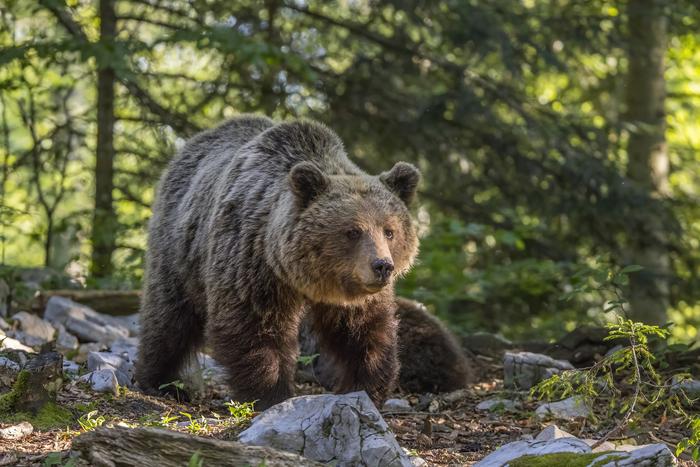
New research led by University College Dublin has overturned one of the most persistent stories in Irish prehistory. Bones excavated more than three decades ago at Ferriter’s Cove, a small bay on the Dingle Peninsula in County Kerry, were long regarded as the earliest evidence that domesticated cattle—and perhaps the first farming communities—had reached Ireland before the Neolithic period was fully established. A new biomolecular investigation has now shown that the fragments were not cattle bones at all. Instead, they came from a bear and a wild boar, removing a central piece of evidence from long-running debates about how agriculture first arrived on the island.
Ferriter’s Cove has occupied a pivotal position in discussions of Ireland’s Mesolithic–Neolithic transition since excavations in the 1980s and 1990s. The site contains evidence dating to the closing stages of the Mesolithic, a period when people lived primarily by hunting, fishing and gathering rather than cultivating crops or raising livestock. Ireland’s Mesolithic communities occupied the island for at least four thousand years, yet they have often been overshadowed in popular accounts by the monumental tombs, stone architecture and agricultural settlements associated with later Neolithic societies. The apparent discovery of cattle bones at Ferriter’s Cove seemed to offer a dramatic exception: it suggested that hunter-gatherers in Ireland had established contact with farming communities on the European mainland before agriculture became firmly established locally.
The supposed cattle remains became known informally as the “Kerry Cow” and were repeatedly cited as the earliest evidence for domesticated farm animals in Ireland and Britain. Their presence appeared to challenge the idea that agriculture spread to Ireland only with the arrival or expansion of Neolithic communities after about 4000 BC. If the identification had been correct, the bones could have indicated that cattle were transported to the island by seafaring groups, exchanged through long-distance networks or introduced by people who maintained connections with farming societies in Continental Europe. Because cattle are domesticated animals and cannot be interpreted simply as wild prey, the fragments carried implications far beyond their small size. They appeared to link Ireland’s Mesolithic inhabitants to a major economic and cultural transformation taking place across Europe.
The new study revisited the original archaeological material, which is now stored at University College Cork. Dr Martin Moucheron of the UCD School of Archaeology led the research as part of a Research Ireland-funded postdoctoral project, working under the mentorship of Professor Graeme Warren. The investigation was conducted with researchers from University College Cork, including Dr Benjamin Gearey, Barra Ó Donnabháin and Margaret McCarthy, as well as Kate Kanne of UCD. The team sent the Ferriter’s Cove fragments to a laboratory operated by France’s CNRS in Lille, where they could be examined using modern biomolecular methods unavailable, or not routinely applied, when the bones were first identified.
The key technique was ZooMS, short for Zooarchaeology by Mass Spectrometry. Rather than relying only on the shape, size or visible features of a fragment, ZooMS identifies an animal by analyzing collagen, the structural protein preserved inside ancient bone. Collagen contains sequences of amino acids that vary subtly among species. Scientists extract surviving collagen from a small sample, digest it into characteristic peptide fragments and measure those peptides with mass spectrometry. The resulting molecular pattern acts like a biological barcode, allowing researchers to distinguish closely related animals even when the archaeological bone is too damaged or incomplete for conventional identification. In this case, the protein signatures contradicted the original attribution and revealed that the fragments belonged to a bear and a wild boar.
The discovery dramatically changes what Ferriter’s Cove can tell us about the arrival of farming. There is currently no archaeological evidence supporting the presence of domesticated cattle, or direct influence from early farming communities, in Ireland before 4000 BC. This does not prove that Mesolithic people had no contact with communities elsewhere in Europe, nor does it settle every question about how agriculture later spread across the island. It does, however, remove the most frequently cited early animal evidence for such contact. The distinction is crucial: a wild boar could have been hunted as part of a Mesolithic subsistence strategy, while a domestic cow would have represented a managed herd, a transported animal and an entirely different economic system.
The reassessment also highlights how vulnerable archaeological narratives can be when they rest on a small number of identifications. Bone fragments are often fragmented, burned, weathered or altered by burial conditions, making visual comparison difficult. Earlier researchers worked with the techniques and reference collections available at the time, and the cattle interpretation became influential because it appeared to fit an important historical model. Once accepted, it was repeated in discussions of Irish prehistory and used to support wider ideas about migration, exchange and the transition from hunting and gathering to farming. ZooMS offers a way to test such assumptions directly against molecular evidence, demonstrating how a new analysis can transform the meaning of an entire site without changing the excavation record itself.
For Dr Moucheron, the findings are also a reminder that Mesolithic Ireland should not be treated as an archaeological blank. “For at least four millennia hunting and gathering people lived on the island,” he said, noting that popular images of Ireland often make later farming communities seem more familiar than the people who preceded them. Returning to old collections with new techniques, he argued, can reveal how much remains to be learned about those earlier societies. The animal remains at Ferriter’s Cove now point away from an early cattle connection and toward a more complex picture of human interaction with Ireland’s wild fauna. A bear and a wild boar may not support the same dramatic narrative as the “Kerry Cow,” but they provide direct evidence of the animals present in the Mesolithic environment and the species that people may have encountered, hunted or processed.
The bear identification may eventually generate another unexpected chapter in the site’s story. Further analyses are planned to determine whether the remains belonged to a brown bear or a polar bear, a distinction that could provide new information about prehistoric bear populations in Ireland before their extinction during the Bronze Age. Identifying the species will require additional biomolecular investigation because the available fragments may not preserve enough diagnostic anatomy for a confident visual determination. Whatever the result, the research shows why archaeological collections continue to matter long after excavation has ended. Ferriter’s Cove has not become less important because the bones are no longer cattle; it has become important in a different way, offering a vivid example of how scientific methods can overturn a celebrated claim and force researchers to rethink the timing, mechanisms and human consequences of Ireland’s transition from Mesolithic lifeways to Neolithic farming.
News Publication Date: 18-Aug-2026
Web References: https://www.eurekalert.org/multimedia/1147225
References: PAST, the newsletter of the Prehistoric Society; University College Dublin; University College Cork; CNRS laboratory in Lille, France
Cite Scienmag News
Courtney Benton. (August 18, 2026). Kerry Cow bones identified as ancient bear, reshaping theories of farming’s arrival. Scienmag. https://scienmag.com/kerry-cow-bones-identified-as-ancient-bear-reshaping-theories-of-farmings-arrival/
Courtney Benton. "Kerry Cow bones identified as ancient bear, reshaping theories of farming’s arrival." Scienmag, 18 August 2026, https://scienmag.com/kerry-cow-bones-identified-as-ancient-bear-reshaping-theories-of-farmings-arrival/. Accessed 3 September 2026.
Courtney Benton. "Kerry Cow bones identified as ancient bear, reshaping theories of farming’s arrival." Scienmag. August 18, 2026. https://scienmag.com/kerry-cow-bones-identified-as-ancient-bear-reshaping-theories-of-farmings-arrival/


