


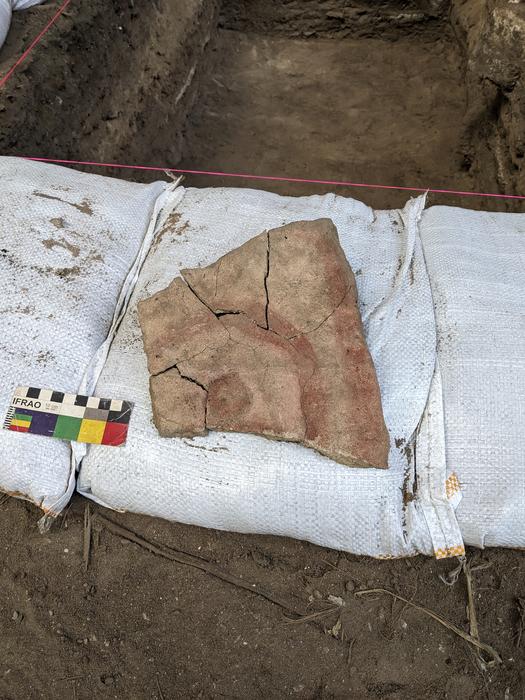
A painted stone plaque recovered from a remote Indonesian island is offering archaeologists an unusually intimate glimpse into the symbolic world of the first Austronesian seafarers. Dated to approximately 4,090 to 3,900 years ago, the small object is the earliest known portable example of art associated with the Austronesian Painting Tradition, or APT. Its discovery on Wetar Island, in eastern Indonesia, suggests that the visual language now recognized on cave and rockshelter walls was not confined to fixed landscapes. Instead, the designs may have traveled with people across the sea, helping communities express shared identities, affiliations and beliefs during one of the most remarkable migrations in human history.
The plaque was found during excavations at Huknaur rockshelter by an international team led by researchers from The Australian National University and Indonesia’s National Research and Innovation Agency. It came from a preceramic archaeological layer, a detail that gives the discovery particular importance. Archaeologists have often used pottery and related material technologies as evidence for tracing the spread of Austronesian-speaking populations through Island Southeast Asia and the western Pacific. The Wetar find shows that the movement of these communities, and the ideas they carried, began before pottery appeared at the site. In other words, the symbolic tradition arrived ahead of one of the material markers most commonly associated with the Neolithic expansion.
The object bears a vivid red design composed of concentric circles and radiating lines resembling sun rays. This motif is characteristic of the Austronesian Painting Tradition, a broad artistic pattern found on rock surfaces across eastern Indonesia and parts of the western Pacific where Austronesian languages are spoken. Because many APT paintings occur on cave walls and exposed rockshelter surfaces, they are difficult to date directly. The painted plaque changes that situation by linking the same visual pattern to a securely dated archaeological deposit. Rather than relying only on stylistic comparisons between distant sites, researchers can now place a recognizable APT motif within a defined period at the beginning of Austronesian expansion into southern Wallacea.
The technical significance of the discovery lies in the relationship between the image, the stone support and the archaeological layer in which the plaque was recovered. Radiocarbon dating of associated deposits established the object’s approximate age, while analysis of its painted surface identified the characteristic red, circular and radiating composition. The combination of contextual dating and visual comparison provides a chronological anchor for a tradition that has otherwise remained difficult to sequence. It also expands the definition of APT art: the tradition was not simply a collection of images fixed to rock shelters, but a flexible system of visual communication that could be reproduced on objects capable of being carried, exchanged or transported during long-distance voyages.
Professor Sue O’Connor of The Australian National University, the study’s lead author, said the object represents the first portable example of Austronesian painted art found in an archaeological context. That distinction is crucial because portable art behaves differently from immovable rock art. A painting on a cave wall remains connected to a particular place, while a painted object can accompany a person, household or group as it moves. It can be displayed, exchanged or carried between islands. The Wetar plaque therefore raises the possibility that APT imagery helped maintain connections among communities separated by stretches of ocean. Its design may have communicated a common ancestry, social affiliation or set of spiritual beliefs even when speakers from different islands had limited opportunities to meet.
The sun-like motif may also have carried protective meaning. The researchers note that similar designs were historically painted on boats and other objects, where they could serve as symbols of protection and group identity. The plaque cannot, by itself, reveal precisely what its makers intended, and archaeologists caution against treating a modern interpretation as a direct translation of ancient belief. Yet its portability provides an important clue about how visual symbols functioned in maritime societies. A design that could be placed on a vessel, personal object or communal possession would have been especially suited to people whose lives depended on movement between islands. The image may have worked simultaneously as decoration, a statement of belonging and a sign of protection during journeys across unpredictable seas.
The chronology places the plaque at a pivotal moment in the settlement of Island Southeast Asia. Austronesian-speaking populations were rapidly dispersing across thousands of kilometres of ocean during this period, reaching islands and archipelagos that demanded sophisticated knowledge of navigation, weather, currents and marine resources. Archaeological evidence commonly emphasizes the practical side of this expansion: boats, food production, tools and pottery. The Wetar plaque highlights another dimension of the migration. The people who crossed these waters did not merely transport technologies and possessions. They also carried an ideological framework expressed through recurring images, and those images may have helped transform distant settlements into parts of a connected cultural world.
The discovery also complicates the way archaeologists reconstruct the emergence of Austronesian societies. If APT imagery was already present before Neolithic pottery reached Wetar, then cultural change did not unfold as a single package in which language, art, technology and ceramics appeared together. Different elements may have moved at different speeds, through different networks and under different social conditions. Pottery may have arrived later through extended contact, exchange or subsequent migration, while the symbolic tradition was introduced during an earlier phase of movement. The preceramic context thus suggests that the first Austronesian pioneers brought a compelling visual ideology with them, even before the material assemblage typically used to identify their arrival was established on the island.
For researchers, the plaque provides both an answer and a new set of questions. It confirms that the sun-ray motif was part of the Austronesian Painting Tradition during the earliest phases of Austronesian expansion into southern Wallacea, but it does not yet reveal how widespread portable versions were or who was allowed to use them. Further excavations may uncover additional painted objects, fragments of pigment or other forms of early symbolic material that clarify whether the Wetar plaque was exceptional or representative. Additional imaging and comparative studies could also help distinguish painting techniques, identify patterns of wear and determine how the object was handled. As the earliest known portable example, however, the plaque already demonstrates that the artistic traditions of Austronesian voyagers were mobile, technically deliberate and deeply connected to the process of migration itself.
Web References: https://www.eurekalert.org/news-releases/1146538; https://www.eurekalert.org/multimedia/1146538
References: Proceedings of the National Academy of Sciences; DOI: 10.1073/pnas.2611580123
Cite Scienmag News
Courtney Benton. (August 17, 2026). Ancient Seafarers Carried Symbolic Art Across the Seas 4,000 Years Ago. Scienmag. https://scienmag.com/ancient-seafarers-carried-symbolic-art-across-the-seas-4000-years-ago/
Courtney Benton. "Ancient Seafarers Carried Symbolic Art Across the Seas 4,000 Years Ago." Scienmag, 17 August 2026, https://scienmag.com/ancient-seafarers-carried-symbolic-art-across-the-seas-4000-years-ago/. Accessed 3 September 2026.
Courtney Benton. "Ancient Seafarers Carried Symbolic Art Across the Seas 4,000 Years Ago." Scienmag. August 17, 2026. https://scienmag.com/ancient-seafarers-carried-symbolic-art-across-the-seas-4000-years-ago/


