


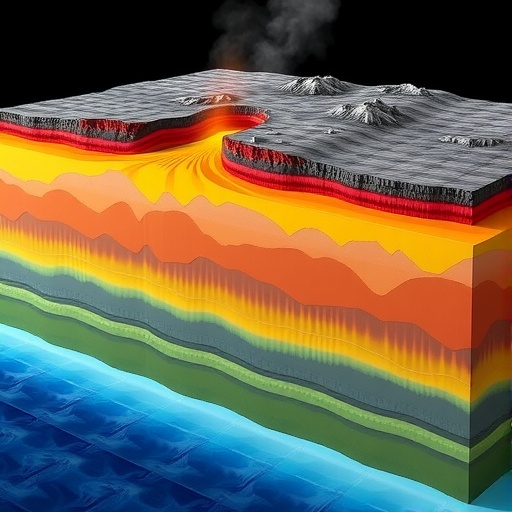
A vast slab of oceanic crust can plunge beneath a continent, disappear into Earth’s mantle, and still shape where volcanoes erupt millions of years later. A new study published in Nature Communications proposes that the key to this long-distance influence lies in the slab’s internal diversity. Rather than behaving as a uniform, rigid plate, a stagnant slab may contain contrasting sections that control where crustal material is recycled, where melts rise, and why volcanoes sometimes appear in tightly concentrated clusters instead of spreading evenly across a volcanic arc.
The research, led by Zhu, Deng, Xu and colleagues, focuses on the deep fate of subducted oceanic lithosphere. At subduction zones, one tectonic plate is forced beneath another and carried into the mantle. As the descending slab heats and interacts with surrounding rock, it can release water and other chemical components, trigger melting above it, and transport fragments of oceanic crust deep into Earth. In some regions, however, the slab does not continue smoothly toward the core-mantle boundary. It can flatten and become trapped, forming what geoscientists call a stagnant slab.
These stagnant slabs are commonly associated with the mantle transition zone, a region roughly 410 to 660 kilometers beneath Earth’s surface where minerals change structure under extreme pressure. The transition zone can act as both a barrier and a temporary storage reservoir for subducted material. A slab that stalls there may later deform, sink, or interact with rising and descending mantle currents. The new study argues that the slab’s chemical and physical heterogeneity can determine how those processes unfold, producing narrow pathways for crustal recycling and concentrating volcanic activity above them.
The idea challenges a simple picture of subduction in which an entire slab descends as a coherent sheet and affects the surface in a broadly uniform way. Oceanic plates are assembled from different materials and experience different histories before they reach a trench. Their crust may include chemically distinct volcanic rocks, sediments, altered minerals, and sections formed at different temperatures or along different parts of a spreading ridge. Once buried, these contrasts can survive deep within the mantle and influence how the stagnant slab bends, breaks apart, exchanges material with surrounding rock, and eventually releases components capable of generating magma.
“Crustal recycling” refers to the return of surface-derived material to Earth’s interior and, in some cases, its eventual transport back toward the surface. Subduction is the planet’s principal recycling system. Oceanic crust formed at mid-ocean ridges is progressively altered by seawater, covered by sediment, and carried toward trenches. When it descends, fluids and melts derived from the slab can enter the mantle wedge above it. Those additions lower the temperature required for mantle melting, helping produce the magmas that feed many volcanoes around the Pacific Ring of Fire and other subduction-related regions.
The study’s central implication is that recycling may be focused rather than evenly distributed. A heterogeneous stagnant slab could create localized zones where the slab becomes especially rich in water-bearing minerals or chemically fertile crustal components. It could also generate sharp differences in density and buoyancy. Denser portions may sink more readily, while less dense or more buoyant sections can remain suspended, fold, or spread laterally. These variations could funnel recycled material into restricted parts of the mantle, creating “hotspots” of chemical enrichment without requiring a conventional mantle plume.
That focused recycling may help explain volcanic clustering, a phenomenon in which volcanoes occur in groups or along unusually narrow belts. Volcanic arcs are often treated as relatively continuous features produced by the geometry of a subducting plate, but their activity can be highly uneven. Some segments host numerous volcanoes, intense eruptions, or distinctive magma compositions, while neighboring regions remain comparatively quiet. According to the study’s framework, such contrasts may reflect deep slab architecture rather than only shallow variations in faulting, crustal thickness, or magma storage.
The connection between a deep stagnant slab and surface volcanism is not immediate or simple. Material can move through the mantle by convection, chemical diffusion, sinking, and buoyant ascent, while mantle rocks deform over geological timescales. A chemically enriched parcel generated near the transition zone may rise slowly and interact with several mantle layers before reaching the base of the crust. During that journey, it can mix with hotter or more depleted mantle, change its mineral composition, and acquire new chemical signatures. The resulting magma may therefore preserve a complex record of both its deep source and its later evolution.
This perspective could give geoscientists a new way to interpret volcanic rocks. Magmas carry isotopic and elemental fingerprints that reveal whether their ingredients came mainly from the mantle, subducted sediments, altered oceanic crust, or older continental material. If volcanic clusters are linked to particular portions of a heterogeneous stagnant slab, neighboring volcanoes may display systematic differences in elements associated with fluids, sediment, or recycled crust. Such patterns could allow researchers to trace the movement of deep material even when the original slab lies hundreds of kilometers below the surface.
The findings also matter for understanding how continents grow and change. Subduction does not merely generate volcanoes; it transfers material between the ocean floor, mantle, crust, and atmosphere. Over time, volcanic activity and magmatic intrusions can add new material to continental margins, while erosion and sedimentation return surface material to the subduction system. If stagnant slabs focus where recycled components re-enter the melting cycle, they may influence the distribution of chemically unusual rocks, mineral deposits, and regions of long-term crustal construction.
The study presents Earth’s mantle as a dynamic archive rather than a featureless layer. A slab that appears to have stalled may remain tectonically active, preserving contrasts inherited from the ocean floor while reorganizing them under extreme pressure and temperature. Those contrasts can affect mantle flow, chemical exchange, and the pathways taken by magma-forming ingredients. The result is a deep-earth feedback system in which events at a subduction trench can influence volcanic geography far into the future.
For the public, the most striking message is that volcanoes may be connected to structures hidden far beneath the surface, not simply to the location of a plate boundary. The position of a volcanic cluster could reflect the architecture of a slab that began its journey on the seafloor, traveled into the mantle, and then became trapped in the transition zone. By identifying how heterogeneous stagnant slabs control crustal recycling, the research offers a more detailed explanation for why some parts of Earth become volcanic centers while nearby regions remain relatively calm. It also shows that the planet’s most dramatic surface events may be shaped by ancient materials moving through a concealed, slowly evolving interior system.
Cite Scienmag News
Violet Maxwell. (August 15, 2026). Heterogeneous stagnant slabs focus crustal recycling and volcanic activity. Scienmag. https://scienmag.com/heterogeneous-stagnant-slabs-focus-crustal-recycling-and-volcanic-activity/
Violet Maxwell. "Heterogeneous stagnant slabs focus crustal recycling and volcanic activity." Scienmag, 15 August 2026, https://scienmag.com/heterogeneous-stagnant-slabs-focus-crustal-recycling-and-volcanic-activity/. Accessed 3 September 2026.
Violet Maxwell. "Heterogeneous stagnant slabs focus crustal recycling and volcanic activity." Scienmag. August 15, 2026. https://scienmag.com/heterogeneous-stagnant-slabs-focus-crustal-recycling-and-volcanic-activity/


