


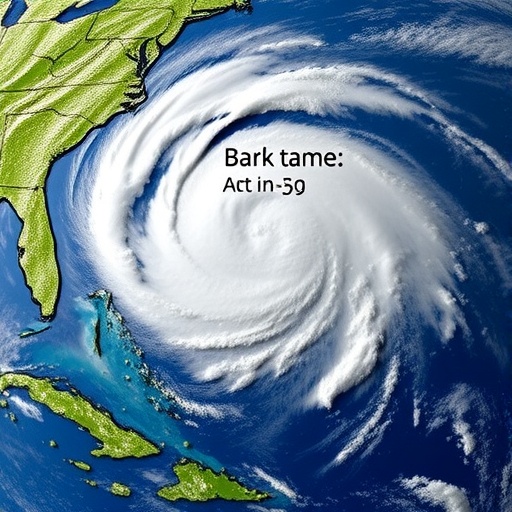
For decades, hurricane danger has been communicated through a familiar number: maximum sustained wind speed. The faster the winds, the more powerful the storm is assumed to be. But a new study in npj Natural Hazards argues that another measurement may offer a more reliable warning of the destruction a hurricane can ultimately cause. Researchers Klotzbach, Needham, Gori and their colleagues report that a storm’s minimum central pressure outperforms its maximum wind speed when predicting storm surge, physical damage and fatalities. Their finding challenges one of the most deeply rooted habits in hurricane communication and could influence how forecasters, emergency managers and the public interpret the threat posed by tropical cyclones.
Minimum central pressure is the lowest atmospheric pressure recorded near the center of a hurricane, usually inside or close to the eye. As air spirals inward around the storm, the pressure at its core can fall dramatically below the surrounding atmosphere. That pressure difference, known as the pressure gradient, helps drive the hurricane’s circulation. In general, a lower central pressure is associated with a stronger storm, although the relationship is not perfectly fixed. Maximum wind speed measures the highest sustained wind found somewhere within the circulation, while minimum pressure reflects the storm’s broader atmospheric structure and intensity. The study suggests that this deeper, more integrated signal may better capture the factors that determine whether a hurricane becomes a catastrophe.
The distinction matters because hurricanes do not produce danger through wind alone. Storm surge—the abnormal rise of seawater pushed toward the coast—often causes the greatest number of deaths and can generate enormous economic losses. A hurricane’s winds transfer momentum to the ocean, but low atmospheric pressure also allows the sea surface beneath the storm to rise, a process called the inverse barometer effect. In simplified terms, lower pressure reduces the weight of the atmosphere pressing on the ocean, allowing the water surface to lift. When that effect combines with powerful onshore winds, shallow coastal waters and the storm’s forward motion, sea levels can rise several meters above normal tides. Minimum pressure therefore connects directly to one of the physical mechanisms behind surge.
Maximum wind speed, by contrast, is a local measurement. It describes the strongest sustained winds at a particular portion of the storm, but it does not fully reveal how large the wind field is, how long the storm has been pushing water toward shore or how the hurricane’s structure is organized. Two storms can have identical peak winds while producing very different hazards. One may be compact, moving quickly and crossing a sparsely populated coastline. Another may be enormous, slow-moving and aimed directly at a densely developed coastal region. Their maximum wind categories could look similar even though their surge, damage and fatality risks are profoundly different. Minimum pressure may provide a more stable indication of the storm’s total intensity across these changing structures.
The finding also highlights why hurricane categories can be misunderstood. The Saffir-Simpson Hurricane Wind Scale is based solely on maximum sustained wind and was designed to communicate wind damage potential. It does not incorporate storm surge, rainfall, tornadoes, storm size or the number of people exposed. A storm classified below the highest category can still produce a devastating surge, especially if its pressure is exceptionally low, its circulation is broad or it approaches a coastline with a vulnerable shape. Conversely, a hurricane with extreme winds may not generate the largest surge if its wind field is compact, its track is unfavorable for onshore water transport or it moves rapidly over a steep continental shelf.
By identifying minimum pressure as a stronger predictor of surge, damage and deaths, the research points toward a more sophisticated approach to risk assessment. Pressure is not a magic number capable of predicting every consequence, but it can serve as a powerful summary of a hurricane’s intensity. Its value may be especially important when comparing storms from different eras, because wind measurements have historically been affected by changes in aircraft reconnaissance, satellite technology, observing networks and analysis methods. Central pressure observations also come from several established sources, including aircraft instruments, surface stations and remote sensing techniques, giving scientists another pathway for reconstructing storm behavior.
The relationship between pressure and human consequences is not purely meteorological. A hurricane becomes a disaster when its physical hazards intersect with exposed communities, infrastructure and limited capacity to evacuate or recover. Low pressure can signal elevated surge potential, but fatalities also depend on warning time, transportation systems, building standards, coastal defenses, income, age distribution and public trust. Damage depends on the storm’s size, rainfall, wind duration, landfall angle and the resilience of homes, hospitals, power grids and communication networks. The study’s result does not erase these variables; instead, it suggests that minimum pressure may be a more informative starting point for combining them into forecasts of overall impact.
For emergency managers, the implications could be significant. A warning system that emphasizes only the highest wind speed may cause residents outside the immediate eyewall to underestimate their danger. The most destructive surge can extend far beyond the area experiencing the maximum winds, and a wide, low-pressure hurricane can affect coastlines over hundreds of kilometers. If pressure-based indicators are incorporated more prominently into forecast briefings, officials may be able to identify storms whose potential consequences exceed what their wind category appears to suggest. That could improve decisions about evacuation zones, shelter operations, hospital preparation, fuel supplies and the protection of critical infrastructure before conditions deteriorate.
The study also arrives as coastal risk is becoming more difficult to interpret. Rising sea levels mean that the same storm-driven surge can begin from a higher baseline, allowing seawater to penetrate farther inland. Rapid urbanization has placed more homes, roads, ports and industrial facilities in low-lying coastal areas, while changing climate conditions are altering the environment in which tropical cyclones develop. These trends do not mean that every hurricane will become more dangerous in the same way, but they increase the consequences of misjudging a storm’s potential. A measurement that more closely reflects the physical power capable of producing surge could become increasingly valuable as coastal populations grow.
The researchers’ conclusion is ultimately a warning against reducing hurricane risk to a single familiar category. Maximum wind speed remains essential for estimating wind damage, but minimum central pressure may better predict the combined human toll of storm surge, structural destruction and fatalities. The most effective forecasts will likely use both measures alongside storm size, rainfall, forward speed, track, coastal shape and population exposure. For the public, the practical message is simple: a hurricane’s category is not a complete description of its danger. The lowest pressure at the storm’s core may reveal a threat that the headline wind speed fails to capture—and recognizing that difference could save lives when the next major hurricane approaches.
Cite Scienmag News
Violet Maxwell. (August 15, 2026). Minimum pressure predicts hurricane surge, damage and deaths better than maximum winds. Scienmag. https://scienmag.com/minimum-pressure-predicts-hurricane-surge-damage-and-deaths-better-than-maximum-winds/
Violet Maxwell. "Minimum pressure predicts hurricane surge, damage and deaths better than maximum winds." Scienmag, 15 August 2026, https://scienmag.com/minimum-pressure-predicts-hurricane-surge-damage-and-deaths-better-than-maximum-winds/. Accessed 3 September 2026.
Violet Maxwell. "Minimum pressure predicts hurricane surge, damage and deaths better than maximum winds." Scienmag. August 15, 2026. https://scienmag.com/minimum-pressure-predicts-hurricane-surge-damage-and-deaths-better-than-maximum-winds/


