


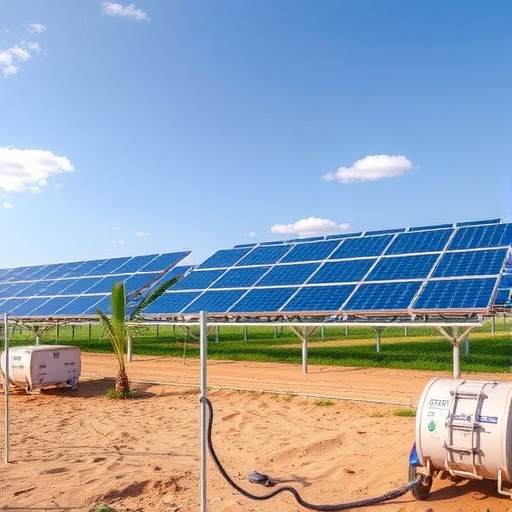
Solar power is often presented as one of the cleanest technologies in the fight against climate change. Yet behind every photovoltaic panel lies a future waste problem that is growing almost as rapidly as solar capacity itself. A study by Wang, Zuo, Chen and colleagues, published in Nature, argues that the next phase of the energy transition must address not only how panels are manufactured and installed, but also who will handle them when they reach the end of their working lives. Without coordinated global rules, the researchers warn, photovoltaic waste recycling could become another environmental system in which the benefits are widely distributed while the risks and costs are concentrated in less wealthy regions.
Photovoltaic modules typically operate for 25 to 35 years, although their performance gradually declines as materials weather, electrical components degrade and newer technologies make older panels economically unattractive. The result is a delayed but accelerating stream of discarded equipment. Panels contain valuable materials, including aluminium, copper, silicon and silver, as well as polymers, glass and semiconductor compounds. Glass and aluminium make up most of a module’s mass, but the smaller quantities of high-value materials can determine whether recycling is economically viable. Recovering them requires dismantling, separation and, in some cases, chemical processing capable of removing coatings and extracting metals from complex multilayer structures.
The challenge is that a solar panel is not simply a flat sheet of glass that can be melted down. Most crystalline-silicon modules consist of a glass front layer, an encapsulant that protects the solar cells, silicon wafers, metal contacts, a polymer backsheet and an aluminium frame. These layers are bonded together to withstand decades of heat, moisture and ultraviolet radiation. That durability is essential during operation, but it makes recovery difficult at the end of the module’s life. Mechanical shredding can separate bulk materials, yet it may reduce the quality of recovered components and leave valuable metals dispersed in mixed residues. More advanced thermal, mechanical and chemical methods can achieve higher recovery rates, but they require additional energy, specialised infrastructure and strict controls for hazardous substances.
The researchers place this technical problem within a larger question of global equity. Solar manufacturing and deployment are distributed unevenly across the world, as are the facilities capable of processing complex electronic waste. Countries with strong environmental regulations may require producers to finance collection and recycling, while regions with weaker regulatory systems can become destinations for used or damaged equipment. In such settings, informal workers may dismantle panels without adequate protection, recovering easily accessible metals while discarding glass, polymers or contaminated residues. The economic value of recovered materials can therefore coexist with exposure to dust, solvents and heavy metals, creating a recycling economy in which vulnerable communities bear disproportionate health and environmental risks.
A central message of the study is that photovoltaic waste should be treated as a global material-flow issue rather than a local disposal problem. Panels may be manufactured in one country, installed in another, sold into a third market and eventually exported for repair, reuse or dismantling. This international movement complicates responsibility. If ownership changes several times, it may be unclear whether the manufacturer, importer, project developer, asset owner or final user must pay for collection and treatment. The authors’ analysis points toward policies that assign responsibility across the entire life cycle, rather than waiting until a panel becomes waste and leaving the final handler to absorb the cost.
Design choices made before a panel reaches the market could have a major influence on future recycling. Modules designed for repair, disassembly and component replacement would be easier to process than permanently bonded structures. Standardised fasteners, identifiable material labels and digital records could help recyclers determine the composition and condition of incoming panels. Such information is important because photovoltaic technologies are changing rapidly. Alongside conventional crystalline silicon, the industry is developing thin-film modules, tandem cells and perovskite-based devices, each with different material profiles and recycling requirements. A product that is efficient to manufacture may not automatically be efficient to recover, and the study highlights the need to evaluate both characteristics together.
The economic barriers are just as significant as the engineering barriers. In many regions, the cost of collecting, transporting and dismantling a panel can exceed the market value of the recovered materials. New panels may also be so inexpensive and efficient that owners prefer replacement rather than repair, even when older modules could continue producing electricity. This creates a difficult policy balance: extending a panel’s life through testing, refurbishment and resale can reduce immediate waste, but exporting used modules without clear performance standards can shift future disposal burdens to countries that lack recycling capacity. Effective systems will need to distinguish between genuine second-life use and the transfer of obsolete equipment under the label of reuse.
The study also underscores the importance of measuring recycling success more carefully. A high recovery rate by mass can conceal the loss of the most valuable or strategically important materials. Recovering nearly all of a module’s glass and aluminium, for example, may still leave silicon, silver and semiconductor compounds trapped in residues. Life-cycle assessment can compare the environmental costs of different treatment methods by accounting for energy consumption, chemical use, transport and avoided mining. These assessments are essential for determining whether a recycling process delivers a real climate and resource benefit, rather than merely moving pollution from one stage of the supply chain to another.
For the solar industry, the findings represent a warning that rapid deployment without end-of-life planning could undermine public confidence in renewable energy. The solution is not to slow the expansion of photovoltaics, which remain a crucial source of low-carbon electricity, but to build circular systems alongside new installations. Governments could establish producer-responsibility rules, minimum recycling targets, financial guarantees for future treatment and international standards for cross-border shipments. Manufacturers could invest in modular designs and recovery technologies, while project owners could maintain accurate records of panel age, composition and performance. Shared data systems would allow regulators and recyclers to anticipate waste volumes instead of reacting after disposal capacity has already been exceeded.
The global photovoltaic transition is therefore approaching a test that cannot be solved by efficiency improvements alone. Solar panels convert sunlight into electricity for decades, but their environmental value ultimately depends on what happens to the materials after that service ends. Wang and colleagues frame equitable recycling as a question of technology, economics and justice at the same time. If countries coordinate early, discarded panels could become a secondary source of industrial materials and reduce pressure on mining. If they do not, the world may discover that the clean-energy revolution has produced a new waste frontier—one in which the panels powering a sustainable future leave their greatest burdens far from the consumers who benefited from them.
Cite Scienmag News
Violet Maxwell. (August 14, 2026). Building an Equitable Future for Global Photovoltaic Waste Recycling. Scienmag. https://scienmag.com/building-an-equitable-future-for-global-photovoltaic-waste-recycling/
Violet Maxwell. "Building an Equitable Future for Global Photovoltaic Waste Recycling." Scienmag, 14 August 2026, https://scienmag.com/building-an-equitable-future-for-global-photovoltaic-waste-recycling/. Accessed 4 September 2026.
Violet Maxwell. "Building an Equitable Future for Global Photovoltaic Waste Recycling." Scienmag. August 14, 2026. https://scienmag.com/building-an-equitable-future-for-global-photovoltaic-waste-recycling/


