


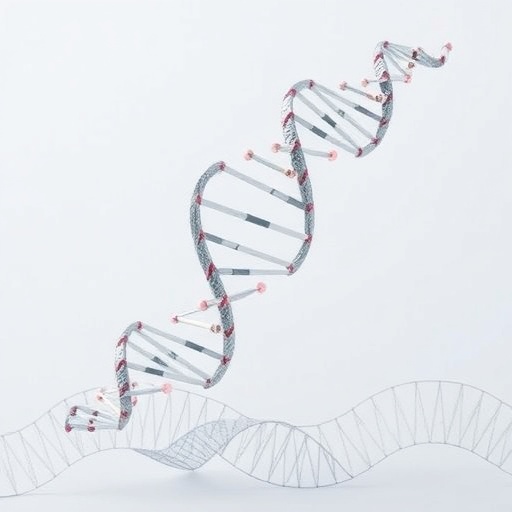
LA JOLLA, Calif., August 13, 2026—For decades, biologists have been able to catalog many of the chemical reactions that sustain life, yet the physical movements driving those reactions have remained largely invisible. A new imaging method from scientists at the Salk Institute now brings one of biology’s most important molecular motions into view. The technique, called dye-cycling ORBIT, enables researchers to track how individual RNA polymerase molecules rotate as they move along DNA during transcription, maintaining base-pair resolution for minutes and, in later laboratory applications, even hours. The work, published in Cell Reports Methods, could offer an unusually detailed way to investigate the mechanical behavior of the molecular machines that read genetic information.
“ If you don’t know how something moves, you don’t know what it does,” says Pallav Kosuri, PhD, an assistant professor at Salk and senior author of the study. Kosuri’s laboratory is pursuing a view of biology in which movement is as fundamental as chemistry. Chemical reactions may determine which bonds are formed or broken, but the motions of atoms, proteins, and larger molecular assemblies often determine how those reactions occur in real time. According to Kosuri, biology has a relatively comprehensive catalog of chemical reactions, while the mechanical side remains far less explored. The new method is designed to reveal that missing layer by converting molecular-scale motion into a signal visible through a conventional fluorescence microscope.
The approach is based on DNA origami, a form of molecular engineering that uses the predictable pairing of DNA bases to build custom structures. DNA contains four nucleic-acid bases—adenine, thymine, cytosine, and guanine—that pair in specific combinations, with adenine pairing with thymine and cytosine pairing with guanine. Researchers can design a long scaffold strand and hundreds of shorter “staple” strands so that the DNA folds into a predetermined three-dimensional shape. Because the structure assembles from the bottom up according to the sequence of its components, DNA origami can produce objects with nanometer-scale precision without the machinery required for conventional manufacturing. The technology has been explored for applications including drug delivery and nanoscale devices, but Kosuri’s group is using it as a tool for foundational molecular biology.
The challenge is that the movements the researchers want to measure are far smaller than the resolution of visible-light microscopy. DNA has a helical structure, and proteins that travel along it must rotate as they follow the twisting molecular track. The diameter of this rotation is roughly 100 times smaller than the wavelength of visible light, making the motion impossible to observe directly with a standard microscope. Rather than attempting to image DNA’s tiny rotation itself, Kosuri and his colleagues designed a much larger DNA-origami rotor that can be attached to the DNA-protein system. When the molecular machinery rotates, the origami device rotates with it, amplifying the movement into a fluorescent signal that can be recorded over time.
The original version of this technology, known as ORBIT, uses a fluorescently labeled DNA-origami rotor to track rotation as RNA polymerase transcribes DNA into RNA. RNA polymerase is an enzyme that moves along a DNA template, assembling a complementary RNA molecule one nucleotide at a time. Since transcription proceeds base by base, the attached rotor can report the enzyme’s progress with single-base-pair resolution. The engineered structure resembles a nanoscale wine opener: a spiraling stem connects the DNA-interacting region to a large, X-shaped handle carrying a fluorescent label. The handle magnifies the underlying rotation, allowing researchers to follow the direction and timing of the enzyme’s movement with a microscope that cannot resolve the DNA helix itself.
However, fluorescence microscopy has a fundamental limitation. Fluorescent molecules emit light when excited, but the repeated illumination gradually damages them in a process known as photobleaching. Once the dye molecules are chemically altered, they no longer produce a sufficiently bright signal, and the molecular motion disappears from the image even if the biological process continues. In early ORBIT experiments, photobleaching restricted observations to only a few seconds and allowed RNA polymerase to be followed across just a small number of base pairs. That short time window made it difficult to study pauses, changes in speed, or other mechanical behaviors that emerge over longer transcriptional journeys.
To overcome the problem, first author Amanda Wacker, PhD, and her colleagues developed a dye-cycling strategy that continually replenishes the fluorescent signal. Instead of relying on one permanently attached fluorescent tag, the system allows fresh fluorescent probes to associate with the DNA-origami rotor during the observation period. As older dyes fade, new probes replace them, effectively refueling the rotor while it is being tracked. The cycling process preserves the spatial information encoded by the origami structure while extending the period during which the molecular motion can be detected. In their study, the researchers used dye-cycling ORBIT to observe DNA rotations associated with transcription for approximately 10 minutes, a major increase over the seconds available with the original method.
“Pairing dye-cycling with ORBIT allowed us to overcome photobleaching limitations and track RNA polymerase transcription over long timescales while maintaining our single base-pair resolution,” says Wacker, who recently completed her PhD in Kosuri’s laboratory. The extended measurements provide more than a longer video of the same process. They allow researchers to examine how a molecular machine behaves across an extended DNA sequence, including whether its rotation remains uniform, whether it pauses, and how its motion may change as it encounters different regions of genetic material. Kosuri says the technique has since been used in his laboratory to capture molecular movement for hours, suggesting that the method could be adapted to study biological processes whose most informative events occur slowly or intermittently.
The immediate focus of the work is transcription, but the researchers see dye-cycling ORBIT as a broader platform for studying proteins that interact mechanically with DNA. RNA polymerase must negotiate the structural constraints of the DNA helix as it reads genetic instructions, and its movement is influenced by the physical properties of both the enzyme and the nucleic-acid track. A longer-lasting rotor could help scientists connect biochemical events—such as nucleotide incorporation—to mechanical events, including rotation, forward stepping, and pausing. Such measurements may ultimately clarify how transcription is regulated, how errors are avoided, and how molecular motion changes when genetic processes malfunction. More broadly, the method could make it possible to investigate the largely unexplored “mechanical universe” of biology, in which enzymes and molecular complexes constantly twist, step, bend, and reorganize themselves to keep cells alive.
The study also illustrates how DNA origami is evolving from a nanoscale construction technique into an instrument for observing life. Kosuri’s laboratory previously drew global attention after helping engineer a functional miniature Nerf gun made entirely from DNA for an educational project with engineer and science communicator Mark Rober. That project highlighted the extraordinary design flexibility of DNA-based structures; dye-cycling ORBIT applies the same precision to a more fundamental biological question. By attaching a visible, programmable nanostructure to an invisible molecular process, the researchers have created a bridge between the scale of individual base pairs and the scale accessible to optical microscopy. Their paper, titled “Dye-cycling DNA origami rotors for long-term tracking of transcription at base-pair resolution,” reports a method that could help turn molecular movement from an abstract model into an experimentally measurable feature of gene expression.
News Publication Date: August 13, 2026
Web References: https://www.cell.com/cell-reports-methods/fulltext/S2667-2375(26)00251-1; https://www.salk.edu/scientist/pallav-kosuri/; https://doi.org/10.1016/j.crmeth.2026.101550
References: Wacker A, Tenner B, Liu B, Fantasia R, Monell N, Wu J, Kosuri P. “Dye-cycling DNA origami rotors for long-term tracking of transcription at base-pair resolution.” Cell Reports Methods. Published August 13, 2026. DOI: 10.1016/j.crmeth.2026.101550.
Cite Scienmag News
Drew Townsend. (August 14, 2026). DNA Origami Reveals Hidden Molecular Movements. Scienmag. https://scienmag.com/dna-origami-reveals-hidden-molecular-movements/
Drew Townsend. "DNA Origami Reveals Hidden Molecular Movements." Scienmag, 14 August 2026, https://scienmag.com/dna-origami-reveals-hidden-molecular-movements/. Accessed 4 September 2026.
Drew Townsend. "DNA Origami Reveals Hidden Molecular Movements." Scienmag. August 14, 2026. https://scienmag.com/dna-origami-reveals-hidden-molecular-movements/


