


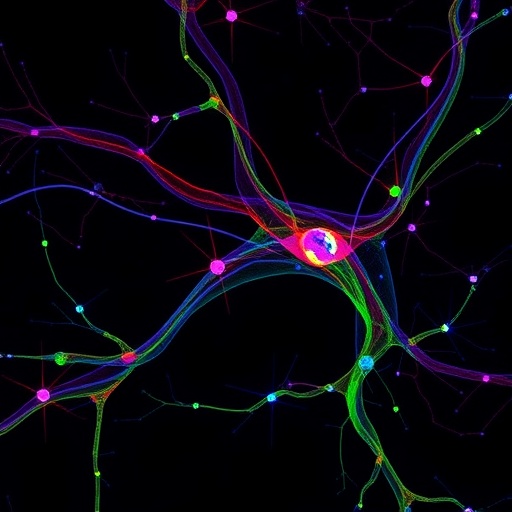
Alzheimer’s disease has long been associated with the accumulation of tau, a neuronal protein that normally helps organize and stabilize microtubules inside axons. In the disease, tau becomes abnormally distributed, appearing in the somatodendritic compartment—the region containing the cell body and dendrites—and eventually forms fibrillar aggregates. A new study now reveals that the earliest stages of this process may be governed by a previously underappreciated balance between local protein production and local protein destruction. The findings suggest that neurons continuously produce more tau than they retain, relying on a specialized degradation system to prevent the excess protein from becoming toxic.
Published in Nature Neuroscience, the study introduces a technology called STARFISH, which allows researchers to visualize where endogenous messenger RNA molecules are translated inside neurons. Unlike many existing methods, STARFISH can track protein synthesis at single-molecule sensitivity and with near-codon resolution without attaching a fluorescent tag or other modification to the newly forming protein. This distinction is important because modifying a nascent polypeptide can alter its folding, movement, interactions or degradation, potentially obscuring the biology researchers are trying to measure. STARFISH instead captures the translation process through molecular signals associated with ribosomes and translating messenger RNA.
The technique was applied to primary neurons and to neurons in living animals to follow the translation of Mapt, the gene that encodes tau. The researchers found that Mapt messenger RNA is broadly distributed throughout the neuron, including regions near the cell body and along dendrites. Yet the protein was not produced uniformly across these compartments. According to the study, endogenous tau translation occurred exclusively in neuronal dendrites. This result challenges the simple assumption that a widely distributed messenger RNA necessarily produces protein wherever it is found. Instead, it indicates that neurons impose a highly localized form of translational control on tau.
Dendrites are complex, highly active structures that receive and integrate signals from other neurons. They contain local populations of ribosomes and messenger RNAs capable of producing proteins close to synapses, allowing neuronal responses to be adjusted rapidly without relying exclusively on transport from the cell body. Local translation can be advantageous, but it also creates a potential risk: newly synthesized proteins are particularly vulnerable to misfolding before they achieve their mature structures. The discovery that tau is translated in dendrites therefore raises a central question. If tau is produced in a compartment where it can become mislocalized or aggregate, how does the neuron maintain protein quality?
The answer identified by the researchers involves a specialized proteasome associated with the neuronal plasma membrane. Proteasomes are large molecular machines that recognize and dismantle proteins marked for destruction, breaking them into smaller peptides that can be recycled or further degraded. The study describes a neuronal-specific form known as the neuroproteasome, positioned at the cell surface and capable of operating near sites where dendritic translation occurs. This arrangement would place protein synthesis and protein disposal in close proximity, creating a local quality-control system for newly produced tau.
Using STARFISH, the researchers reported that approximately one-third of newly synthesized tau is degraded either during translation or shortly after translation in dendrites. Co-translational degradation occurs while a polypeptide is still being assembled by the ribosome, whereas peri-translational degradation refers to destruction occurring immediately around the translation event. The scale of this process suggests that dendritic tau production is not simply a pipeline in which every newly made molecule proceeds into the cellular protein pool. Instead, a substantial fraction is eliminated almost immediately, before it can mature, move through the neuron or contribute to aggregate formation.
This finding provides a new perspective on tau homeostasis. Neurons may constitutively overproduce tau in dendrites, with the neuroproteasome acting as a safety valve that removes surplus or defective molecules. Such a system could be especially valuable because tau is intrinsically prone to abnormal interactions when its concentration, localization or conformation changes. By degrading a portion of tau at the site of synthesis, the neuron may limit the amount of vulnerable protein entering the somatodendritic compartment. The process also suggests that tau aggregation could begin not only with a failure of mature protein clearance, but with a breakdown in the immediate quality control surrounding translation.
The researchers further found that when neuroproteasome-mediated degradation was impaired, endogenous tau aggregates accumulated in the somatodendritic compartment. This accumulation depended on ongoing protein synthesis, indicating that the aggregates were being supplied by newly produced tau rather than arising solely from redistribution of an existing axonal pool. The result strengthens the connection between local translation and pathological tau deposition. It also points to a mechanism by which disruption of a membrane-associated degradation pathway could convert a normal physiological process—dendritic protein production—into a source of toxic accumulation.
The work does not establish that neuroproteasome failure is the initiating event in Alzheimer’s disease, and it does not show that restoring this pathway would prevent dementia. However, it identifies a potentially important vulnerability in neuronal proteostasis. If the system is weakened by age, cellular stress, altered membrane organization or other disease-related changes, dendritic tau could escape early degradation and persist long enough to misfold and assemble into aggregates. The study’s broader implication is that Alzheimer’s research may need to examine not only where tau travels and how mature aggregates are cleared, but also where tau is born and how quickly it is destroyed. STARFISH offers a way to observe that hidden stage of protein biology, potentially revealing how local translation and local degradation together determine whether a neuron remains healthy or moves toward tau pathology.
Cite Scienmag News
Cassandra Pierce. (August 13, 2026). STARFISH Reveals Dendritic Translation and Neuroproteasome Degradation of Endogenous Tau. Scienmag. https://scienmag.com/starfish-reveals-dendritic-translation-and-neuroproteasome-degradation-of-endogenous-tau/
Cassandra Pierce. "STARFISH Reveals Dendritic Translation and Neuroproteasome Degradation of Endogenous Tau." Scienmag, 13 August 2026, https://scienmag.com/starfish-reveals-dendritic-translation-and-neuroproteasome-degradation-of-endogenous-tau/. Accessed 4 September 2026.
Cassandra Pierce. "STARFISH Reveals Dendritic Translation and Neuroproteasome Degradation of Endogenous Tau." Scienmag. August 13, 2026. https://scienmag.com/starfish-reveals-dendritic-translation-and-neuroproteasome-degradation-of-endogenous-tau/


