


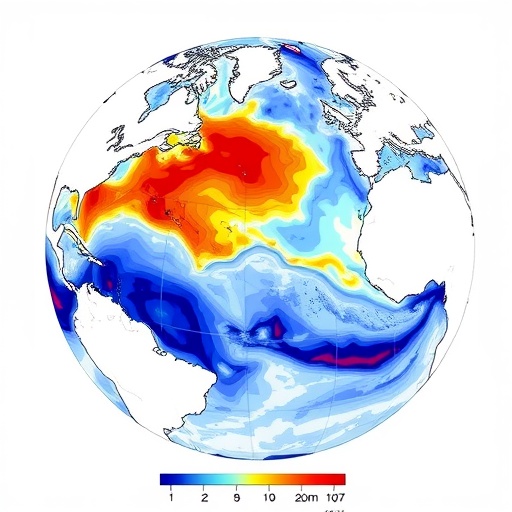
For decades, climate scientists have warned that the Atlantic Meridional Overturning Circulation, or AMOC, could weaken dramatically—and potentially collapse—if global warming passes a critical threshold. The circulation is often described as the Atlantic Ocean’s great heat engine, carrying warm, salty surface water from the tropics toward the North Atlantic while returning colder, denser water southward at depth. New research from Utrecht University suggests that this familiar picture is missing a crucial variable: not only how warm the planet becomes, but how quickly the warming occurs may determine whether the AMOC remains stable or tips into a much weaker state.
The AMOC is not a single current but a vast, interconnected system of ocean circulation. Near the surface, warm water flows northward, releasing heat into the atmosphere as it reaches higher latitudes. Cooling and increasing salinity make some of this water dense enough to sink in the North Atlantic, forming deep-water currents that travel southward and help complete the circulation loop. This process redistributes heat around the planet and contributes to the relatively mild climate of Western Europe. Because the system depends on a delicate balance between temperature, salinity, density and freshwater input, it can be disrupted by global warming and melting ice.
Scientists have long suspected that the AMOC possesses a tipping point. Beyond that point, relatively small additional disturbances could cause the circulation to shift rapidly from its modern, vigorous state to a substantially weaker one. Such a transition would not simply mean that the ocean currents slowed by a few percent. It could alter rainfall patterns, intensify regional climate contrasts, affect sea levels along parts of the North American coast and sharply reduce the northward transport of heat. Earlier studies often associated AMOC collapse with roughly 4 degrees Celsius of global warming, but the Utrecht study indicates that no universal temperature threshold exists.
“Our results show there is not necessarily a fixed temperature beyond which the AMOC inevitably collapses,” says lead author René van Westen of Utrecht University’s Institute for Marine and Atmospheric Research. “The stability of the circulation depends on how fast the climate is changing.” The finding challenges the idea that the AMOC responds only to the final amount of warming. Instead, the circulation may be forced out of equilibrium when environmental conditions change faster than the deep ocean can adjust.
To test that possibility, van Westen and colleagues conducted computational climate-model experiments using steadily rising atmospheric carbon dioxide concentrations. They ran the model under two different rates of increase: approximately 0.5 parts per million of carbon dioxide per year in one experiment and 2.5 parts per million per year in the other. The slower pathway was designed to isolate the effects of the pace of climate change, while the faster pathway was comparable to the rapid growth in atmospheric carbon dioxide occurring in the modern era. Because the experiments used different rates of forcing, rather than simply different final temperatures, the researchers could examine how quickly the ocean was being pushed away from its previous state.
The contrast between the simulations was striking. Under the slower warming pathway, the AMOC remained stable well beyond 4 degrees Celsius of global warming and did not collapse even when warming reached approximately 5 degrees Celsius in the model. Under the faster pathway, however, the circulation collapsed at around 2 degrees Celsius of warming. The results do not mean that the real-world AMOC will necessarily collapse at exactly 2 degrees, nor do they provide a precise forecast date. Climate models differ in their representation of ocean mixing, atmospheric processes, ice sheets and freshwater flows. But the experiments reveal a powerful mechanism: a rapidly changing climate can make the circulation vulnerable at a lower temperature than would be expected from a slow-warming scenario.
The physical explanation involves the ocean’s ability to reorganize. The AMOC extends from the surface to great depths, and its stability depends on how density changes are communicated through the water column. Under gradual warming, the ocean has more time to redistribute heat, adjust salinity patterns and modify its deep circulation. This allows the system to track a sequence of relatively stable states as conditions change. Under rapid warming, the surface ocean changes faster than the deeper ocean can respond. That mismatch can generate a transient state in which the circulation fails to follow the stable pathway available under slower environmental change.
“Under slow warming, the entire ocean, from the surface down to its deepest layers, has time to gradually reorganize and adapt to the changing conditions,” says co-author Henk Dijkstra, professor of Dynamical Oceanography at Utrecht University. “Under faster warming, the ocean simply can’t keep up.” The researchers identify a critical warming rate of approximately 0.3 degrees Celsius per decade, a pace the world is already approaching. Their comparison is similar to driving toward an obstacle: lowering the eventual speed matters, but braking early enough to change course may be just as important. In climate terms, reducing the rate of warming could give the ocean more time to adapt before destabilizing feedbacks take hold.
The study helps explain why previous AMOC assessments have produced different estimates of its tipping behavior. In earlier work, the Utrecht group found that large freshwater inputs into the North Atlantic could make the circulation more unstable by reducing surface-water density and hindering deep-water formation. Their 2024 simulations showed a critical freshwater threshold in a modern, complex climate model, although the threshold was considered unrealistically high for the present-day AMOC to become unstable through that mechanism alone. A later study examining intermediate- and high-emission scenarios estimated that a tipping point could occur around 2060, at approximately 2.5 degrees Celsius of warming. The new research suggests that differences among these results may arise partly because each experiment applies climate forcing at a different rate.
The implications extend beyond the AMOC itself and into climate policy. Many climate strategies focus on limiting the eventual peak level of global warming, sometimes allowing temporary overshoot on the assumption that future technologies will remove carbon dioxide and reduce temperatures later. The new findings indicate that the path to a temperature target may matter as much as the target itself. A short-lived period of rapid warming could push the ocean into a less stable state even if temperatures later decline. Slowing the rise in global temperature could therefore reduce near-term tipping risk by preserving the ocean’s capacity to adjust. The AMOC remains difficult to monitor and model, and the study does not establish that collapse is imminent. It does, however, deliver a clear warning: for one of Earth’s largest climate systems, the speed of change may be as consequential as the final number on the thermometer.
News Publication Date: 13-Aug-2026
Web References: Utrecht University Institute for Marine and Atmospheric Research: https://www.uu.nl/en/research/institute-for-marine-and-atmospheric-research-imau ; DOI: https://doi.org/10.1038/s41558-026-02730-w
References: Nature Climate Change, “Failure to track a stable AMOC state under rapid climate change,” DOI: 10.1038/s41558-026-02730-w
Cite Scienmag News
Sloane Callahan. (August 13, 2026). Climate Change Speed Influences Atlantic Meridional Overturning Circulation Stability. Scienmag. https://scienmag.com/climate-change-speed-influences-atlantic-meridional-overturning-circulation-stability/
Sloane Callahan. "Climate Change Speed Influences Atlantic Meridional Overturning Circulation Stability." Scienmag, 13 August 2026, https://scienmag.com/climate-change-speed-influences-atlantic-meridional-overturning-circulation-stability/. Accessed 3 September 2026.
Sloane Callahan. "Climate Change Speed Influences Atlantic Meridional Overturning Circulation Stability." Scienmag. August 13, 2026. https://scienmag.com/climate-change-speed-influences-atlantic-meridional-overturning-circulation-stability/


