


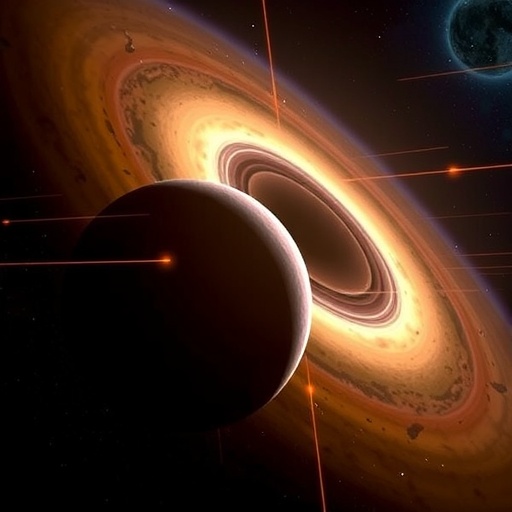
A new study suggests that the turbulent neighborhoods surrounding supermassive black holes may be far more than cosmic engines of destruction. They could also function as extraordinary planet factories, producing worlds thousands of times more massive than Earth and, in some cases, objects heavy enough to approach the mass of the Sun. The research, led by New Mexico State University astronomy associate professor Wladimir Lyra, proposes that the doughnut-shaped structures of gas and dust encircling active galactic nuclei may host a planetary formation process unlike anything found around ordinary stars.
The idea challenges the familiar image of a black hole as a cosmic vacuum cleaner. Although a black hole’s gravity can capture matter that crosses its event horizon, the material surrounding a supermassive black hole is not simply swallowed. Instead, gas and dust can form a rapidly rotating accretion disk, with the outer regions extending across vast distances. In these cooler, denser zones, dust grains may collide, stick together and gradually assemble into larger bodies. Lyra and his collaborators argue that this environment could resemble a protoplanetary disk, but on a vastly larger and more energetic scale.
“We’re finding objects that are a thousand times the mass of the Earth, but built of pure dust,” Lyra said. “And not only that, but also some of these objects are approaching the mass of the Sun.” The results come from computational modeling conducted by Lyra, Bhupendra Mishra and collaborators at the American Museum of Natural History and other institutions. Their paper, “Active Galactic Nucleus Tori: Potential Birthplace to Millions of Planets,” published in the Astrophysical Journal, explores how solid material could accumulate inside the toroidal structures surrounding active galactic nuclei, or AGNs.
An AGN is the compact, intensely luminous region at the center of a galaxy where a supermassive black hole is actively consuming matter. As gas spirals inward, friction and compression heat it to extraordinary temperatures, causing it to radiate across the electromagnetic spectrum. The black hole itself remains invisible, but its accretion disk and surrounding clouds can shine brighter than the combined light of billions of stars. According to the simulations, the outer regions of this system may be sufficiently cool for dust to survive while still containing enough material and orbital structure for solid bodies to grow.
The proposed mechanism begins with small dust particles embedded in the AGN’s rotating disk. Collisions can cause these grains to clump, creating larger aggregates that interact gravitationally with the surrounding gas and with one another. Over millions of years, the bodies could migrate through the disk, alter their orbits and collide. This process resembles the growth of planetary embryos in the disk around a young star, but the scale is dramatically different. Instead of assembling planets from a relatively modest stellar system, the AGN channel could generate enormous populations of massive objects around a central black hole.
The researchers describe this as a bottom-up pathway for creating not only planets but also stars and black holes. Conventional star formation generally proceeds through gravitational collapse: a giant cloud of gas becomes unstable, contracts under its own gravity and eventually forms a star. In the proposed AGN environment, the sequence could run in reverse. Solid bodies would first emerge from dust, then accumulate gas as their gravity increased. If they became sufficiently massive, some could reach the threshold for nuclear fusion and ignite as stars. The most massive stars could then exhaust their fuel and collapse into black holes.
That possibility gives the AGN channel implications far beyond planetary science. The resulting stellar-mass black holes could remain embedded in the accretion disk, migrate toward the galactic center and interact with other black holes. Repeated encounters and mergers might produce black holes hundreds of times more massive than the Sun, potentially helping explain how heavy black holes form in cosmic environments where standard growth mechanisms appear too slow. “They’re hundreds or thousands of times the size of the Sun,” Mishra said, noting that their movement and mergers could generate gravitational waves detectable by future observatories.
One of the most striking predictions is that these hypothetical planets and compact objects could reveal themselves through microlensing. When a massive object passes between an observer and a bright background source, its gravity bends spacetime and magnifies the light behind it. The resulting change in brightness produces a characteristic light curve. Objects orbiting inside an AGN disk could therefore act as gravitational lenses, temporarily brightening the active nucleus in patterns that differ from ordinary variability. Detecting these predicted signatures would provide a direct test of whether planet formation is taking place around supermassive black holes.
The researchers also anticipate that gravitational-wave observations could offer an independent test. As black holes migrate inward and merge, they should send ripples through spacetime. The Laser Interferometer Space Antenna, or LISA, a planned European Space Agency mission involving three spacecraft linked by laser beams, is being designed to detect low-frequency gravitational waves from massive black-hole systems. Before such observations become possible, the team intends to build more sophisticated simulations incorporating magnetic fields, turbulence, gas inflow and the complex geometry of the accretion disk. These models could predict electromagnetic signals accompanying gravitational-wave events and clarify whether the apparent cosmic nursery around a black hole can truly give birth to worlds, stars and new generations of black holes.
Web References:
https://iopscience.iop.org/article/10.3847/1538-4357/ae6f0b
References:
Lyra, W., Mishra, B., McKernan, B., Mac Low, M.-M., Ford, S., Cook, H. E. “Active Galactic Nucleus Tori: Potential Birthplace to Millions of Planets.” The Astrophysical Journal.
Keywords
supermassive black holes, active galactic nuclei, planet formation, exoplanets, accretion disks, cosmic dust, gravitational waves, microlensing, LISA, computational astrophysics
Cite Scienmag News
Grant Pearson. (August 12, 2026). NMSU Team Finds Supermassive Black Holes May Forge Giant Planets. Scienmag. https://scienmag.com/nmsu-team-finds-supermassive-black-holes-may-forge-giant-planets/
Grant Pearson. "NMSU Team Finds Supermassive Black Holes May Forge Giant Planets." Scienmag, 12 August 2026, https://scienmag.com/nmsu-team-finds-supermassive-black-holes-may-forge-giant-planets/. Accessed 3 September 2026.
Grant Pearson. "NMSU Team Finds Supermassive Black Holes May Forge Giant Planets." Scienmag. August 12, 2026. https://scienmag.com/nmsu-team-finds-supermassive-black-holes-may-forge-giant-planets/


