


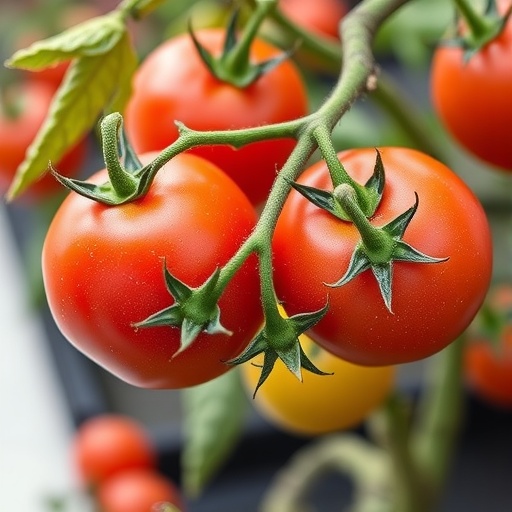
Every tomato begins as a flower, but producing a ripe fruit requires a precisely timed biological sequence. The male and female reproductive organs must develop in coordination, pollen must mature and be released when it can reach the stigma, and fertilization must occur before the young ovary begins expanding into a fruit. When any part of this sequence fails, flowers may drop without producing tomatoes. Temperature is one of the most disruptive factors. Cold can damage pollen, delay anther opening, interfere with pollen transfer and reduce fertilization, while heat can also disturb reproductive development and fruit set. Now, researchers have identified a genetic regulatory system that links flower development, pollen release and the initiation of fruit growth in tomato plants, revealing a possible route toward more dependable harvests during stressful growing seasons.
The study, led by Professor Naomi Ori and doctoral researcher Nave Man of The Hebrew University of Jerusalem, was conducted with scientists from the Leibniz Institute of Plant Biochemistry in Germany and Israel’s Agricultural Research Organization, the Volcani Institute. The team investigated a molecular pathway controlled by auxin, a plant hormone that influences cell division, tissue growth, organ formation and reproductive development. Auxin does not act alone. Its effects are interpreted through a network of response factors, including auxin response factors, or ARFs, which bind to regulatory regions of genes and activate or repress their expression. The activity of these factors is modulated by small regulatory RNAs, including miR167, creating a finely balanced system in which developmental signals can be adjusted as the plant’s conditions change.
The researchers focused on two closely related tomato genes, SlARF8A and SlARF8B, together with miR167, which acts as a molecular brake on ARF8 activity. MicroRNAs are short RNA molecules that regulate gene expression after transcription, typically by guiding the degradation of messenger RNA or reducing its translation into protein. In this case, miR167 helps determine how much ARF8 protein is available in developing floral tissues. By modifying different components of this regulatory module with CRISPR gene-editing technology, the scientists were able to examine how changes in auxin signaling affected the formation and function of reproductive organs. The experiments effectively separated the contributions of the individual genes while also revealing how strongly their effects depend on genetic balance.
The results showed that SlARF8A and SlARF8B operate together to coordinate the development of stamens and pistils, the flower’s male and female reproductive structures. This coordination is essential because successful fruit production depends on both organs reaching functional maturity at compatible times. The researchers also found that one of the ARF8 genes contributes to the timing of anther dehiscence, the opening of the pollen-bearing anthers. If anthers open too early or too late, pollen may fail to reach the stigma when it is receptive. Under cold conditions, such timing problems can become more severe because low temperatures slow development and can reduce pollen viability. The findings therefore connect a specific auxin-response module not only to organ formation, but also to the physical event that releases pollen.
One combination of gene edits produced a particularly striking reproductive change. The modified plants were able to initiate fruit development without fertilization, a phenomenon known as parthenocarpy. In tomatoes, parthenocarpy can produce seedless fruit because the ovary begins to grow even when pollen does not successfully fertilize the ovules. This trait is valuable under conditions in which pollen is damaged or pollen transfer is unreliable. It can also be useful for processing tomatoes, where seedless fruit and reduced amounts of jelly surrounding the seeds may simplify industrial handling. In the edited plants, fruit initiation occurred earlier than in unmodified plants under all of the conditions tested, suggesting that the genetic changes affected the developmental threshold required for the ovary to begin expanding.
The advantage became most evident in winter greenhouse experiments. Early in the growing season, the gene-edited plants produced more than 18 times as many fruits as regular tomato plants. By the end of the experiment, they had produced six times more ripe tomatoes and ten times the total weight of ripe fruit. The difference was not limited to the number of developing fruit. Most tomatoes on the modified plants had already turned red and reached ripeness, while most fruit on the unmodified plants remained green. This pattern indicates that the edits improved the reliability and timing of reproductive output during cold conditions rather than simply increasing the number of flowers. The plants were also more compact, with a greater proportion of their growth directed toward fruit production instead of stems and leaves.
The study suggests that the miR167–ARF8 system acts as a developmental coordination mechanism rather than as a single switch for fruit formation. Too much or too little activity in a regulatory network can disrupt organ development, but an appropriate adjustment may allow the plant to bypass a reproductive bottleneck. In the edited tomatoes, changing both the signal-promoting ARF8 factors and the miR167 restraint revealed a combination that preserved the coordinated development of reproductive tissues while enabling fruit initiation without fertilization. This distinction is important for crop improvement because simply increasing auxin signaling could produce undesirable effects, including abnormal growth or defective flowers. The researchers’ results instead point to the value of tuning a specific regulatory relationship within the broader hormone-response pathway.
Professor Ori said the findings show how tomato plants use a carefully balanced genetic system to coordinate flower development, pollen release and the beginning of fruit growth. The work also illustrates why reproductive traits can be difficult to improve through conventional breeding alone. Flowering and fruit set are influenced by many genes and are highly sensitive to the environment, yet the miR167–ARF8 module appears to connect several of these processes at a central point. By identifying that connection, scientists may be able to design plants that maintain reproductive productivity when temperatures make normal fertilization difficult. Such varieties could be especially useful in greenhouses, winter production systems and regions where sudden cold spells interrupt the growing season.
The findings do not yet establish that the edited plants are ready for commercial cultivation. Further research will be needed to determine how the genetic changes affect fruit size, texture, flavor, nutritional composition and post-harvest performance. Scientists will also need to test the trait in diverse agricultural tomato varieties and under field conditions, where light, humidity, pathogens, nutrient availability and fluctuating temperatures may alter the outcome. The long-term behavior of the plants, their interactions with pollinators and their performance across multiple generations will also require evaluation. Even so, the study provides a detailed molecular explanation for why certain tomato plants can continue setting fruit when cold suppresses ordinary fertilization. By manipulating the miR167–ARF8 auxin-response module, researchers have opened a promising avenue for stabilizing tomato production and extending reliable harvests into colder months.
News Publication Date: 11-Aug-2026
Web References: https://doi.org/10.1111/nph.71503
References: New Phytologist; DOI: 10.1111/nph.71503
Cite Scienmag News
Juliet Wilcox. (August 12, 2026). Genetic switch may enable tomatoes to fruit during cold weather. Scienmag. https://scienmag.com/genetic-switch-may-enable-tomatoes-to-fruit-during-cold-weather/
Juliet Wilcox. "Genetic switch may enable tomatoes to fruit during cold weather." Scienmag, 12 August 2026, https://scienmag.com/genetic-switch-may-enable-tomatoes-to-fruit-during-cold-weather/. Accessed 3 September 2026.
Juliet Wilcox. "Genetic switch may enable tomatoes to fruit during cold weather." Scienmag. August 12, 2026. https://scienmag.com/genetic-switch-may-enable-tomatoes-to-fruit-during-cold-weather/


