


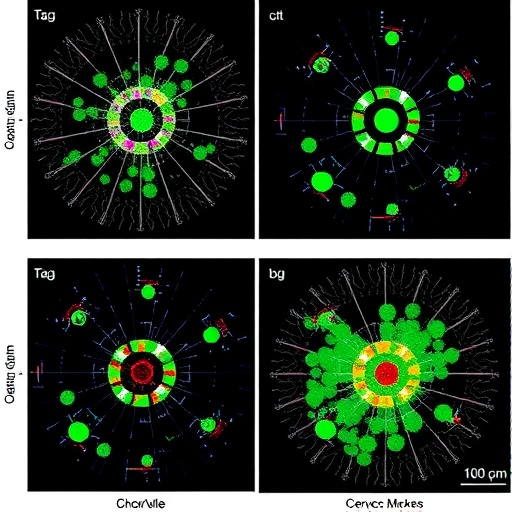
A new single-cell technology is giving researchers an unusually complete view of how individual cells establish and change their identities. Called OneCell CUT&Tag, the method simultaneously profiles chromatin states, gene activity and cell-surface markers from the same cell, even when only one cell is available. The approach, reported by Schwager, Moutaux, Durand and colleagues in Nature Biotechnology, is designed to overcome a persistent problem in single-cell biology: most techniques can measure several molecular layers, but rarely capture them together with sufficient resolution in rare populations. By connecting regulatory DNA packaging with transcription and surface phenotype cell by cell, the researchers say OneCell CUT&Tag can expose biological transitions that would otherwise be blurred by averaging thousands of cells.
The challenge begins with the fact that a cell’s identity is controlled at several interconnected levels. Chromatin—the complex of DNA and associated proteins—determines which genomic regions are accessible to regulatory proteins. Chemical modifications on histones, the proteins around which DNA is wrapped, can help activate or silence genes, while the transcriptome records which genes are being transcribed at a particular moment. Surface proteins provide another layer of information, often revealing a cell’s lineage, developmental stage or response to its environment. Conventional single-cell assays typically measure one or two of these features, and methods that combine multiple measurements often require substantial amounts of starting material. In rare tissues, early embryos or small clinical samples, those requirements can make the most informative cells effectively inaccessible.
OneCell CUT&Tag adapts the principles of CUT&Tag, or cleavage under targets and tagmentation, for extremely limited input. In a conventional CUT&Tag experiment, an antibody recognizes a selected chromatin-associated protein or histone modification. An antibody-linked enzyme then cuts nearby DNA and attaches sequencing adapters to the resulting fragments, marking the genomic locations where that chromatin feature is present. The new method integrates this chromatin readout with full-transcriptome sequencing and quantification of surface markers in the same individual cell. Rather than using computationally assembled “metacells” to increase apparent signal, it preserves the molecular connections within each cell, allowing researchers to ask whether a particular chromatin state, transcriptional program and surface phenotype coexist in the same biological unit.
That distinction is important because cellular populations that appear uniform when studied in bulk can contain cells at different stages of regulation. A gene may already be positioned in an active chromatin environment before its RNA becomes abundant, or transcription may persist briefly after a regulatory region has begun to close. If measurements from different cells are combined, such temporal relationships can disappear. Matching the molecular layers in one cell makes it possible to distinguish a cell that is actively changing from one that has already completed a transition. It also helps separate genuine intermediate states from statistical mixtures created when measurements from many cells are averaged together.
The researchers used OneCell CUT&Tag to investigate cellular organization in the mammary gland, focusing on the relationship between basal and luminal cell states. These populations perform different functions and are distinguished by characteristic transcriptional and surface-marker programs, but their developmental relationship can involve gradual changes rather than a simple switch. The single-cell data revealed epigenomic priming in basal cells, indicating that aspects of their chromatin landscape may prepare or predispose them toward future regulatory programs before those programs are fully expressed at the transcriptional level. Such priming suggests that cell identity is not merely a reflection of genes already turned on; it can also include a poised regulatory architecture that equips a cell to respond to developmental signals.
The method also captured the dynamics of basal-to-luminal transdifferentiation, a process in which cells move from one lineage-associated state toward another. The combined measurements indicated that chromatin remodeling and transcriptional remodeling do not proceed in complete synchrony during this conversion. Some regulatory regions may acquire a luminal-compatible chromatin configuration before the corresponding luminal gene network becomes fully active. In other cases, transcriptional changes may emerge while elements of the previous chromatin state remain detectable. This asynchronous behavior provides a more nuanced picture of cell-fate change, in which cells pass through molecularly mixed states rather than moving instantaneously between two fixed identities.
The findings have broader implications for understanding reprogramming in development, tissue repair and disease. Many biological processes depend on rare transitional cells, including stem-cell activation, immune-cell differentiation, tumor evolution and resistance to therapy. These cells can be difficult to identify because they may exist only briefly and may share features with both their starting and ending populations. A method capable of connecting chromatin, RNA and surface phenotype in the same cell could help identify these fleeting states more confidently. It may also reveal whether a cell is truly undergoing a fate transition or merely displaying an unusual expression pattern caused by stress, signaling or changes in its environment.
The researchers further demonstrated that the approach can be adapted to different samples and tissues, including early developmental material. In studies of zygotic expression programs, OneCell CUT&Tag revealed a role for the repressive histone modification H3K27me3 in shaping gene activity during the earliest stages of development. H3K27me3 is deposited by Polycomb-associated machinery and is widely linked to transcriptional repression and developmental gene regulation. Its influence in zygotes highlights how chromatin states can help organize the first wave of embryonic gene expression, when the regulatory system is being reset and reorganized. By measuring this chromatin feature alongside RNA in individual cells, the method can help clarify whether repression reflects a stable developmental barrier, a temporary pause or a mechanism that coordinates the timing of gene activation.
Although the technology does not eliminate the technical difficulties of single-cell sequencing, it offers a strategy for extracting more information from scarce material. The quality of results still depends on antibody performance, efficient handling of very small amounts of DNA and RNA, and careful library preparation. Chromatin fragments and transcripts also differ in abundance and molecular behavior, creating challenges for balancing the assays so that each layer remains informative. Even so, the ability to obtain matched measurements from individual cells represents a significant shift from approaches that rely on large inputs or infer cellular states by combining partial datasets. As single-cell research moves toward increasingly rare samples, OneCell CUT&Tag could make it possible to study the regulatory logic of cells that were previously too few, too transient or too precious to analyze.
By bringing together epigenomic information, gene expression and surface markers, OneCell CUT&Tag offers a molecular record of both what a cell is doing and what it may be prepared to do next. Its results in mammary-gland cell-fate conversion and zygotic gene regulation illustrate how regulatory layers can be offset in time, with chromatin changes preceding or outlasting transcriptional shifts. That temporal complexity is central to understanding development and disease, yet it is difficult to detect when each molecular layer is measured separately. The new method therefore provides more than a technical advance: it creates a way to study cellular identity as a coordinated but imperfectly synchronized process, one individual cell at a time.
Cite Scienmag News
Juliet Wilcox. (August 12, 2026). OneCell CUT&Tag Maps Chromatin, Transcripts and Surface Markers, Revealing Epigenomic Reprogramming. Scienmag. https://scienmag.com/onecell-cuttag-maps-chromatin-transcripts-and-surface-markers-revealing-epigenomic-reprogramming/
Juliet Wilcox. "OneCell CUT&Tag Maps Chromatin, Transcripts and Surface Markers, Revealing Epigenomic Reprogramming." Scienmag, 12 August 2026, https://scienmag.com/onecell-cuttag-maps-chromatin-transcripts-and-surface-markers-revealing-epigenomic-reprogramming/. Accessed 4 September 2026.
Juliet Wilcox. "OneCell CUT&Tag Maps Chromatin, Transcripts and Surface Markers, Revealing Epigenomic Reprogramming." Scienmag. August 12, 2026. https://scienmag.com/onecell-cuttag-maps-chromatin-transcripts-and-surface-markers-revealing-epigenomic-reprogramming/


