


A vast stream of gas falling toward a young triple-star system in the Orion constellation may have solved one of astronomy’s most persistent puzzles: why some planetary systems develop worlds whose orbits are dramatically tilted relative to one another.
The discovery centers on GW Orionis, a system located roughly 1,300 light-years from Earth. Three stars orbit within a complex environment surrounded by a broad disk of gas and dust, the raw material from which planets can eventually form. Unlike the relatively orderly architecture of our solar system, the rings of material around GW Orionis are sharply misaligned, creating a striking example of how chaotic planetary systems may emerge.
Astronomers often picture a planet-forming disk as a flattened structure rotating in a single plane. In a simple system, planets born from that disk should follow similar paths around their star, much like the eight planets orbit the Sun along nearly the same broad plane. But observations of exoplanet systems have revealed that this arrangement is not universal. Some planets orbit at steep angles, and in certain systems, neighboring planets may not even share the same orbital orientation.
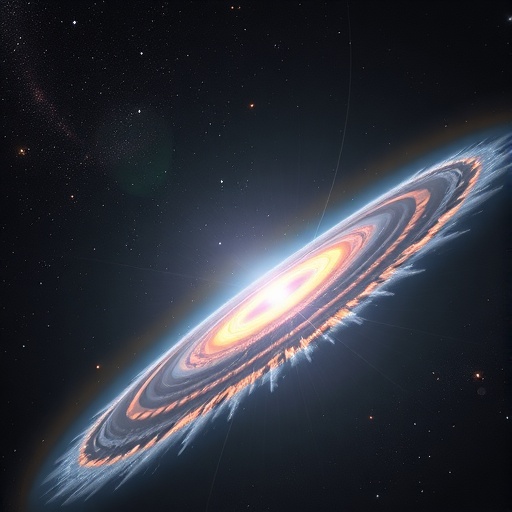
GW Orionis offers a particularly dramatic illustration of this phenomenon. Its surrounding material appears to be organized into several nested rings, but the rings do not line up. Instead, each is tilted at a different angle, resembling a series of hula hoops suspended in space with no common plane. The inner portion of the disk remains comparatively stable, while the outer regions are inclined away from it.
Previous explanations focused primarily on the gravitational influence of the three stars. Because the stars orbit one another, their combined gravitational field can exert complex torques on the surrounding disk. Over time, those forces could twist, warp or tear the disk into separate sections. Although stellar dynamics undoubtedly play a role in the system, a new study argues that they do not fully explain the observed configuration.
The research team analyzed observations collected with the Atacama Large Millimeter/submillimeter Array, or ALMA, a network of radio telescopes in Chile designed to detect the faint millimeter-wavelength emission from cold gas and dust. Within the ALMA data, the astronomers identified evidence for a narrow, elongated flow of material entering the system from outside. This feature, known as a streamer, appears to be delivering fresh gas to the outer regions of the circumtriple disk.
According to the team’s modeling, the incoming gas carries angular momentum that differs from the rotation of the existing disk. Angular momentum describes the quantity that governs how material spins and orbits, and changing it can gradually alter the orientation of a rotating structure. As the streamer feeds gas into the outer disk, the mismatch between the incoming material and the disk can exert a torque, pushing the outer ring into a new plane while leaving the denser inner disk relatively unaffected.
That process provides a natural explanation for the rings’ misalignment. Rather than being tilted solely by the gravitational tug of the three stars, the outer disk may have been redirected by a continuing supply of gas with a different orbital orientation. If planets form inside those rings, they would inherit the geometry of the material from which they grew. Planets born in separate sections of the warped disk could therefore end up following orbits that are inclined relative to one another and to the system’s stars.
The finding also suggests that planetary systems may be shaped by their surrounding environments long after their initial disks form. Young stars are often embedded in dense clouds of gas, and their disks can interact with material left over from the star-forming process. A streamer may represent a channel through which that external gas continues to fall inward, adding mass while simultaneously changing the disk’s direction of rotation. In this view, planetary architecture is influenced not only by the stars at the center, but also by the large-scale flow of matter through the birth environment.
The researchers caution that a single system cannot establish how common such streamers are. The next step is a systematic survey of young stars to determine how frequently these gas flows occur and whether systems with streamers are more likely to show warped or misaligned disks. If similar structures are found around many young stars, streamers could become a major piece of the explanation for why planetary systems across the galaxy display such a wide range of orbital patterns. The study was led by Maria Galloway-Sprietsma of the University of Florida, with contributions from Jaehan Bae and collaborators at the Max-Planck Institute for Astronomy, the University of Galway and Queen Mary University of London.
News Publication Date: 6 August 2026
Web References: https://astro.ufl.edu/directory/jaehan-bae/ ; https://iopscience.iop.org/article/10.3847/1538-3881/ae8bae
References: The Astronomical Journal, DOI: 10.3847/1538-3881/ae8bae
Keywords
GW Orionis, triple-star systems, planet formation, misaligned planetary orbits, circumtriple disks, gas streamers, ALMA, protoplanetary disks, astronomy, exoplanets
Cite Scienmag News
Grant Pearson. (August 6, 2026). Cosmic gas stream may have tilted young planetary system in Orion. Scienmag. https://scienmag.com/cosmic-gas-stream-may-have-tilted-young-planetary-system-in-orion/
Grant Pearson. "Cosmic gas stream may have tilted young planetary system in Orion." Scienmag, 6 August 2026, https://scienmag.com/cosmic-gas-stream-may-have-tilted-young-planetary-system-in-orion/. Accessed 3 September 2026.
Grant Pearson. "Cosmic gas stream may have tilted young planetary system in Orion." Scienmag. August 6, 2026. https://scienmag.com/cosmic-gas-stream-may-have-tilted-young-planetary-system-in-orion/


