


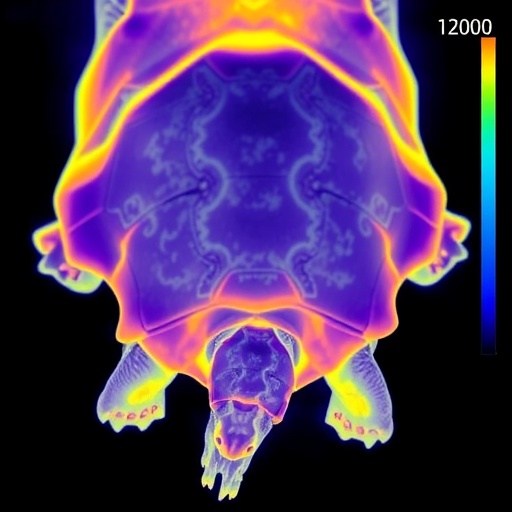
A handheld infrared camera may offer scientists a safer way to measure the body temperature of hatchling Mojave desert tortoises, according to new research from San Diego Zoo Wildlife Alliance. The study suggests that thermal imaging can estimate internal body temperature without requiring researchers to capture and physically handle the young reptiles, a development that could make field studies less stressful for one of North America’s most vulnerable desert species.
Published in Conservation Physiology, the research evaluates infrared thermography as a non-invasive alternative to conventional temperature measurements. Traditionally, scientists determine a tortoise’s body temperature by restraining the animal and taking a cloacal measurement with a probe. Although this approach can provide direct data, it may disturb the animal, increase handling time and potentially influence its behavior immediately afterward. For hatchlings, which are especially small and sensitive to environmental changes, minimizing that disturbance is particularly important.
Infrared thermal cameras work by detecting the invisible radiation emitted from an animal’s surface and converting it into a visual temperature map. The resulting image, often called a thermogram, displays differences in temperature across the body. Because the camera does not need to touch the animal, researchers can collect measurements from a distance and potentially observe tortoises while they remain in a natural posture or continue normal activity.
The central challenge is that a tortoise’s surface temperature is not always identical to its internal body temperature. A shell, skin surface or limb can warm or cool more rapidly than the tissues beneath it, depending on sunlight, wind, humidity, substrate temperature and recent activity. The researchers therefore examined whether readings from a thermal camera could reliably reflect internal temperature under a range of conditions, rather than assuming that the warmest visible point directly represented the animal’s physiological state.
Their findings indicate that infrared imaging can provide a dependable estimate of internal body temperature in hatchling Mojave desert tortoises in many circumstances. This does not mean that thermal cameras will replace direct measurements in every experiment. Instead, the technique could give researchers a practical screening tool and reduce the number of times animals must be captured, restrained or exposed to procedures that may alter their behavior and physiology.
Body temperature is one of the most important variables in reptile biology because reptiles are ectothermic. Unlike mammals and birds, they do not generate enough metabolic heat to maintain a constant internal temperature. Their body temperature is shaped largely by the surrounding environment and by behavioral choices, such as moving between sun and shade, entering burrows or changing their position on the ground. Temperature influences metabolism, digestion, movement, immune function and the timing of daily activity.
For Mojave desert tortoise hatchlings, these relationships are especially significant. The young tortoises live in an environment where temperatures can change rapidly, and their small bodies may heat or cool faster than those of adults. Understanding how hatchlings respond to temperature can help scientists determine when they forage, seek shelter or become vulnerable to heat stress. It may also reveal how changing weather patterns are affecting survival during the earliest stages of life.
The conservation implications extend beyond a single tortoise population. Mojave desert tortoises are threatened by habitat loss, disease, predators, human development and increasingly challenging climate conditions. As the region becomes hotter and precipitation patterns shift, researchers need methods that can measure the physiological effects of these changes without adding unnecessary stress to already vulnerable animals. Thermal imaging could allow more frequent observations while preserving natural behavior, improving studies of habitat use, thermoregulation and climate resilience.
The method may also be useful for other turtles, tortoises and ectothermic species, although additional validation will be necessary. Differences in shell structure, body size, skin properties, habitat and activity can affect the relationship between surface and internal temperatures. Future studies will need to test the technology across species and environmental conditions, compare camera readings with established physiological measurements and determine how factors such as distance, camera angle and solar exposure influence accuracy.
By demonstrating that hatchling Mojave desert tortoises can be assessed with less invasive technology, the study adds young turtles to the expanding range of animals that may benefit from infrared thermography. The approach could support conservation programs, veterinary care and field research while reducing the handling burden placed on endangered wildlife. In a warming world, a camera that quietly records an animal’s thermal state may give scientists a clearer view of how reptiles survive—and where they may need help.
Web References: https://sandiegozoo.box.com/s/ek77z2wze0g44m0gwq04n8wf0278mf79
References: Conservation Physiology; DOI: 10.6084/m9.figshare.31271974
Cite Scienmag News
Margaret Porter. (August 6, 2026). Noninvasive thermal imaging may advance research on endangered hatchling tortoises. Scienmag. https://scienmag.com/noninvasive-thermal-imaging-may-advance-research-on-endangered-hatchling-tortoises/
Margaret Porter. "Noninvasive thermal imaging may advance research on endangered hatchling tortoises." Scienmag, 6 August 2026, https://scienmag.com/noninvasive-thermal-imaging-may-advance-research-on-endangered-hatchling-tortoises/. Accessed 3 September 2026.
Margaret Porter. "Noninvasive thermal imaging may advance research on endangered hatchling tortoises." Scienmag. August 6, 2026. https://scienmag.com/noninvasive-thermal-imaging-may-advance-research-on-endangered-hatchling-tortoises/


