


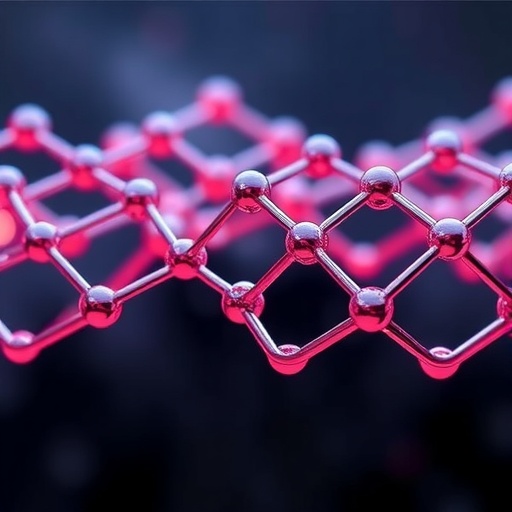
The discovery of superconductivity and correlated insulating states in magic-angle twisted bilayer graphene transformed a deceptively simple material into one of the most powerful laboratories for quantum physics. Now, a new review in National Science Review explains how a slight rotational misalignment between graphene sheets can generate a landscape of strongly interacting, topological and potentially unconventional superconducting states. The article, titled “Twisting Graphene into Correlation and Topology,” brings together recent advances in the rapidly expanding field of twistronics and examines why twisted graphene continues to produce unexpected forms of quantum matter.
Graphene consists of a single layer of carbon atoms arranged in a two-dimensional honeycomb lattice. In an ordinary sheet, electrons can move with exceptional mobility, behaving approximately like massless particles over a broad energy range. However, when one graphene layer is placed on top of another and rotated by a small angle, the two atomic lattices interfere to create a much larger periodic pattern known as a moiré superlattice. At a critical rotation of approximately 1.1 degrees, known as the magic angle, the electronic bands become extremely narrow and nearly flat. This flattening dramatically reduces the kinetic energy available to electrons, allowing their mutual Coulomb repulsion to dominate the system’s behavior.
The result is a highly tunable platform in which electrons can no longer be treated as independent particles. Instead, their collective interactions can produce insulating phases even when conventional band theory would predict metallic behavior. Experiments on magic-angle twisted bilayer graphene have revealed correlated insulating states, superconductivity, orbital magnetism and quantum anomalous Hall behavior. The review’s authors, Assistant Professor Shuo-Ying Yang of the Southern University of Science and Technology and Professor Cheng Shen of the University of Electronic Science and Technology of China, describe these phenomena as connected consequences of the same central design principle: twisting graphene reshapes its electronic structure until correlation and topology become impossible to ignore.
Flat electronic bands are particularly important because they concentrate many electronic states within a narrow energy window. In a dispersive band, electrons can lower their energy by moving through the crystal, and this kinetic energy often competes successfully with interactions. In a flat band, that motion is strongly suppressed. Even relatively modest Coulomb interactions can therefore reorganize the electrons into ordered states. These may include correlated insulators, valley-coherent phases and unusual “heavy-fermion-like” states in which charge carriers appear to acquire a greatly enhanced effective mass. The valley degree of freedom, associated with distinct energy extrema in graphene’s band structure, provides an additional internal label that can participate in this ordering.
Twisted graphene is not only a system of strong electronic correlation; it is also a system with unusual quantum geometry. The wave functions in its flat bands can possess nontrivial Berry curvature, a geometric property of quantum states that acts in some ways like a magnetic field in momentum space. Berry curvature and related band-topological characteristics can generate orbital magnetic moments and support phases such as orbital Chern insulators. In these states, electrons collectively occupy bands with a nonzero topological invariant, enabling conducting edge channels even when the bulk is insulating. Under suitable conditions, the system can also display a quantum anomalous Hall effect, in which electrical current flows along the edges without an externally applied magnetic field.
The combination of topology and electron interaction makes the resulting phases especially rich. In conventional materials, topology is often discussed in terms of relatively weakly interacting electrons, while correlation is treated as a separate source of complexity. Magic-angle graphene brings the two effects together in a clean, adjustable structure. Changes in carrier density, electric displacement field, pressure, magnetic field or twist angle can shift the balance among competing phases. This tunability allows researchers to explore how topological order, symmetry breaking and electronic correlation emerge, compete and sometimes coexist within the same material platform.
Superconductivity is one of the most closely watched consequences of this competition. When a material becomes superconducting, electrons form collective paired states that can carry electrical current without resistance. In conventional Bardeen–Cooper–Schrieffer theory, these pairs are typically produced by interactions involving lattice vibrations. However, observations in twisted graphene have increasingly suggested that its superconductivity may not fit neatly within this conventional picture. The relatively low carrier densities, proximity to correlated insulating states and sensitivity to the system’s internal quantum structure all point toward a strong-coupling and potentially unconventional pairing mechanism.
Quantum geometry may also help explain how superconductivity survives in a flat-band system. A simple flat band appears unfavorable for superconductivity because the usual contribution from electron velocity to superfluid stiffness is strongly reduced. Yet the geometry of the electronic wave functions can provide an additional geometric contribution to that stiffness. This contribution can support phase-coherent superconductivity even when the bands themselves have very little dispersion. The idea offers a possible explanation for why superconducting behavior can emerge from electronic structures that seem, at first glance, unable to sustain the movement needed for a robust superfluid state.
The review further explores how researchers are extending the original bilayer design into more elaborate architectures. Multilayer systems with different numbers of graphene sheets, alternating-twist structures and supermoiré materials can produce several interfering length scales and more intricate band structures. These platforms offer new ways to control bandwidth, topology, layer polarization and interaction strength. As fabrication techniques improve, the number of accessible quantum phases is expected to grow, potentially enabling controlled transitions between correlated metals, insulators, magnetic states, topological phases and unconventional superconductors.
Twisted graphene has therefore evolved from an elegant demonstration of moiré physics into a broad research frontier linking materials science, quantum geometry and many-body physics. Its appeal lies not only in the remarkable states already observed, but also in the ability to engineer them through a geometric parameter measured in degrees. The emerging picture is that rotation can act as a form of quantum control, converting ordinary carbon sheets into programmable environments for discovering new collective behavior. As moiré engineering and measurement technologies advance, twisted graphene and related systems could provide both fundamental insights into quantum matter and a foundation for future electronic, magnetic and quantum-device applications.
Web References: https://doi.org/10.1093/nsr/nwag363
References: National Science Review, DOI: 10.1093/nsr/nwag363
Cite Scienmag News
Neil Sanderson. (August 5, 2026). Twisting graphene unlocks correlated states and topological phenomena. Scienmag. https://scienmag.com/twisting-graphene-unlocks-correlated-states-and-topological-phenomena/
Neil Sanderson. "Twisting graphene unlocks correlated states and topological phenomena." Scienmag, 5 August 2026, https://scienmag.com/twisting-graphene-unlocks-correlated-states-and-topological-phenomena/. Accessed 4 September 2026.
Neil Sanderson. "Twisting graphene unlocks correlated states and topological phenomena." Scienmag. August 5, 2026. https://scienmag.com/twisting-graphene-unlocks-correlated-states-and-topological-phenomena/


