


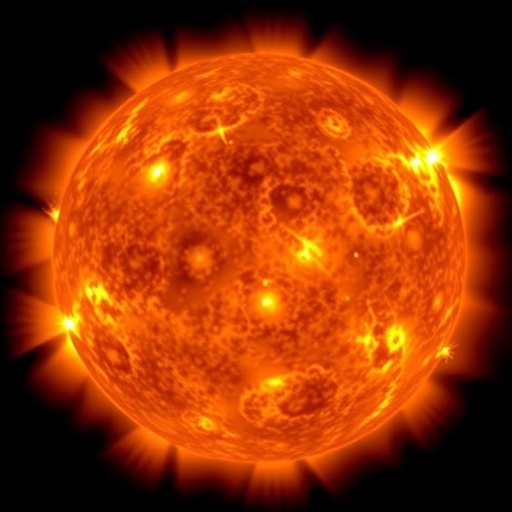
The Sun’s Surface Is Swirling: Inouye Telescope Reveals Kelvin–Helmholtz Instability in Unprecedented Detail
The Sun’s surface has just yielded one of its most closely guarded secrets. Using the world’s largest solar telescope, an international team of researchers has captured the clearest evidence yet of Kelvin–Helmholtz instability—a fluid-like phenomenon that produces curling waves and vortices wherever layers of material slide past one another at different speeds. The discovery, announced by the U.S. National Science Foundation National Solar Observatory on August 5, 2026, offers a new view of the small-scale motions that may help power solar flares, coronal mass ejections and the million-degree outer atmosphere of the Sun.
The observations were made with the NSF Daniel K. Inouye Solar Telescope on Maui, Hawai‘i. At a wavelength of 416 nanometers, the telescope resolved structures on the photosphere—the visible layer commonly described as the Sun’s surface—with extraordinary clarity. The images show deformed boundaries around concentrated magnetic regions and ultra-fine dark stripes moving along their edges. Among these features are dozens of small, whirlpool-like patterns that closely resemble the vortices generated by Kelvin–Helmholtz instability in Earth’s atmosphere, oceans and laboratory fluids.
Kelvin–Helmholtz instability develops when two adjacent fluids or plasmas move past one another with a velocity difference, creating shear at their interface. Even a tiny disturbance at that boundary can grow as energy from the relative motion is transferred into waves and rotating structures. On the Sun, however, the fluids are electrically charged plasma and are strongly influenced by magnetic fields. That makes the process far more complex than an ordinary ocean wave: gas motion, magnetic tension, radiative energy transport and turbulent convection all interact within an environment where temperatures and densities change rapidly over extremely short distances.
The Inouye observations indicate that these conditions occur repeatedly around magnetic concentrations embedded in the Sun’s granulated surface. Granulation is produced by convection, as hot plasma rises from below, spreads across the photosphere, cools and sinks again. When these turbulent flows encounter magnetic structures, neighboring layers can acquire different speeds and directions. The resulting shear appears to create an environment in which Kelvin–Helmholtz vortices form almost continuously. Rather than being rare curiosities, the patterns may be a ubiquitous component of the Sun’s magnetic atmosphere.
The researchers compared the telescope’s images and time-lapse sequences with numerical simulations produced using the MURaM radiative magnetohydrodynamics code, developed and maintained by international teams including scientists at the NSF National Center for Atmospheric Research High Altitude Observatory and Germany’s Max Planck Institute for Solar System Research. Magnetohydrodynamics combines the equations of fluid motion with those governing electromagnetic fields, allowing scientists to model how magnetized plasma behaves. In this case, the simulated vortices reproduced the observed shapes, motion and fine-scale dark striations with striking precision.
One of the strongest points of agreement was the distance between neighboring vortices, known as the instability wavelength. In both observations and simulations, the typical spacing ranged from approximately 50 to 65 kilometers. That correspondence, together with the structures’ evolution over time and their location along magnetic boundaries, allowed the team to identify the patterns as Kelvin–Helmholtz instability rather than unrelated convective motions or imaging artifacts. The result represents an unusually detailed observational test of solar magnetohydrodynamic theory.
The discovery could reshape scientists’ understanding of how the Sun stores and releases magnetic energy. Solar magnetic fields are continually twisted and tangled by plasma motion in a process often called flux braiding. As magnetic field lines become increasingly stressed, they can undergo magnetic reconnection, abruptly changing their configuration and releasing energy. This energy drives phenomena ranging from tiny nanoflares to powerful solar flares, jets and coronal mass ejections—the eruptions that can disturb satellites, navigation systems, communications networks and electrical grids on Earth.
The newly observed vortices may provide a missing link in that process. Their constant motion could twist magnetic field lines, mix magnetized and non-magnetized plasma, and enhance the diffusion of magnetic fields through the lower solar atmosphere. This matters because current models have difficulty explaining how the magnetic flux generated by the Sun’s dynamo is dispersed quickly enough to match the star’s approximately 11-year magnetic cycle. Kelvin–Helmholtz instability may supply an efficient mechanism for that small-scale magnetic diffusion, potentially influencing the evolution of active regions and the timing of explosive events.
The vortices may also help address one of astrophysics’ most persistent mysteries: why the Sun’s corona is far hotter than the photosphere beneath it. While the photosphere has a temperature of roughly 5,500 degrees Celsius, the corona reaches temperatures of around one million degrees or more. The energy required to sustain that difference must be transported upward through the solar atmosphere. If Kelvin–Helmholtz vortices carry energy through turbulent plasma motions, dissipate magnetic stresses or generate smaller-scale waves, they could contribute to coronal heating. The team cautions that the instability is unlikely to explain the entire phenomenon on its own, but it may be an important part of the solution.
Researchers are now developing automated systems to identify and measure the vortices across the Inouye telescope’s expanding archive. By counting their frequency, tracking their lifetimes and estimating how much energy they transport, scientists hope to determine whether these small structures have a measurable influence on the corona and on the spread of magnetic fields. The findings also have implications beyond the Sun, because similar plasma processes may operate in other stars and in astrophysical environments throughout the universe. By revealing motions that remained invisible until now, the Inouye Solar Telescope has brought solar physics closer to connecting the smallest turbulent eddies on a star’s surface with the largest eruptions that can reach across space.
News Publication Date: 5 August 2026
Web References: Nature article; DOI: 10.1038/s41586-026-10871-3
References: Nature, “Ubiquitous Kelvin–Helmholtz instabilities driving plasma mixing on the Sun,” published 5 August 2026
Keywords
Sun, solar physics, Kelvin–Helmholtz instability, Inouye Solar Telescope, photosphere, solar plasma, magnetic fields, magnetic reconnection, solar flares, coronal heating, space weather, magnetohydrodynamics
Cite Scienmag News
Grant Pearson. (August 5, 2026). NSF’s Inouye Solar Telescope Reveals a Hidden Process Shaping the Sun. Scienmag. https://scienmag.com/nsfs-inouye-solar-telescope-reveals-a-hidden-process-shaping-the-sun/
Grant Pearson. "NSF’s Inouye Solar Telescope Reveals a Hidden Process Shaping the Sun." Scienmag, 5 August 2026, https://scienmag.com/nsfs-inouye-solar-telescope-reveals-a-hidden-process-shaping-the-sun/. Accessed 3 September 2026.
Grant Pearson. "NSF’s Inouye Solar Telescope Reveals a Hidden Process Shaping the Sun." Scienmag. August 5, 2026. https://scienmag.com/nsfs-inouye-solar-telescope-reveals-a-hidden-process-shaping-the-sun/


