


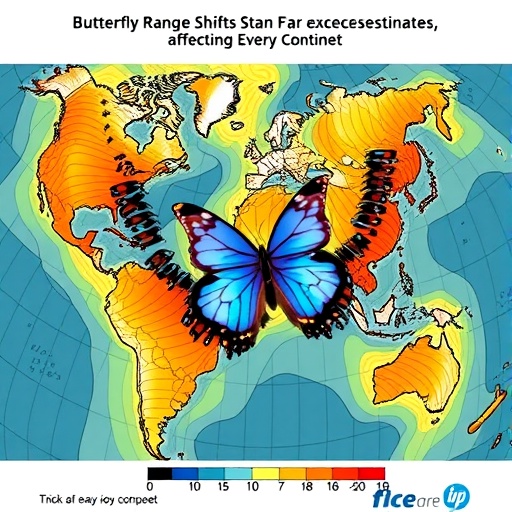
A worldwide analysis of butterfly range shifts has revealed a rapid and geographically widespread redistribution of species, offering one of the clearest signs yet that climate change is reshaping ecosystems across the planet. The study examined 6,182 documented range-shift records involving 1,758 butterfly species—approximately 10 per cent of all known butterfly species—and found that four out of five had expanded their geographic ranges. Overall, 79 per cent of recorded shifts were associated with climate change or extreme weather events.
Published in Nature Ecology & Evolution, the study represents the largest global assessment of butterfly range changes to date. Researchers from Monash University, the German Centre for Integrative Biodiversity Research, the Friedrich Schiller University Jena and the Helmholtz Centre for Environmental Research combined evidence from scientific publications, including studies written in languages other than English, with 68 expert assessments. This approach allowed the team to identify patterns that would have remained hidden in a dataset based only on English-language research or formal monitoring programmes.
The results show that butterfly responses to environmental change are complex and often occur simultaneously in different directions. Although 80 per cent of species had expanded their ranges, 27 per cent also experienced contractions, while 22 per cent shifted their distribution to different elevations. These percentages exceed 100 per cent when combined because individual species may have expanded in one part of their range, disappeared from another and moved uphill or downhill at the same time. Such overlapping responses reflect the uneven effects of warming, drought, floods, habitat loss and extreme weather across landscapes.
Horizontal range expansions were documented on every continent inhabited by butterflies, with especially high numbers recorded in tropical countries. In these cases, species may be appearing in areas that were previously too cold, dry or otherwise unsuitable for survival. Warmer temperatures can allow butterflies to establish populations farther poleward or into higher-latitude regions, provided that host plants, nectar sources and suitable breeding conditions are also available. However, the ability to expand does not necessarily mean that a species is thriving, since newly occupied areas may not compensate for habitat being lost elsewhere.
Range contractions were more common in temperate regions, particularly Europe and North America. These contractions may result when warming exceeds a species’ physiological tolerance, when drought reduces the availability of host plants or when extreme weather destroys breeding habitat. Butterflies are ectothermic animals, meaning that their body temperature and activity are strongly influenced by external conditions. Although moderate warming can increase activity and extend the season for some species, excessive heat can disrupt development, reduce fertility and increase mortality, especially when temperatures rise alongside water stress.
Elevational shifts were reported almost exclusively in the Northern Hemisphere. As temperatures rise, mountain-dwelling butterflies may move toward cooler conditions at higher elevations. This response can create a “mountaintop squeeze,” in which suitable climate zones become progressively smaller as species move uphill. Once populations reach the highest available terrain, further upward movement is impossible. The pattern is particularly concerning for species with specialised habitat requirements, limited dispersal ability or narrow thermal tolerances, because they may have few options when their climatic niche disappears.
The geographical distribution of the evidence also exposed major weaknesses in global biodiversity monitoring. In countries such as the Czech Republic, Finland, Luxembourg, Spain and Sweden, records covered more than half of the national butterfly species. In most other countries, however, documented range changes existed for fewer than 10 per cent of species. The absence of records does not necessarily indicate that species are stable. Instead, it often reflects limited field surveys, inconsistent national monitoring systems, insufficient taxonomic expertise and scientific information that is difficult to access internationally.
Some of the largest gaps occurred in Central Africa, Southeast Asia, New Guinea and the Amazon Basin—regions that contain exceptional levels of butterfly diversity but remain poorly represented in the available data. Tropical areas can contain hundreds or even thousands of species within relatively small geographical regions, making comprehensive monitoring difficult. Many species are also seasonal, rare, difficult to identify in the field or dependent on plants whose distributions have not been mapped in detail. Without long-term observations, researchers cannot reliably distinguish genuine range changes from temporary fluctuations or changes in recording effort.
The researchers argue that butterflies can function as early-warning indicators of broader ecological disruption. Their short life cycles, sensitivity to temperature and dependence on specific plants allow populations to respond quickly to environmental change. When butterfly ranges shift, the consequences may spread through food webs and plant-pollinator interactions. A decline in one butterfly species can affect predators, while changes in pollination may influence plant reproduction. The study therefore suggests that the documented redistribution of butterflies is not an isolated biological curiosity but a signal of deeper changes occurring across ecosystems.
The authors emphasise that future conservation policies will require equitable, standardised and multilingual monitoring. Combining professional surveys with contributions from natural history societies, trained volunteers and local experts could greatly expand the geographic coverage of biodiversity records. More consistent methods would also make it easier to compare changes across countries and determine which species are most vulnerable. The global pattern emerging from the analysis is clear: butterflies are already moving, disappearing from some locations and climbing to new elevations. What remains uncertain is how many species are changing in places where no one is yet recording the evidence.
Web References: https://doi.org/10.1038/s41559-026-03117-y
References: Nature Ecology & Evolution, DOI: 10.1038/s41559-026-03117-y
Cite Scienmag News
Russell Cooper. (August 5, 2026). Butterfly Range Shifts Far Exceed Estimates, Affecting Every Continent. Scienmag. https://scienmag.com/butterfly-range-shifts-far-exceed-estimates-affecting-every-continent/
Russell Cooper. "Butterfly Range Shifts Far Exceed Estimates, Affecting Every Continent." Scienmag, 5 August 2026, https://scienmag.com/butterfly-range-shifts-far-exceed-estimates-affecting-every-continent/. Accessed 5 September 2026.
Russell Cooper. "Butterfly Range Shifts Far Exceed Estimates, Affecting Every Continent." Scienmag. August 5, 2026. https://scienmag.com/butterfly-range-shifts-far-exceed-estimates-affecting-every-continent/


