


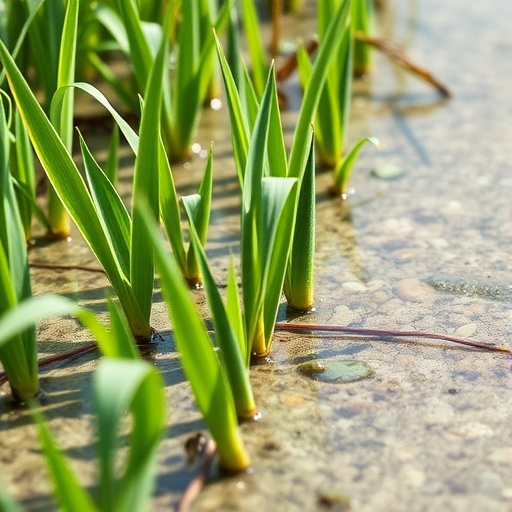
Seagrass meadows are among the planet’s most productive coastal ecosystems, functioning as underwater infrastructure for fish, invertebrates and microorganisms while anchoring sediments and filtering pollutants from the water. Yet almost one-fifth of the world’s historic seagrass cover has disappeared. In Florida’s Indian River Lagoon, repeated harmful algal blooms have driven severe losses, leaving large areas unable to recover naturally. New research from Florida Atlantic University’s Harbor Branch Oceanographic Institute suggests that a relatively uncommon native species, Ruppia maritima, could provide an important biological foothold for restoring these damaged estuarine habitats.
Published in Regional Studies in Marine Science, the study examines how R. maritima survives in mosquito impoundments, engineered wetlands separated from the lagoon by dikes and water-control structures. These systems are managed through Rotational Impoundment Management, a process that periodically reconnects them with the lagoon. The resulting fluctuations in water level, salinity and water quality create difficult conditions for seagrasses, but they also provide a natural experiment: species that persist there must tolerate repeated environmental disruption and rapidly changing habitat conditions.
Over three years, researchers monitored naturally occurring R. maritima populations at two locations within Bee Gum Point Nature Preserve. They measured seasonal changes in plant coverage and biomass while recording environmental conditions that could influence growth and reproduction. The team also analyzed sediment samples for dormant seeds and conducted controlled laboratory experiments to determine which environmental signals trigger germination. In parallel, plants collected from the preserve were grown in aquaculture tanks at the FAU Harbor Branch Seagrass Nursery, where scientists tracked their development, flowering, seed production and potential for large-scale cultivation.
The field observations revealed that R. maritima follows a sharply seasonal annual life cycle. Plants grew mainly from late winter through spring, flowered during the warmer part of the year and then largely disappeared above the sediment during summer. This dieback could easily be mistaken for permanent local extinction. However, the population returned in subsequent years, demonstrating that the visible plants represent only one phase of a broader life-history strategy. The species’ persistence depended on what remained below the surface after the shoots and leaves had vanished.
That hidden survival system was a persistent seed bank embedded in the sediment. Seeds remained viable through periods when the impoundments experienced flooding, high salinity and deteriorating water quality, allowing the population to regenerate when conditions improved. Laboratory trials showed that reduced salinity, especially exposure to freshwater, strongly stimulated germination. The finding indicates that freshwater pulses may act as an ecological cue, signaling a temporary window in which conditions are favorable for seedlings to emerge and establish before the next period of environmental stress.
“Ruppia maritima has a remarkable ability to persist through disturbance,” said Rachel Brewton, Ph.D., senior author and an assistant research professor at FAU Harbor Branch. “Even when the plants disappear above ground, the population can persist as a seedbank in the sediment, waiting for conditions to become favorable.” This capacity is particularly significant in the Indian River Lagoon, where restoration sites may not remain stable long enough for conventional planting methods to succeed. A seed bank can preserve genetic material through unfavorable seasons and release new plants when hydrological conditions shift.
The species also performed well under nursery conditions. Plants transplanted into aquaculture tanks became established, reproduced and produced viable seeds while maintaining a seasonal growth pattern similar to that observed in the wild. Most notably, the cultivated population has remained self-sustaining since it was established in 2021. “That ability to regenerate from a persistent seed bank, combined with its successful cultivation in our seagrass nursery, is what makes this species particularly interesting from a restoration perspective,” said Richard Mulroy, a study co-author and biological scientist at FAU Harbor Branch.
The researchers say R. maritima could function as a pioneer species in degraded parts of the lagoon. Rather than replacing mature seagrass communities, it could be introduced into bare or disturbed areas where its rapid seasonal growth and tolerance of fluctuating conditions might help begin the recovery process. By stabilizing sediment, adding habitat structure and influencing local water conditions, early colonizers can potentially make sites more suitable for other seagrass species. “The goal of restoration is not simply to put seagrass back—it is to create the conditions for a functioning ecosystem to recover,” Brewton said.
The results also point toward seed-based restoration as a promising alternative or complement to transplanting adult plants. During the experiments, R. maritima seeds remained viable during prolonged exposure to high salinity and germinated after freshwater treatment, suggesting that seeds could be collected, stored and propagated before deployment. The approach could improve the timing and scale of restoration, but field trials are still needed to determine how seeds and nursery-grown plants perform under natural conditions. Researchers will next test planting methods, identify suitable environmental windows and evaluate whether the species can help rebuild seagrass habitat in the Indian River Lagoon and other disturbed estuaries. The study was supported by the U.S. Fish and Wildlife Service’s Coastal Program, with matching support from the Indian River Land Trust, and was dedicated to the memory of research professor M. Dennis Hanisak, Ph.D.
News Publication Date: 18-Jul-2026
Web References: Florida Atlantic University, https://www.fau.edu/; FAU Harbor Branch Oceanographic Institute, https://www.fau.edu/hboi/; FAU Harbor Branch Seagrass Nursery, https://www.fau.edu/hboi/research/marine-ecosystem-conservation/coral-reefs/seagrass-nursery-and-marine-botany/
References: Regional Studies in Marine Science, DOI: 10.1016/j.rsma.2026.105271
Cite Scienmag News
Violet Maxwell. (August 4, 2026). Resilient Native Seagrass Could Transform Coastal Restoration Efforts. Scienmag. https://scienmag.com/resilient-native-seagrass-could-transform-coastal-restoration-efforts/
Violet Maxwell. "Resilient Native Seagrass Could Transform Coastal Restoration Efforts." Scienmag, 4 August 2026, https://scienmag.com/resilient-native-seagrass-could-transform-coastal-restoration-efforts/. Accessed 3 September 2026.
Violet Maxwell. "Resilient Native Seagrass Could Transform Coastal Restoration Efforts." Scienmag. August 4, 2026. https://scienmag.com/resilient-native-seagrass-could-transform-coastal-restoration-efforts/


