


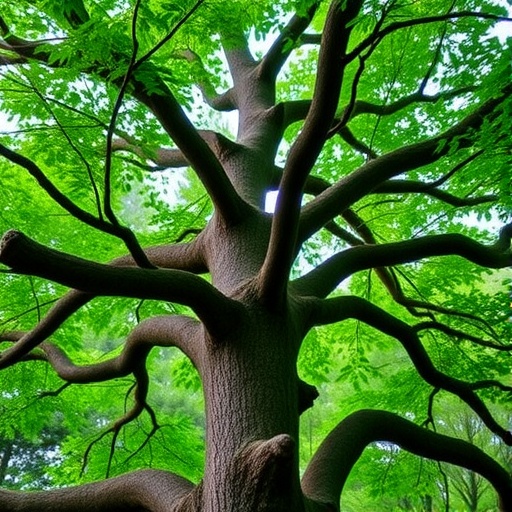
A new conservation analysis has revealed a striking vulnerability among some of Southeast and East Asia’s most threatened oak trees: nearly three-quarters of the species examined have no living backup in botanical collections anywhere in the world. If these trees disappear from their natural habitats, many could vanish entirely, leaving scientists with no managed populations from which to support research, genetic restoration or future reintroduction efforts.
The findings come from the first Conservation Gap Analysis of Select Native Asian Oaks, produced by scientists at The Morton Arboretum in collaboration with conservation partners across Asia. The study examined 54 oak species listed by the International Union for Conservation of Nature as either threatened or Data Deficient in Vietnam, Laos, Thailand, Cambodia, Myanmar, Brunei, Malaysia, Singapore, Indonesia, the Philippines, Timor-Leste, Korea, Japan and Taiwan. Together, these regions contain some of the world’s richest and least adequately documented oak diversity.
Oaks are far more than familiar forest trees. Their acorns provide food for insects, birds, mammals and people, while their trunks, branches and leaf litter create habitat and nutrients that support entire ecological networks. Because many oak species grow slowly and depend on specific soil, climate and pollination conditions, their decline can have consequences that extend well beyond the loss of a single plant species. In fragmented forests, the disappearance of mature oaks may also reduce food availability and disrupt regeneration for other organisms.
The analysis found that 40 of the 54 species, or 74 percent, are not currently represented in botanical collections. These collections function as living conservation banks: trees are cultivated under managed conditions, documented genetically and made available for scientific study or carefully planned restoration. The contrast with other regions is pronounced. A previous analysis of 91 native U.S. oak species found that only one lacked representation in collections, while 22 of 59 Mesoamerican oak species were not held in managed collections.
“Southeast Asia is a biodiversity hotspot for oaks,” said Kate Good, global tree conservation research manager at The Morton Arboretum and lead author of the report. “There are more threatened species of oak in Asia than anywhere in the world, and yet many of these species are not adequately represented in protected areas or in botanic gardens.” The shortage of living collections means that conservationists are often forced to act before they possess basic information about how a species reproduces, grows or responds to environmental stress.
Agriculture emerged as the most frequently reported threat to oak habitat, affecting approximately two-thirds of the species assessed. The pressure includes land conversion for crops as well as wood and pulp plantations. Urban and infrastructure development, climate change and extremely small wild populations were also identified as major risks. When only a handful of trees remain, inbreeding, poor seed production, disease and random environmental events can push a species rapidly toward extinction. Climate change may intensify these dangers by shifting temperature and rainfall patterns faster than long-lived trees can adapt or migrate.
Several species illustrate the urgency of the situation. Critically rare Quercus trungkhanhensis is known from only two individuals, both located within a protected area. Quercus dilacerata has just one known record, and that occurrence lies outside a protected area, where it may be exposed to continuing habitat loss. Quercus dankiaensis was last recorded inside a protected area in 1934. The absence of recent observations raises the possibility that it may already be extinct in the wild, although targeted surveys are needed to determine whether surviving trees remain undiscovered.
Protected areas are essential, but they cannot provide complete security when species are poorly surveyed or occur in isolated populations. A reserve may legally safeguard a forest while failing to protect a rare oak if its location is unknown, its seedlings cannot regenerate or its habitat changes under a warming climate. The researchers therefore emphasize a complementary strategy: locating surviving trees, collecting seeds or other propagative material, establishing genetically diverse living collections and restoring populations in suitable native habitats.
Immediate plans include training local partners in propagation and planting techniques, collecting and planting oaks in Vietnam, and conducting additional field surveys and collections in Laos. Propagation is technically challenging because oak acorns are often sensitive to drying and cannot always be stored like conventional seeds. Successful conservation may require rapid collection after fruit maturity, careful handling, fungal protection and specialized nursery conditions. Maintaining genetic diversity is equally important; collecting from only one or two trees could preserve a species in name while leaving its future population vulnerable to inbreeding and disease.
The report is intended to help conservation organizations prioritize limited resources by identifying species facing the greatest combination of threats: little or no protection in the wild, no representation in managed collections and high levels of human pressure. Silvia Alvarez-Clare, director of The Morton Arboretum’s Global Tree Conservation Program and a co-author of the analysis, said the approach can direct action toward the species and regions where it will have the greatest impact. For Asia’s threatened oaks, the message is immediate: conservation cannot wait for complete data, because for some species the next survey may determine whether a living population still exists.
News Publication Date: August 3, 2026
Web References: https://mortonarb.org/science/projects/conservation-gap-analysis-of-select-native-asian-oaks/ ; https://www.iucnredlist.org/ ; https://mortonarb.org/science/projects/conservation-gap-analysis-of-native-u-s-oaks/ ; https://mortonarb.org/science/projects/conservation-gap-analysis-native-mesoamerican-oaks/
References: Conservation Gap Analysis of Select Native Asian Oaks, The Morton Arboretum; International Union for Conservation of Nature Red List of Threatened Species.
Cite Scienmag News
Margaret Porter. (August 3, 2026). Asia Leads Worldwide in Threatened Oak Species, New Report Guides Conservation. Scienmag. https://scienmag.com/asia-leads-worldwide-in-threatened-oak-species-new-report-guides-conservation/
Margaret Porter. "Asia Leads Worldwide in Threatened Oak Species, New Report Guides Conservation." Scienmag, 3 August 2026, https://scienmag.com/asia-leads-worldwide-in-threatened-oak-species-new-report-guides-conservation/. Accessed 4 September 2026.
Margaret Porter. "Asia Leads Worldwide in Threatened Oak Species, New Report Guides Conservation." Scienmag. August 3, 2026. https://scienmag.com/asia-leads-worldwide-in-threatened-oak-species-new-report-guides-conservation/


