


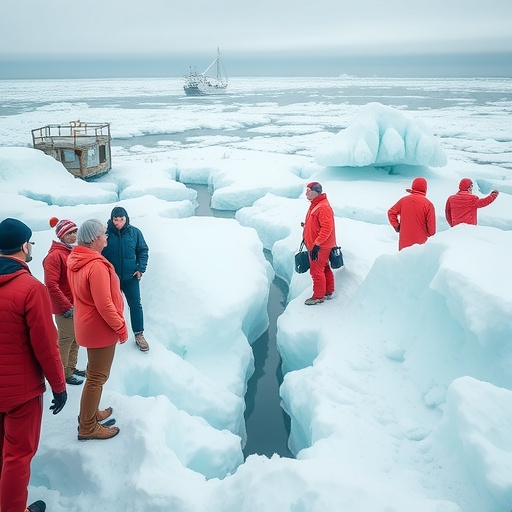
Arctic permafrost is often described as a frozen vault of climate-damaging carbon, but new research suggests that much of the ancient organic material released from thawing coastal permafrost may remain buried beneath the seafloor instead of immediately returning to the atmosphere. Studying sediments off Qikiqtaruk, also known as Herschel Island, in Canada, researchers from the Alfred Wegener Institute and MARUM – Center for Marine Environmental Sciences at the University of Bremen found that microorganisms broke down only a relatively small fraction of the terrestrial carbon transported into the coastal ocean. Their findings provide one of the clearest estimates yet of what happens to permafrost-derived carbon after it leaves the land.
The discovery matters because Arctic permafrost contains an estimated 1,300 gigatonnes of organic carbon, accumulated over thousands of years from plant and other biological remains. A further 400 gigatonnes are stored in marine and river-delta sediments. As the Arctic warms faster than any other region on Earth, thawing ground and rapidly eroding shorelines are transferring increasing quantities of this material into rivers and coastal waters. Researchers estimate that as much as 0.02 gigatonnes of carbon currently enter the sea each year, and climate projections suggest that this flow could increase by 70 to 150 percent by 2100.
Once organic carbon reaches the ocean, its climate effect depends largely on what happens next. Microorganisms can consume the material and convert it into dissolved carbon dioxide and other gases, some of which may eventually reach the atmosphere. Alternatively, the carbon can settle into marine sediments, where it may remain stored for decades, centuries or longer. Until now, scientists have had limited information about the balance between these two pathways, particularly in Arctic coastal environments where erosion, thawing and marine biological activity interact.
To investigate the process, the research team collected sediment cores at different distances from the coast of Herschel Island. These cores preserve layers of material deposited over approximately 50 years, creating a historical record of carbon entering the nearshore environment. The scientists examined the physical and chemical composition of the sediments and determined how quickly permafrost-derived deposits accumulated on the seabed. Their central question was not simply how much carbon arrived, but how much was actually consumed by microorganisms after burial.
The team used pore water—the fluid trapped in microscopic spaces between sediment grains—as a chemical record of microbial activity. When microorganisms digest organic matter, they release dissolved inorganic carbon, including carbon dioxide, into these tiny cavities. By measuring the concentration of this dissolved carbon, researchers could estimate how much organic material had been decomposed. The team also analyzed carbon isotopes, forms of carbon with different atomic masses, to identify the origin and age of the material being consumed.
The carbon-13 isotope helped distinguish between carbon originally produced on land and carbon derived from marine organisms. Carbon-14 provided an additional time signature: ancient permafrost carbon contains far less radiocarbon than recently produced marine organic matter because radioactive carbon decays over time. This allowed the researchers to determine whether sediment-dwelling microorganisms were feeding primarily on old carbon released from permafrost or on fresh carbon generated by algae and other marine life.
The results revealed an unexpected microbial preference. Although large quantities of terrestrial organic carbon are carried away from the eroding coast, microorganisms in the sediments appeared to favor fresher marine carbon, including recently produced algal remains. Only about 10 percent of the organic carbon in the sediments was converted into gases that could rise through the water column and potentially contribute to atmospheric greenhouse gas concentrations. The majority remained buried in the seabed, meaning that permafrost-derived carbon had a smaller immediate role in the active coastal carbon cycle than many scientists had feared.
The finding does not mean that thawing permafrost is harmless or that its carbon can be excluded from climate models. Some of the ancient organic material may be decomposed before it reaches the seabed, either on land, in rivers or within the water column. The study also focused on a specific Arctic coastal setting, and microbial behavior may differ in other regions, particularly where water temperatures, oxygen availability, sediment composition or marine productivity are different. Nevertheless, the research demonstrates that the fate of permafrost carbon is controlled by a complex series of biological and geological filters rather than by a simple direct transfer from frozen ground to atmosphere.
The movement of this material may also reshape Arctic coastal ecosystems even when its greenhouse-gas impact is limited. Eroding sediment can make seawater cloudy, reducing the sunlight available to algae for photosynthesis. Dissolved organic carbon can darken the water further, altering light penetration and potentially changing marine productivity. Because algae form the base of food webs supporting fish, crustaceans, seals and communities that depend on coastal resources, changes in sediment and carbon transport could affect food availability and ecosystem health. Researchers plan to examine these connections during the international Arctic Pulse campaign, scheduled for 2027, using coordinated observations from the research icebreaker Polarstern, aircraft and land-based stations. By showing how much carbon remains safely stored beneath the seafloor—and how little of the decomposed fraction comes from ancient permafrost—the study offers a crucial new benchmark for predicting the climate and ecological consequences of a rapidly changing Arctic.
News Publication Date: 31-Jul-2026
Web References: https://www.awi.de/ueber-uns/service/presse/presse-detailansicht/default-d3bd6640772aaf799e98095e01f80024.html; https://www.awi.de/im-fokus/arctic-pulse.html
References: Nature Geoscience; DOI: 10.1038/s41561-026-02060-8
Cite Scienmag News
Violet Maxwell. (July 31, 2026). Arctic Ocean Keeps Permafrost Carbon Securely Locked Away. Scienmag. https://scienmag.com/arctic-ocean-keeps-permafrost-carbon-securely-locked-away/
Violet Maxwell. "Arctic Ocean Keeps Permafrost Carbon Securely Locked Away." Scienmag, 31 July 2026, https://scienmag.com/arctic-ocean-keeps-permafrost-carbon-securely-locked-away/. Accessed 3 September 2026.
Violet Maxwell. "Arctic Ocean Keeps Permafrost Carbon Securely Locked Away." Scienmag. July 31, 2026. https://scienmag.com/arctic-ocean-keeps-permafrost-carbon-securely-locked-away/


