


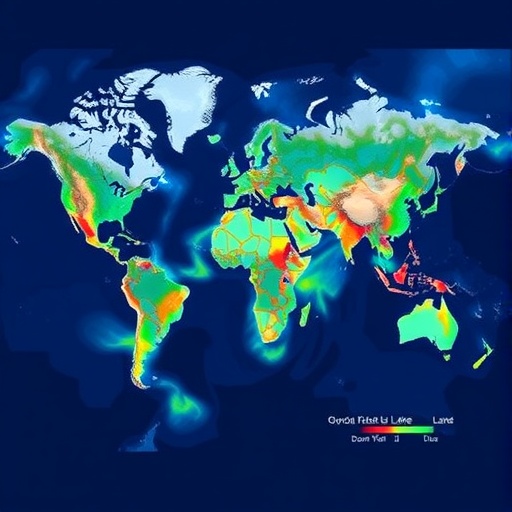

Satellite-based assessment using the GlakeWQ framework reveals global patterns of lake water quality across 16,409 lakes in 145 countries and quantifies population exposure to different water quality conditions. The results highlight pronounced regional inequalities in freshwater security, with vulnerable populations disproportionately exposed to poor-quality lake water. a, Global status of lake water quality and national progress toward SDG 6.3.2 targets. b, Population exposure to different lake water quality classes. c, Representative lake water quality patterns across countries with different development levels. d, Long-term relationships between lake health indicators (chlorophyll-a concentrations or algal bloom frequency) and socioeconomic development for representative lakes.
view more
Credit: ©Science China Press
What is the state of global lake water quality? A global assessment covering 16,409 lakes across 145 countries reveals that only 63.3% of lakes worldwide meet good water quality standards. More concerningly, among the approximately 2 billion people living within the service areas of freshwater lakes, more than half are exposed to lakes with poor water quality, indicating potential health risks associated with freshwater security.
Recently, a research team led by Prof. Hongtao Duan from the Nanjing Institute of Geography and Limnology, Chinese Academy of Sciences (NIGLAS), together with collaborators from China, Italy, Estonia, Uganda, Brazil, and other countries, developed a global lake water quality assessment framework, GlakeWQ. By integrating satellite remote sensing and machine learning, the framework enables a consistent and comparable assessment of lake water quality worldwide and establishes a global lake water quality database covering 16,409 lakes across 145 countries.
The study, entitled “Satellite Mapping Exposes Global Inequities in Lake Water Quality Across 145 Countries,” has been published in National Science Review (NSR).
Global lake water quality assessment: a long-standing data gap
Lakes are among the most important freshwater resources supporting global drinking water supplies and ecosystem services. For decades, global lake water quality monitoring has largely relied on field sampling and laboratory-based chemical analyses. However, these approaches require substantial human, financial, and technical resources, making large-scale and long-term monitoring extremely challenging. The monitoring gap is particularly severe in developing regions.
The United Nations Sustainable Development Goal (SDG) 6.3.2 calls for regular assessment of global water quality. However, more than 60% of UN member states currently lack comprehensive lake water quality datasets, with major data gaps concentrated in Africa, Asia, and South America.
Dr. Ming Shen, the first author of the study, stated: “The ecological and societal importance of lake water quality has been widely recognized. However, a globally consistent and comparable assessment system covering lakes worldwide has remained unavailable, leaving us without a standardized ‘report card’ of global lake water quality.”
Traditional water quality assessments rely on key physicochemical parameters such as dissolved oxygen, nutrients, and chemical oxygen demand. However, many of these indicators cannot be directly measured by satellite remote sensing. How to extend satellite-based water quality assessment from limited field observations to a global scale has therefore remained a major challenge in global aquatic environmental assessment.
GlakeWQ framework: making global lake water quality visible
To address this challenge, the research team developed the GlakeWQ framework. The framework uses optical information captured by satellites and integrates machine learning approaches to establish relationships between satellite observations and comprehensive water quality classes.
The researchers compiled approximately 1.39 million Sentinel-2 satellite images acquired between 2019 and 2022 and combined them with global in situ water quality observations to achieve a consistent assessment of lake water quality across different regions.
Satellites provide broad spatial coverage, while machine learning bridges the gap between “observable optical signals” and “measured water quality conditions.” Through this approach, lake water quality assessment, which traditionally requires individual lake sampling, can be extended to the global scale. This approach overcomes limitations associated with conventional monitoring in terms of spatial coverage, temporal continuity, and operational costs, while also addressing information gaps caused by the difficulty of directly observing key water quality parameters from space.
Large regional disparities: only two-thirds of global lakes meet good water quality standards
Based on the GlakeWQ database, the researchers found that only 63.3% of global lakes meet good water quality standards, indicating that more than one-third of lakes worldwide are under water quality pressure.
Strong regional disparities were observed. The proportions of lakes meeting good water quality standards reached 73.1% in Europe and 80.6% in North America, whereas they were only 41.7% in Asia, 27.4% in South America, and 20.3% in Africa.
These findings demonstrate that global lake water quality is not merely an ecological issue of “good” or “poor” conditions, but also reflects a pronounced geographical inequality.
The study further revealed that regions with lower levels of economic development often face both greater water quality pressures and weaker monitoring capabilities. In many areas, higher water quality risks coexist with limited access to timely and continuous water quality information. This dual inequality—greater water risks coupled with weaker information capacity—poses additional challenges for freshwater security management.
Unequal population exposure: water quality risks affect billions of people
Changes in lake water quality directly influence freshwater security. The study further assessed population exposure risks and found that approximately 2 billion people live within the service areas of freshwater lakes, among whom 57.4% are exposed to potential health risks associated with poor-quality lake water.
This risk is particularly pronounced in developing and least-developed countries, where the exposed population ratio reaches 63.7%, approximately 1.8 times higher than that in developed economies (34.7%).
In other words, inequalities in lake water quality are being translated into inequalities in freshwater security.
In many densely populated developing regions, large numbers of people depend on lakes for drinking water and other freshwater services. Declining water quality may further increase pressure on water security. In contrast, developed countries with stronger environmental governance and more comprehensive protection measures generally maintain better lake water quality. This contrast highlights the critical role of sustained environmental management and pollution control in safeguarding freshwater resources.
From local observations to globally consistent assessment
The GlakeWQ framework provides a new technological pathway for global lake water quality monitoring. By integrating satellite remote sensing, field observations, and machine learning, the framework enables continuous tracking of large-scale lake water quality changes and identification of regional water quality risks and freshwater security inequalities.
The research team emphasized that this achievement can particularly improve access to water quality information in low- and middle-income regions, providing scientific support for SDG water quality assessments, lake conservation, and sustainable water resource management.
“In the past, global lake water quality monitoring mainly relied on fragmented local observations. In the future, satellite remote sensing may enable continuous observation of global lake water quality dynamics.”
This study establishes a new paradigm that bridges the gap between “local observations” and “global sensing.” It enables lake water quality to be assessed at a more consistent, continuous, and comparable scale, providing new information for identifying high-risk regions and optimizing environmental management strategies.
When lake water quality can be continuously observed and compared globally, water management can move beyond reactive pollution remediation toward proactive risk identification and prevention.
Dr. Ming Shen from the Nanjing Institute of Geography and Limnology, Chinese Academy of Sciences, is the first author of this study, and Prof. Hongtao Duan is the corresponding author. Other contributors include Prof. Yunlin Zhang, Prof. Juhua Luo, Dr. Tianci Qi, Dr. Zhigang Cao, and Dr. Zhe Sun from NIGLAS; Prof. Wei Zhi from Hohai University; Prof. Tiit Kutser from the University of Tartu, Estonia; Prof. Steven Loiselle from the University of Siena, Italy; Prof. Anthony Gidudu from Makerere University, Uganda; and Dr. Daniel A. Maciel from the National Institute for Space Research (INPE), Brazil.
This research was supported by the National Natural Science Foundation of China and other funding programs.
Bei Yan
Science China Press
yanbei@scichina.com
Cite Scienmag News
Violet Maxwell. (July 30, 2026). Satellite mapping reveals global inequities in lake water quality: over one-third of lakes fail to meet good water quality standards. Scienmag. https://scienmag.com/satellite-mapping-reveals-global-inequities-in-lake-water-quality-over-one-third-of-lakes-fail-to-meet-good-water-quality-standards/
Violet Maxwell. "Satellite mapping reveals global inequities in lake water quality: over one-third of lakes fail to meet good water quality standards." Scienmag, 30 July 2026, https://scienmag.com/satellite-mapping-reveals-global-inequities-in-lake-water-quality-over-one-third-of-lakes-fail-to-meet-good-water-quality-standards/. Accessed 3 September 2026.
Violet Maxwell. "Satellite mapping reveals global inequities in lake water quality: over one-third of lakes fail to meet good water quality standards." Scienmag. July 30, 2026. https://scienmag.com/satellite-mapping-reveals-global-inequities-in-lake-water-quality-over-one-third-of-lakes-fail-to-meet-good-water-quality-standards/

